• Happy Mathematics Day! ❌📐♾️

What's this paddling technique?

Joined
Aug 25, 2024
Messages
17
Reaction score
34
Location
Anchorage, AK
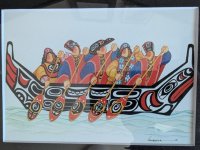
I was gifted this

1000001488.jpg
picture about a year ago based on my interest in canoeing. I was curious about the paddling technique where the hand on the top of the paddle wraps around the shaft. I guess there's no grip on the top of the paddle?

At first I thought it might have been a thing for these long canoes but later I saw a picture by the same artist of a single person canoe at a different angle also showing their top and curling around the paddle shaft instead of holding a grip. Seems like it'd be hard to do the correction portion of a stroke. This artist is from AK. Do traditional paddles from AK lack a grip? If so, how did single-blade paddlers control their boat?

Maybe I'm just reading too much into artist's rendering.
 
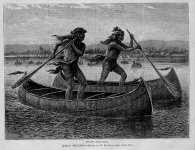
These are commonly known as pole grip paddles which are frequently used while standing up. The link below has lots of interesting information about these and other early paddles. The image below shows pole grip paddles from Harper's Weekly in June, 1874. I believe that control is maintained by simply switching sides (which predates the more modern hit-and-switch techniques by quite a bit).

Benson


1766184731942.png
 
Last edited:
I don't understand why boat control might be a concern. I wonder if it's even possible to create a twisting force on a symmetric paddle. You could still do a c-stroke or j-stroke or Northwoods stroke and long paddles are inherently better for control since they reach further from the center of rotation (more leverage). The "adjustable length" seems extremely practical where paddles could be shared among different height people or a single paddler could use one paddle for standing, sitting, poling or just paddling in different boats.

However, that's all speculation. I sure wish we could ask the folks that use(d) them.
 
I sure wish we could ask the folks that use(d) them.

Murat is the author of the paddle making blog at the previous link. He has made replicas of many early paddles and used them with other well known Canadian paddlers like Becky Mason. My recollection is that Becky found the pole grip paddles work much better while standing up. You may want to contact one of them directly for more details about this.

Benson
 
Last edited:
Yes that's a good idea and I'd be curious to learn more even though I'm not very good at standing even on dry land. Thanks for the tip.
 
The Haida paddles I've seen all had a grip on them. I had one in my possession for a while. I was holding it for a friend who was a Haida. He carved it as part of a cultural program in school. It had his family Totem on it. I had it hung on my wall and really enjoyed it while I had it.

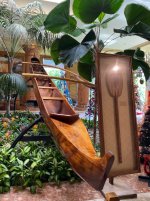
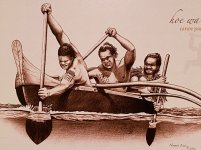
As far as using a paddle with no grip, the old Hawaiian outrigger paddles didn't have them. They were pretty burly with a large diameter shaft. I never thought I would like using one, but I have no problem using a six foot paddle while sitting with my upper hand low on the shaft. I have no problem with blade orientation or control.IMG_6703.jpegIMG_4405.jpeg
 
Last edited:
Thanks Benson for looping me into this thread. Though I'm not really familiar with Alaskan paddle designs, there is a long tradition of "pole-grip" style paddles across multiple indigenous cultures in Canada.

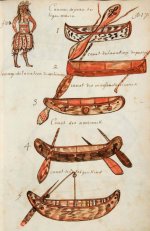
Louis Nicolas, a Jesuit Priest travelling in New France between 1664-1675, documented indigenous peoples in his personal notes which formed the basis of his manuscript the Codex Canadensis (1700). Though he never had any formal artistic training and was limited to his homemade natural inks and earth-toned dyes, his observations included sketches of canoes and paddles. This labelled sketch showcases designs from tribal groups he encountered including the "Porcupine Nation", the "Magoauchirinouek", the "Amicouek" and the Algonquin all of which have this pole style grip. The upper most example is an "Esquimaux" kayak made from seal skin and used with a familiar double blade paddle
Codex p17.jpg


In 1749, an 18ft bark canoe was brought back to England for a wealthy Lord. Although its whereabouts are unknown today, the British Admiralty commissioned a sketch documenting the plans of the canoe, including a scale drawing of the accompanying pole style grip paddle. A copy of this sketch survives in the Maritime Museum, Greenwich, London and was later documented in Adney's Bark Canoes book in Figure 4

Early+Micmac+Paddle+-+1749.jpg


This is further corroborated with artwork from an unknown artist (dated to 1850s) whose work accurately recorded the material culture of the time. Here is a closeup of the piece entitled "Micmac Indians" in the National Gallery of Canada:

Micmac+Canoes_rs.jpg


Roughly in the same era, William Armstrong, a railway engineer and artist, documented indigenous scenes in his journey's west across the country. Included in his large body of work are watercolours reflective of indigenous life, fur trade outposts, trade canoes. Of particular note is is his rendering entitled, "The Distribution of the Government Bounty on Great Manitouling Island 1856" where he was present for this significant gathering of Ojibwe and Odawa peoples. Closeup of some of the figures also reveal this paddle style

Armstrong+-+Government+Bounty+Manitouling+Paddle+Closeup.jpg


As to the question about paddling technique, here's an image from Robert Pinkerton's book, (1914) explaining the indigenous method of gripping which showcases the way the paddles were often held.

Pinkerton+-+Indian%2527s+paddling+position.jpg


Surviving photographic evidence shows this was still being used well into the 20th century. Here is a photo of Ojibwe Chief Busticogan in a bark canoe on the Big Fork River (MN):
Ojibwe+Paddling+Grip.jpg


In a photo of one of the last fur trade canoes in the Abitibi region of northern Quebec (1907), many of the indigenous paddle men are utilizing this technique which can be seen in these closeup:

Lac+des+Quinze+1907+closeup+1.JPG


A photo of guides from NW Ontario also showcases this style of paddle (Nipigon Museum):
Farancis%20Hardy%20Nipigon%20Guides.jpeg


As late as the 1930s, the Eastern Cree were still using this style of grip less paddle. A surviving sample is in the Musee de Quai Branly in Paris, France.

Musee+de+L%2527Homme+Cree+Paddle1.jpeg

Pagaie
Géographie : Amérique – Amérique du Nord – Canada
Culture : Amérique – Cree
Date : 1930-1935
Dimensions et poids : 158.5cm x 12.5cm, 647 g
Donateur : Paul Coze
Précédente collection : Musée de l'Homme (Amérique)
Numéro d'inventaire : 71.1931.44.155


I happened to recreate the design of one of the c.1850 Mi'kmaw paddles from that earlier painting and have used it solo.

Anon+Mikmaq+Paddle.jpg


Like gumpus mentioned in his post, correction can be achieved with the "C" stroke or a variation of the "Northwoods", basically with the correction achieved while the paddle is partially underwater during the recovery. It does take some getting used to but not impossible and certainly isn't that exhausting. In the context of short term solo racing, I can see how the only option would be to switch sides while just muscling through for forward momentum. Sloppy and wet but it would get the job done.

However, given the surviving historical record, most canoes were larger and never really meant to be used exclusively as solo craft and certainly not just for leisure like today. Having a bow paddler (or multiple paddlers) changes the paddling dynamic and creates a need for fewer correction strokes. Like the image that Al posted, the stern paddler could just use some form of ruddering to steer.

 
In this photo, the ranger seems to be holding the top of the blade with his right hand. I never thought about doing that with any of my paddles, but it certainly would be possible with the very long and narrow "quill blade" paddles. Maybe that's how some paddlers of yore executed corrections strokes with quill blade pole paddles.

As to the question about paddling technique, here's an image from Robert Pinkerton's book, (1914) explaining the indigenous method of gripping which showcases the way the paddles were often held.

Pinkerton+-+Indian%2527s+paddling+position.jpg

In this next photo, I think the Ojibwe paddler is in the process of doing an in-water slice recovery while sliding the paddle along the gunwale—i.e., a "northwoods" or "guide" stroke.

Surviving photographic evidence shows this was still being used well into the 20th century. Here is a photo of Ojibwe Chief Busticogan in a bark canoe on the Big Fork River (MN):
Ojibwe+Paddling+Grip.jpg
 
Getting back to the question of traditional Haida paddles not having grips, I was unable to find any examples of it in the limited search I did. In fact the grips on their paddles seem to be on the ornate side.

Generally speaking their paddle were pretty robust. I had read somewhere that they would sharpen the blades to use as weapons.
 
I had read somewhere that they would sharpen the blades to use as weapons.

There has been a fair amount of academic debate about pointed paddles being used as weapons. The general conclusion is that the reduced noise of paddling with a pointed paddle was probably a more compelling reason for the design. This is another topic that is likely to continue generating a lot of campfire discussions for many years.

Benson
 
Back
Top Bottom