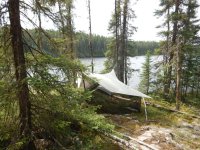
Monday, June 13, 2022, Day 19
I was greeted by strong winds and grey clouds early in the morning. Despite the wind, the mosquitoes and black flies were very active. Because of the wind, I only lit a small fire to boil water for coffee. It rained lightly on and off. The wind was actually too strong to continue. Nevertheless, I wanted to try to proceed, as I was already days behind schedule.
The first portage to a small lake was, besides a very swampy start, almost unobstructed. There were waves on the next lake, but fortunately, it was too small for them to build up into high crests. The wind was bothersome but was somewhat dampened by the nearby forest.
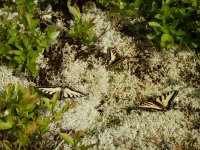
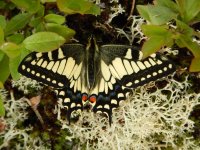
After a very short portage, I took a smoke break in the canoe while the current of the creek carried me along. A butterfly visited me. It seemed to like the sweat on my head and at the same time found a suitable resting place in the wind.
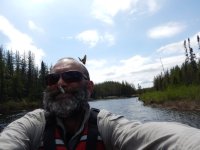
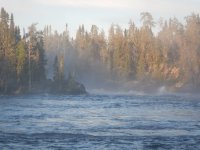
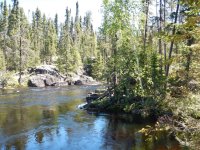
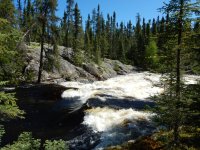
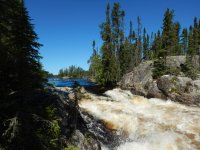
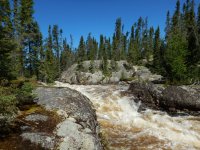
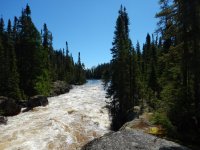
The final portage before Lower Wabakimi Lake required a tricky landing in the fast-flowing water. The route led steeply uphill, then to a section with fallen trees, which was easily bypassed. Once at the bottom, I had to wade a few more meters before I could get into the canoe. Fishing below the rapids was excellent, but due to time constraints, the walley were released back into the water.
Lower Wabakimi Lake presented higher waves with whitecaps and stronger winds. Nevertheless, I paddled on, repeatedly finding shelter from the wind by islands and small bays. During a short break in the lee of an island, I spotted a bull moose grazing in the shallow water on the southern shore. Upon noticing me, it immediately fled into the dense forest. This happened so quickly that I couldn't take a photo of the encounter.
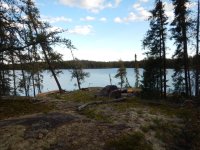
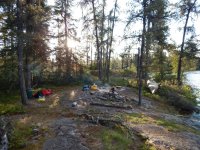
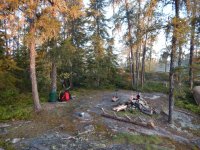
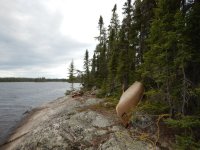
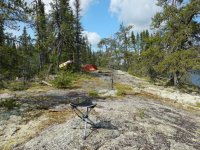
Wind and waves drove me toward an island where there was supposedly a campsite. Paddling in these borderline conditions seemed increasingly risky. Getting closer, I could see a fire pit. Carefully, so as not to damage the canoe on the rocky shore, I landed on the island. "If the wind doesn't die down, you can stay here," I thought. After waiting for more than three hours, I realized I would be spending the night here. Bruce's name for this campsite, "Stonehenge," was fitting. Several large boulders, though not as large as those of the famous stone circle, resembled it. Now that I'm writing these lines, I realize that I didn't photograph these erratic rocks at all.
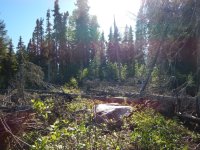
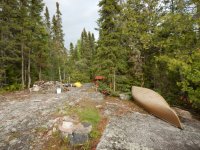 "Stonehenge" camp
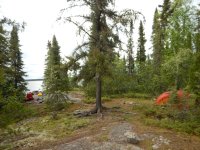
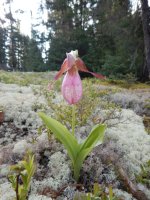
The island had other sights to offer; while gathering firewood, I discovered orchids. No sooner had I gathered enough wood than the first raindrops fell. I quickly pitched my tent and crawled inside.
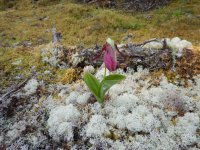 Lady slippers
When the rain eased, I could only light a fire using dry heartwood from split logs (that's one of the reasons why I take an axe with me on my trips). Once the fire was burning well, I could easily add even very wet wood. After dinner, I caught a rather large pike from shore, which was immediately released. Until nightfall, I explored the island and gathered more firewood for the next morning.
Repeated rain showers drove me to the tent.
Tuesday, June 14, 2022, Day 20
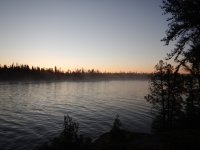
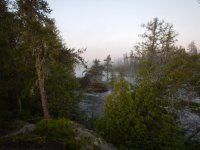
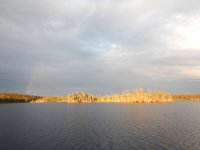
I woke up quite early, not because it was noisy, but because of the silence. No rain, no wind, no chattering squirrel and hardly any birdsong. Strange. It was cloudy and relatively warm. After breakfast, the sun broke through the cloud cover.
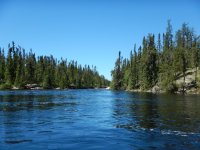
The onward journey began promisingly. The lake was smooth like glass. I soon reached the portage at the outflow. It was open, and apart from one spot at the end where I had to wade through the cold water, it presented no significant obstacles.
After a short paddle, I reached the flooded start of the next portage. I was able to pull the canoe behind me to a rock where the ground was firmer. Otherwise, the portage was almost completely free of obstacles. Footprints two or three days old indicated that at least two people had passed through this area this spring. One of them left very large footprints; I called him "Bigfoot". Along the path, I was able to admire blooming lady slippers.
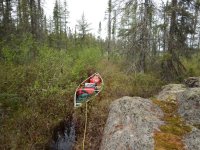
The sun was still shining through the thin cloud cover, and it was getting increasingly humid. After another short stretch on the water, I reached the next short portage. Here, too, the traces of "Bigfoot" were visible.
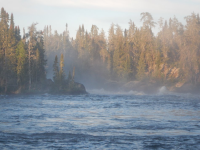
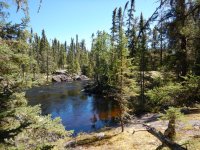
This was followed by a section of the river with a strong current and high waves, before the river widened again. This section could not be bypassed by portaging. Going downstream, this wasn't a big problem. However, had I been traveling in the opposite direction, I would have had to find a path through the forest.
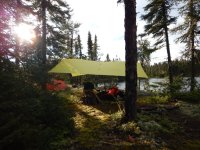
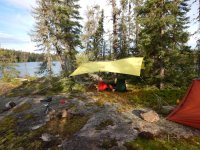
I was so focused on paddling through the challenging water that I didn't notice the darkness until I reached the end of the narrow passage. Heavy clouds, accompanied by thunder, were gathering. Another storm was brewing. Just before the rain started, I reached a nearby island with a campsite. The tarp wasn't even up yet when a torrential downpour began. Within seconds, I was drenched. The downpour stopped as suddenly as it had begun. The break in the rain lasted just long enough for me to finish setting up the tarp and change my clothes. Then the first of many violent thunderstorms passed over the camp. I made myself comfortable under the tarp and waited for a good opportunity to pitch my tent. Sometimes it rained so hard that I even got my butt wet sitting on the campchair under the tarp.
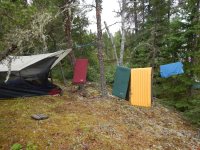
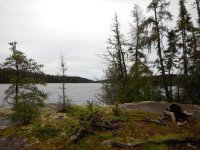 A brief respite before the next severe thunderstorm
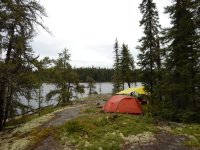 Tarp and tent offer protection
It rained continuously for three and a half hours, accompanied by hail, lightning, and thunder. I used the periods when it was "only" raining to pitch the tent and gather firewood. However, the prospect of a proper fire was very slim. That's when the stick stove came in handy. Under the shelter of the tarp, I was able to boil water for coffee and later for a hot meal.
As I reflected on the day, I found an explanation for the strange silence in the morning. The animals must have already sensed the approaching thunderstorms.
As I retreated to the tent, thunder rumbled.