• Happy Birthday, Mary Outerbridge (1852-86)! 🎾🇸 🇮 🇳 🇾 🌉

Wabakimi solo trip spring 2022

Brings my trip to Wabakimi back into clear focus. Thanks for putting this together! Very nice prose'.

Re. the axe, I have posted this before, but I always taught my Scouts, best way to avoid an axe issue on a Canoe trip is not to bring one. I never do. Glad you made it ok.
 
Great trip report and photos - they bring back many memories of my trips there.

Thinking of bears, my experience in the Wabakimi area is that while there are many there, I have only ever seen one in the bush and that was at a distance across a small lake. We would regularly encounter evidence of them (scat) but never any direct contact. Almost all my wildlife encounters were on Hwy 527 to/from Armstrong ON. In fact, I never heard of direct bear encounters on Wabakimi Project trips which ran from 2004 to 2018. In camp the food barrels were kept under the tarp where the cooking was done. But we kept a very clean camp and all fish cleaning was done well away from camp.

The locals (Don Elliot, our outfitter and Clem Queville) explained that the bear in the bush were unaccustomed to humans and disappeared before we noticed them.

Wabakimi trips are simply wonderful, aren't they?

As for the bears:
There were no direct sightings in the bush on this trip. But just as you have experienced, I have seen ample evidence (i.e. scat, tracks, fur) that they definitely were around. More than once I sensed the presence of a large animal, whether while searching for firewood or portaging. Occasionally I also heard crashing noises, as if something were fleeing through the woods.
I am convinced that many bears and other animals were watching me while I didn't even notice them.
Keeping a very clean camp definitely helps. I don't hang the barrel either.
 
Saturday, June 11, 2022, Day 17

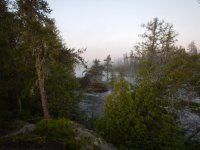
The whisky the evening before was probably a bit too plentiful; I slept through the sunrise and didn't get up until around 7:30 a.m. Outside, I was greeted by fog and a light drizzle. Although everything was damp, I was able to light a fire. After three cups of coffee and granola for breakfast, I felt stengthened for the journey ahead. The weather improved; patches of blue sky could be seen and soon the sun was shining.

DSCN3418.jpeg

It wasn't until after 10:15 a.m. that the camp was packed up and the canoe loaded. Out on the lake, I was once again paddling against a headwind. The portages to Jeep Lake were relatively easy to walk.
I was hoping to find some shelter from the wind at Jeep Lake. The wish was probably father to the thought here, but unfortunately it was not fulfilled.

After leaving Jeep Lake, things became a bit confusing. At a rapid where I couldn't find a portage, I had to wade, line and paddle. Shortly after, I encountered a very bony section that also required wading and lining. At the end of this section, another rapid awaited me. The creek was blocked with logs. That's why I optet for the portage, which didn't looked like it was used often. It was short, steep, and full of blowdown.
The rest of the route to Brennan Lake was clear. Thanks to the high water level, I was able to paddle through a shallow area between a headland and an island that would normally require a portage.

Although I was still about three kilometers away, I could already hear the roar and rumble of Brennan Falls. Brennan Falls can be navigated in several ways. With the high water level, the safer option was the "northern route" or "shortcut" described by Bruce. I slowly approached the entrance to a narrow passage. The current was very strong. A bay to the right offered a place to land, look for the portage, and check if this first passage was navigable. What would have been a C1 run at normal water level had huge waves. I had to carry around it.

The following two narrow passages are normally navigable, but I had to carry my canoe and gear around to the right because high, standing waves had formed there as well. No portages could be found in these two sections, so I had to make my way through the woods.

As I approached another drop in a narrow passage, I soon realized that this one also had to be portaged. A glance from the shore at these rapids suggested that one could simply paddle through at normal water levels. At least a good path could be found here.

Finally, another portage awaited, leading between two side channels. Getting into the canoe at the lower end, in the heavily blocked riverbed and raging water, was a challenge. As soon as I reached more open water, I encountered the strong current and choppy waters of the actual Brennan Falls outflow. I was able to cross them by a front ferry and reach a camp on an island.

DSCN3422.jpeg
It was already late when the camp was set up. At 9:00 p.m., I ate a very welcome trekking meal. I was tired from the strenuous day, but still excited. Probably a result of an adrenaline rush. I kept the fire burning until the mosquitoes and blackflies became too bothersome. As soon as I had settled comfortably into my sleeping bag, I quickly found peace and fell asleep.

Sunday, June 12, 2022, Day 18

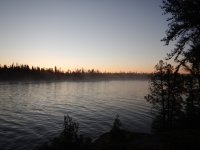
I woke up several times during the night. Perhaps it was the constant roar and thunder of Brennan Falls, perhaps the vibrant atmosphere, perhaps the adrenaline, or all of these factors combined. I got up before sunrise. A very special atmosphere greeted me outside.

DSCN3431.jpeg
Shortly before sunrise

DSCN3434.jpeg

DSCN3441.jpeg
Soon there will be boiling water for a coffee

DSCN3449.jpeg
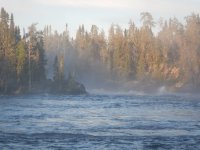
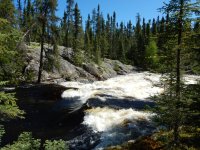
Standing waves below Brennan Falls

Shortly after 9.00 a.m., everything was ready to continue. Before paddling out onto Granite Lake, I took a break on a small island. I wanted to take advantage of the beautiful, warm weather to wash myself. I would have loved to bathe despite the cold water, but I didn't want to put any more strain on the wound. I also would have had to re-bandage it afterward, but I ran out of bandages.

Granite Lake greeted me with a moderate headwind. My route took me away from the Allanwater River, across two portages, to McWade Lake. Around midday, I stopped for a break in the southern part of the lake. A group of Canada geese had gathered in the small bay, apparently also resting.

I had to paddle the entire distance to the northern part of the lake against an increasingly strong wind. The lake's elongated shape offered no protection from the wind.

DSCN3461.jpeg
Along the way, a flock of Canada geese overtook me in the sky and continued their northward migration

As I reached the northern end of McWade Lake, dark clouds hinted at a change in the weather. I was all the more pleased to discover a fire pit on the north shore. I quickly went ashore and put up the tarp. No sooner had that happened than the heavens opened. A cloudburst with lightning and thunder rolled in. The tarp was hanging in a sheltered spot, which attracted countless mosquitoes and black flies. For the first time on this trip, I had to use DEET.

DSCN3472.jpeg
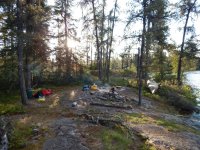
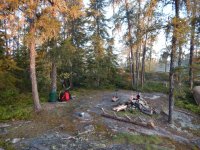
Camp at McWade Lake

DSCN3463.jpeg
After the thunderstorm

I found a sheltered spot for the tent. The mosquitoes and black flies were becoming increasingly bothersome. I also had another visitor: a chipmunk, which took an interest in the ingredients I had laid out for cooking. No, actually I was the visitor, the chipmunk had its residence here.

The annoying insects prompted me to seek shelter in the tent shortly after dinner.
 
"I also had another visitor: a chipmunk, which took an interest in the ingredients I had laid out for cooking. No, actually I was the visitor, the chipmunk had its residence here."
Ha ha. I like your perspective, humility, and gratitude, and fully agree with you.
Great trip and report, thanks for this.
 
Monday, June 13, 2022, Day 19

I was greeted by strong winds and grey clouds early in the morning. Despite the wind, the mosquitoes and black flies were very active. Because of the wind, I only lit a small fire to boil water for coffee. It rained lightly on and off. The wind was actually too strong to continue. Nevertheless, I wanted to try to proceed, as I was already days behind schedule.

The first portage to a small lake was, besides a very swampy start, almost unobstructed. There were waves on the next lake, but fortunately, it was too small for them to build up into high crests. The wind was bothersome but was somewhat dampened by the nearby forest.

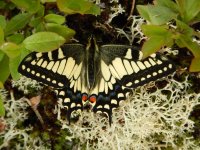
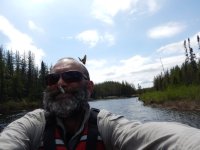
After a very short portage, I took a smoke break in the canoe while the current of the creek carried me along. A butterfly visited me. It seemed to like the sweat on my head and at the same time found a suitable resting place in the wind.
DSCN3479.jpeg

The final portage before Lower Wabakimi Lake required a tricky landing in the fast-flowing water. The route led steeply uphill, then to a section with fallen trees, which was easily bypassed. Once at the bottom, I had to wade a few more meters before I could get into the canoe. Fishing below the rapids was excellent, but due to time constraints, the walley were released back into the water.

Lower Wabakimi Lake presented higher waves with whitecaps and stronger winds. Nevertheless, I paddled on, repeatedly finding shelter from the wind by islands and small bays. During a short break in the lee of an island, I spotted a bull moose grazing in the shallow water on the southern shore. Upon noticing me, it immediately fled into the dense forest. This happened so quickly that I couldn't take a photo of the encounter.

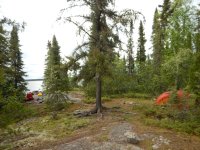
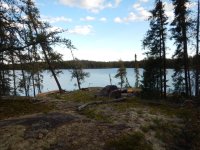
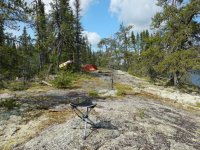
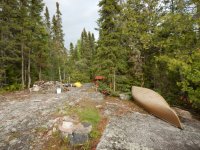
Wind and waves drove me toward an island where there was supposedly a campsite. Paddling in these borderline conditions seemed increasingly risky. Getting closer, I could see a fire pit. Carefully, so as not to damage the canoe on the rocky shore, I landed on the island. "If the wind doesn't die down, you can stay here," I thought. After waiting for more than three hours, I realized I would be spending the night here. Bruce's name for this campsite, "Stonehenge," was fitting. Several large boulders, though not as large as those of the famous stone circle, resembled it. Now that I'm writing these lines, I realize that I didn't photograph these erratic rocks at all.
DSCN3490.jpeg
"Stonehenge" camp
DSCN3487.jpeg

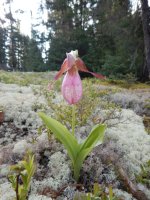
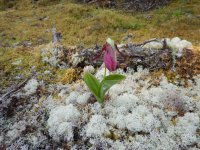
The island had other sights to offer; while gathering firewood, I discovered orchids. No sooner had I gathered enough wood than the first raindrops fell. I quickly pitched my tent and crawled inside.
DSCN3491.jpeg
Lady slippers
DSCN3494.jpeg


When the rain eased, I could only light a fire using dry heartwood from split logs (that's one of the reasons why I take an axe with me on my trips). Once the fire was burning well, I could easily add even very wet wood. After dinner, I caught a rather large pike from shore, which was immediately released. Until nightfall, I explored the island and gathered more firewood for the next morning.

Repeated rain showers drove me to the tent.

Tuesday, June 14, 2022, Day 20

I woke up quite early, not because it was noisy, but because of the silence. No rain, no wind, no chattering squirrel and hardly any birdsong. Strange. It was cloudy and relatively warm. After breakfast, the sun broke through the cloud cover.

The onward journey began promisingly. The lake was smooth like glass. I soon reached the portage at the outflow. It was open, and apart from one spot at the end where I had to wade through the cold water, it presented no significant obstacles.

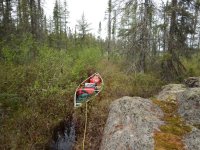
After a short paddle, I reached the flooded start of the next portage. I was able to pull the canoe behind me to a rock where the ground was firmer. Otherwise, the portage was almost completely free of obstacles. Footprints two or three days old indicated that at least two people had passed through this area this spring. One of them left very large footprints; I called him "Bigfoot". Along the path, I was able to admire blooming lady slippers.
DSCN3505.jpeg

The sun was still shining through the thin cloud cover, and it was getting increasingly humid. After another short stretch on the water, I reached the next short portage. Here, too, the traces of "Bigfoot" were visible.

This was followed by a section of the river with a strong current and high waves, before the river widened again. This section could not be bypassed by portaging. Going downstream, this wasn't a big problem. However, had I been traveling in the opposite direction, I would have had to find a path through the forest.

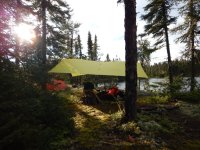
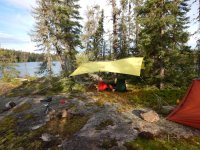
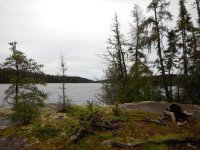
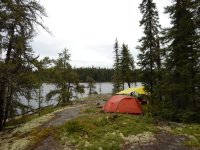
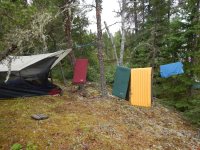
I was so focused on paddling through the challenging water that I didn't notice the darkness until I reached the end of the narrow passage. Heavy clouds, accompanied by thunder, were gathering. Another storm was brewing. Just before the rain started, I reached a nearby island with a campsite. The tarp wasn't even up yet when a torrential downpour began. Within seconds, I was drenched. The downpour stopped as suddenly as it had begun. The break in the rain lasted just long enough for me to finish setting up the tarp and change my clothes. Then the first of many violent thunderstorms passed over the camp. I made myself comfortable under the tarp and waited for a good opportunity to pitch my tent. Sometimes it rained so hard that I even got my butt wet sitting on the campchair under the tarp.
DSCN3509.jpeg
A brief respite before the next severe thunderstorm
DSCN3513.jpeg
Tarp and tent offer protection

It rained continuously for three and a half hours, accompanied by hail, lightning, and thunder. I used the periods when it was "only" raining to pitch the tent and gather firewood. However, the prospect of a proper fire was very slim. That's when the stick stove came in handy. Under the shelter of the tarp, I was able to boil water for coffee and later for a hot meal.

As I reflected on the day, I found an explanation for the strange silence in the morning. The animals must have already sensed the approaching thunderstorms.

As I retreated to the tent, thunder rumbled.

 
One of them left very large footprints; I called him "Bigfoot"
Haha, good one.

I agree with carrying an ax, especially in spring or fall when a fire can be very rewarding. Same with the twig stove. My “littlbug” large stove weighs next to nothing and fits flat in my Duluth Pack, yet I not only cook on it, it can provide a fast hot fire to keep warm by.
I don’t know if it’s the time of year or my frame of mind, but I’m really enjoying your report.
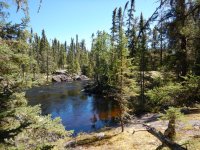
Finally, great picture, reminds one of how beautiful and unique the area is that you traveled thru.(I bet there was a walley or two in that pool)

IMG_6283.png
 
I love the orchids. Lady Slippers are such a treat. I haven’t seen them since I moved south. We have other orchids here, over 100 species of native orchids.

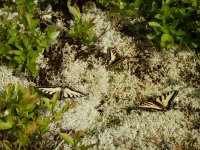
The butterfly is a Swallowtail of some sort. I don’t know the northern species.

I’m enjoying your trip report immensely.
 
Aslowhand, I am really enjoying this trip report. Your way of telling the story, along with the descriptions of the difficulties and missteps is really well done,,,thanks
 
Wednesday, June 15, 2022, Day 21

I was woken early in the morning by the patter of rain on the tent. I quickly decided to take a rest day, turned over, and went back to sleep.
I woke up around 9 a.m. because I was getting too warm in my sleeping bag. The sun was shining. What a surprise!
I quickly got up and briefly considered leaving. No. I felt tired and everything was damp or wet. A rest day was exactly what I needed.

DSCN3538.jpeg

After enjoying plenty of pancakes with maple syrup, I did laundry and spread it out in the sun to dry, along with every damp piece of equipment. For reasons already known, I decided against taking a bath. Body cleaning was also done well with the help of a washcloth and liquid soap. Using cold water proved to be very refreshing. On a whim, I marked the water level on the rocky shore with tape. I wanted to find out if there would be any change by the following day.

DSCN3534.jpeg
Swallowtails
DSCN3532.jpeg

In the afternoon I went out in my canoe and fished in eddies, in calm water, in deep spots, in shallow water, near the shore, further out, etc. I didn't catch a single fish. Somewhat frustrated, I returned to camp and gathered more firewood for dinner.

I spent most of the evening under the tarp while thunderstorms passed over the camp. Mosquitoes and black flies kept me company. As earlier in this trip, I had to have another serious talk with myself to avoid going to my tent frustrated. At least I was able to slip into freshly washed nightwear and a well-dried sleeping bag.

Thursday, June 16, 2022, Day 22

When I got up, a damp, gray morning greeted me at camp. The ground was soaked, and drops of water fell from the lichen and branches of the trees. No wonder after a stormy night. Even before the water boiled, I cast my line. On my second cast, I caught a rather large, magnificent walleye with beautiful coloring. I didn't want to waste time filleting it, but rather quickly pack my things and continue my journey. The fish would have been too big for just one meal anyway.

No sooner had I finished my first cup of coffee than the first raindrops fell. A little later, the second cup was steaming in my hands, and the rain intensified. Soon it was pounding heavily on the tarp. When Lindsey sent a severe weather warning, my hopes of continuing my journey that day dwindled. A continuous, heavy downpour began.

"If only I'd kept the fish," I thought, "I could have made two delicious meals out of it." Instead, I cooked myself some soup for lunch on the stick stove. It was chilly, and something warm in my stomach felt good. Despite the rain, which was occasionally accompanied by strong gusts of wind, countless hungry mosquitoes and black flies kept me company. It rained continuously until late afternoon. Gradually, the clouds broke, and the sun peeked out tentatively.

DSCN3557.jpeg
Evening mood after the continuous rain
DSCN3551.jpeg

I was able to cook a vegetable and rice stew by the fire and have it for dinner before it started raining again. Checking the water level showed that it had risen by more than 9 cm (3.5 inches) in about 30 hours.

I retreated to the tent early. As so often on this trip, I said to myself: “Tomorrow will be better!”
 
Thank you for continuing to take us along on your journey.

The butterfly is either a Canadian Tiger Swallowtail or an Eastern Tiger swallowtail or they can interbreed. At one time it was thought they were the same but genetic studies indicated they were two separate species.
Their caterpillars feed on birch, black cherry and aspen. Also noted feeding on poplar and willow. The caterpillars look like bird droppings except on the far end of older ones there are two big eye spots and a yellow collar.
 
Aslowhand, your enjoyable trip report is reminding me of a 2009 trip down the Albany Rv. 2009 was an extrembly rainy summer in NW Ontario. On that trip we noted overnight water levels coming up by several inches. Our last nights campsite was on a sandy point of land that became a small island overnight. When our outfitter flew in to pick up he said there had been so much rain in the area and extending well to the west that all the dams had been fully opened to drain off the water. And that campsite was the most mosquito ridden place I had ever experienced.
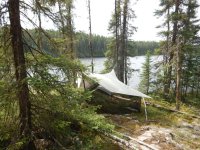
 
Friday, June 17, 2022, Day 23

I was woken several times during the night by loud thunder and rainshowers. When I got up shortly after 6:00 a.m., the rain had stopped. It was cold, but the blue sky with only a few clouds promised a fair weather day. I wanted to set off as soon as possible, but waited until the tent could be packed dry.

It became clear that I would have to skip the loop via the Berg River to Whitewater Lake. That would have been possible in the remaining six days. However, I didn't trust the further weather development at all. That's why I decided to aim for Little Caribou Lake, the end point of my trip, via Smoothrock Lake and Caribou River on a direct route. My next destination was Smoothrock Lake.

After a few hundred meters, I encountered the first obstacle: a rapid that could either be passed by lining the northern channel or carefully paddled directly through the main channel. The second option was too tempting to pass up. Apart from some high waves in a narrow passage, which were easily overcome by paddling a backward ferry, followed by a drop over a ledge, I encountered no further obstacles.

Below the rapids, I caught a walleye, which I released. The subsequent portage around "Wabakimi Falls" was exactly where I expected it to be. What surprised me, however, was the spectacular view along the portage. I took my time and tried to capture what I saw with my camera.

DSCN3656.jpeg
The landing above Wabakimi Falls...
DSCN3655.jpeg
......which you definitely shouldn't miss...
DSCN3629.jpeg
...Wabakimi Falls...
DSCN3599.jpeg
DSCN3594.jpeg
DSCN3596.jpeg
DSCN3663.jpeg
Looking back at Wabakimi Falls

The portage was clear, someone had apparently cleared it recently. On my second carry, with the canoe and the dry bag on my back, I got lost. I only realized my mistake when the tracks disappeared in the dense forest. At the end of the portage, I came across a "civilized" campsite, equipped with a table, a large grill, propane gas cylinders, and even a memorial plaque. Somehow, it all seemed out of place in the middle of the wilderness, I thought.

I fished from the shore for a while, but without success. Fishing out of the canoe was equally unsuccessful. When I reached calmer water, I heard the sound of engines. Two boats were approaching. The first people I'd seen since Flindt Landing. Probably guests of one of the outposts on Smoothrock Lake. My friendly waving was ignored. A little later, I encountered a fleet of seven boats. Some of the passengers waved back.

Smoothrock Lake greeted me – as one might expect – with a strong northwest wind and choppy water. In the early afternoon, I reached a beautiful campsite on an island. I took a rest and briefly considered staying there overnight, but it was still too early. I wanted to visit a campsite in Lonebreast Bay, which was marked as "world-class" on the map.

Arriving at Lonebreast Bay, I hoped to find some shelter from the wind. My hopes were in vain. The wind blew in my face, so strong that it created whitecaps on the lake. At least the beautiful weather held. So, after a short rest, I set off again, slowly but steadily approaching my destination for the day.

Three motorboats overtook me on the way. Shortly after, two more approached. One stopped alongside. The friendly fisherman, who introduced himself as Mike, was very talkative. He was surprised to learn that he was only the second person I had spoken to in the last three weeks. He told me that he hadn't seen any other canoeists in this part of Smoothrock Lake in recent days, nor had anyone set up camp. The campsite I wanted to visit was somewhat hidden, at least that's what a glance at the map suggested, so he couldn't say for sure if it was not taken. I gratefully accepted his information. During our brief conversation, we drifted about 200 meters. I declined his offer to tow me to the campsite because I would have considered that cheating. However, the exchange with Mike had been worthwhile. Only about two kilometers separated me from my destination for the day.

Approximately an hour later, I reached the bay where the camp was marked. At first glance, all I saw where the camp was supposed to be were fallen trees. On closer inspection, I discovered a sawn-off cedar trunk in the middle of the jumble of wood—a clue that there was indeed a camp there. My landing on the woodpile, which was tricky because of the high waves, was accompanied by a swarm of black flies. The campsite looked as if it had been hit by a bomb. The place was anything but inviting.

There should be another camp a little over a kilometer to the northwest. Despite the wind, I wanted to check it out. After some arduous paddling, I reached a flooded camp that looked even less inviting. So I paddled back.

In the storm-ravaged camp, I found two reasonably level, clear spots for my tent. Orchids grew on one of the spots, which I didn't want to damage. Lady slippers also grew on the other spot, but there was just enough room for my tent there. Despite the wind, the mosquitoes and black flies were numerous and hungry. I didn't light a fire. A piece of cheese, some dried sausage for the main course, and a handful of trail mix for dessert would have to suffice as a meal.

DSCN3664.jpeg
«World Class»-Camp!?

Before nightfall, I fled into the tent to escape the very active, blood-sucking insects.
 
Back
Top Bottom