

Hello everyone,
I'm in the process of properly outfitting my Trapper 12' for lake and pond fishing and need to fabricate a utility thwart; it will hold a hook patch, two rod holders, a recess for odds and ends, two cleats, and a very important cup holder. I currently have a pine prototype that I cut out of an unused coffee table top. I royally screwed up the recess and will inlaying some dividers.
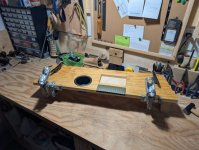
My question is regarding choice of wood; ash is the industry standard for thwarts, but I live on the Oregon Coast. As stated above, the prototype is recycled pine; is there any reason that a softer wood wouldn't be viable for a thwarts in a (almost) strictly flat water boat? I'm partial to red alder for personal reasons and general affordability, but birch and various available conifers seem attractive for a boat that shouldn't be bouncing off of anything. Am I missing anything?
As per the purpose of this forum, I do fully intend to eventually trip out of this glorified Pack.
Any help will be greatly appreciated,
Ben
I'm in the process of properly outfitting my Trapper 12' for lake and pond fishing and need to fabricate a utility thwart; it will hold a hook patch, two rod holders, a recess for odds and ends, two cleats, and a very important cup holder. I currently have a pine prototype that I cut out of an unused coffee table top. I royally screwed up the recess and will inlaying some dividers.
My question is regarding choice of wood; ash is the industry standard for thwarts, but I live on the Oregon Coast. As stated above, the prototype is recycled pine; is there any reason that a softer wood wouldn't be viable for a thwarts in a (almost) strictly flat water boat? I'm partial to red alder for personal reasons and general affordability, but birch and various available conifers seem attractive for a boat that shouldn't be bouncing off of anything. Am I missing anything?
As per the purpose of this forum, I do fully intend to eventually trip out of this glorified Pack.
Any help will be greatly appreciated,
Ben


