• Happy Plum Pudding Day! 🟣🍮

Thoughts on the Dragonfly 15

Well, I missed a lot during today. This thread has been wonderful for me to hear all this experience and discussion. I've been following the forums for years and have learned a lot, but this thread has addressed my particular issues well. Over the years I have also been comforted by all the discussions of getting old and the vicissitudes of orthopedic problems, of which I have had quite a few.

My conceptual plan to deal with the wind issue with my Dragonfly was to build a long pedestal for kneeling that would let me slide forward and back with a 12-in range, hoping that that would allow me to shift the balance enough without carrying and dealing with extra weight. I may yet try this even with a new Dragonfly 15. Has this been talked about in the past?

I talked with Bill Swift this morning, and he said that there was to be a demo day at Rutabaga on Saturday, May 2, if tariffs don't sabotage imports of canoes. There should be a Dragonfly 15 and Cirrus to try out. I really hope to get there for this. He mentioned that there have been changes in the technology of their canoes not on the website yet. As I understood it, they don't do gelcoat anymore! He thought an Expedition Kevlar Lite layup with the Carbon Kevlar trim, with the epoxy resin system and UV shield would come in around 30 lbs and be a really strong and durable construction.
 
My conceptual plan to deal with the wind issue with my Dragonfly was to build a long pedestal for kneeling that would let me slide forward and back with a 12-in range, hoping that that would allow me to shift the balance enough without carrying and dealing with extra weight. I may yet try this even with a new Dragonfly 15. Has this been talked about in the past?

A long pedestal would be possible but sort of heavy and klutzy.

Sliding seats have been common for many decades, including ones that can slide over 12 inches or more. When you slide the seat off center, you will have moved your body weight fore or aft but, unless you adjust your gear load below the gunwales, you may end up out of trim with your bow or stern sticking up. This may make the windage problem worse.

That's because wind-cocking and lee-cocking are affected not only by the location of the center of gravity ("COG") of the canoe—i.e., the body+gear load fore or aft—but also by the wind profile above the gunwale line, which is mainly the paddler's body and, secondly, the canoe's bow and stern stems.

In wind, I believe the best boat/paddler profile is to have the paddler's body at the canoe's center of lateral resistance, or more informally, the canoe's pivot point. Additionally, all gear should be below the gunwale line, so it minimally affects the canoe's wind profile.

Gear should be movable fore or aft, below the gunwales, to try to have the COG of the canoe+gear+paddler compensate for wind-cocking or lee-cocking. Movable gear for a day paddle can be as simple as a heavy day pack on a rope that you can toss or pull fore or aft of your body, or a big dry bag full of water.

A combo of a sliding seat plus some moveable gear would probably allow you to reasonably compensate for wind conditions with some experimentation. Swift has built various sliding seats, and for a price I'm sure they could install one in a DF 15.
 
I kneel exclusively - it’s soothing for my back to straighten and stretch it (damaged lower back), and gives me good reach. I’ve had a paddling thwart in the boat for decades. Anyway, I have such long feet that won’t go under a seat low enough to be stable because of stiffness and cramping. Hence the pedestal - which would be minicell (pretty light) with a Hemlock/Deal kneeling seat sliding along the top. I just go out for casual paddles, not any tripping, and really didn’t want to deal with any substantial extra weight. I’ll think more about this.
 
Well, I missed a lot during today. This thread has been wonderful for me to hear all this experience and discussion. I've been following the forums for years and have learned a lot, but this thread has addressed my particular issues well. Over the years I have also been comforted by all the discussions of getting old and the vicissitudes of orthopedic problems, of which I have had quite a few.

My conceptual plan to deal with the wind issue with my Dragonfly was to build a long pedestal for kneeling that would let me slide forward and back with a 12-in range, hoping that that would allow me to shift the balance enough without carrying and dealing with extra weight. I may yet try this even with a new Dragonfly 15. Has this been talked about in the past?

I talked with Bill Swift this morning, and he said that there was to be a demo day at Rutabaga on Saturday, May 2, if tariffs don't sabotage imports of canoes. There should be a Dragonfly 15 and Cirrus to try out. I really hope to get there for this. He mentioned that there have been changes in the technology of their canoes not on the website yet. As I understood it, they don't do gelcoat anymore! He thought an Expedition Kevlar Lite layup with the Carbon Kevlar trim, with the epoxy resin system and UV shield would come in around 30 lbs and be a really strong and durable construction.
Very cool. That demo day is not listed on the Swift website...you're smart to call. I may attend that demo day to try the Cirrus, DF15, and the 17.8 cruiser, hoping to hate them all (Cirrus looks like a dangerously good fit). Just FYI you might want to get there early or check with Rutabaga to make sure they'll have the boats you're interested in. Last Rutabaga demo day I went to the boats were selling fast but they may have made the new owners wait until the end of the demo period.
 
I kneel exclusively - it’s soothing for my back to straighten and stretch it (damaged lower back), and gives me good reach. I’ve had a paddling thwart in the boat for decades. Anyway, I have such long feet that won’t go under a seat low enough to be stable because of stiffness and cramping. Hence the pedestal - which would be minicell (pretty light) with a Hemlock/Deal kneeling seat sliding along the top. I just go out for casual paddles, not any tripping, and really didn’t want to deal with any substantial extra weight. I’ll think more about this.
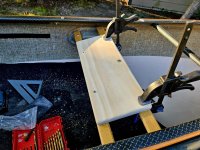
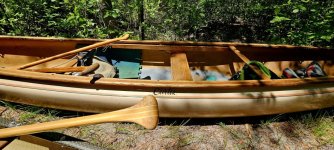
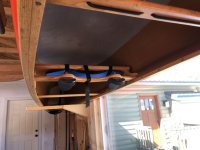
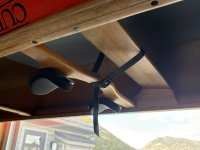
I made a wide kneeling thwart for my DF15. I too need to kneel to take pressure off my back. It's the most comfortable seat I have for me. Glenn tried it and found it uncomfortable, so it's all individual.

1000025984.jpg
 
I've found the best way to counteract the bow wanting to point into the wind is to add more weight to the stern. A dry bag partially filled with water often does the trick if there is no gear to shift rearward. Some boats require more counter weight than others.

Alan

Whenever I encounter this I attribute the problem to what is going on below the surface of the water. I think the wind pushes the water and creates a current. I think this current wants to push your stern downwind. The force of the moving water has more effect on your hull than the force of the wind. You may want to change your trim, especially if you're stern heavy.

In my experience I do not find this to be the case. Moving weight to the stern usually fixes this issue but that should make it worse if it was current rather than wind. Kayaks seem much less affected by the wind than canoes and I can only attribute this to much less hull exposed to wind above the water.

Alan

It's possible that we both are right. I paddle in a lot of wind, I like a bow light trim, solo or tandem. My boats always weathervane with the bow downwind. There are no mysteries on how the wind affects my boat. That being said I have experienced this problem in the past. It hasn't happened in a long time and I thought I overcame it, or it had something to do with my OT Tripper, the boat I was in when I had the problem in the past.

This past summer it happened again. I was on a large lake with over 4 miles of fetch and when I turned downwind my stern wanted to swing around. Even though the wind wasn't terribly strong there was a lot of wave action and I had a hard time keeping the boat from getting broadside. It was not the wind doing this, it had to be something else.

So in your case, with a flatter trim, the wind alone could push your stern around. Adding weight to the stern will help you weathervane downwind.

In my case, I never have the problem with wind on smaller lakes. I don't think they have enough fetch to push enough water to make a difference. I've only had the problem on large lakes with miles of fetch. I think it is safe to assume that the wind does move a lot of water from seeing how storms create storm surges. After this past summers experience I am convinced it is the water pushing my stern downwind and not the wind. I may have benefited from flattening out my trim but there would be a fine line between having the water push the stern around and the wind doing it. I have had that problem going downstream on rivers when there is a downstream wind, with a bow heavy trim.

As far as sea kayaks go, they are less affected by wind, so why do they have a rudder. I think a rudder would go a long way to correct this problem.
 
Last edited:
It's possible that we both are right. I paddle in a lot of wind, I like a bow light trim, solo or tandem. My boats always weathervane with the bow downwind. There are no mysteries on how the wind affects my boat. That being said I have experienced this problem in the past. It hasn't happened in a long time and I thought I overcame it, or it had something to do with my OT Tripper, the boat I was in when I had the problem in the past.

This past summer it happened again. I was on a large lake with over 4 miles of fetch and when I turned downwind my stern wanted to swing around. Even though the wind wasn't terribly strong there was a lot of wave action and I had a hard time keeping the boat from getting broadside. It was not the wind doing this, it had to be something else.

So in your case, with a flatter trim, the wind alone could push your stern around. Adding weight to the stern will help you weathervane downwind.

In my case, I never have the problem with wind on smaller lakes. I don't think they have enough fetch to push enough water to make a difference. I've only had the problem on large lakes with miles of fetch. I think it is safe to assume that the wind does move a lot of water from seeing how storms create storm surges. After this past summers experience I am convinced it is the water pushing my stern downwind and not the wind. I may have benefited from flattening out my trim but there would be a fine line between having the water push the stern around and the wind doing it. I have had that problem going downstream on rivers when there is a downstream wind, with a bow heavy trim.

As far as sea kayaks go, they are less affected by wind, so why do they have a rudder. I think a rudder would go a long way to correct this problem.
Paddling in wind waves has been a challenging study for me. I've been trying to come up with some consistent method for dealing with it, but have not yet figured it out.

My local lake is about nine miles long and pretty much aligned with the prevailing wind. I often plan my day there to be coming back downwind in the afternoon, when the waves sometimes are big, due to that long fetch and the duration of the wind. The only thing I know for sure is that different canoes respond differently to trim adjustments in those conditions.

Looking at the explanation of circular motion of wind waves gives some idea of why, but doesn't fully explain it - at least to me.


My thoughts at this point are that with the boat trimmed stern heavy and lacking stern rocker, unless I'm moving faster than the wave (a rare and short lived event) the stern is going to plow and is likely to pearl. Any turbulence in the wind complicates the matter, and there's also that moment, depending on the wave period, when both stems are out of the water on the peak of the wave. Unfortunately, this seems to be more of a problem with my fastest canoes lacking rocker - my usual choice for putting on miles on the lake.

I'm unsure about how differences in hull shape effect this (symmetrical vs swedeform), but I think it's much less of a problem with moderately rockered canoes. You know - the ones we usually don't consider lake canoes. The thing is, I haven't decided why that is. Is it because the rockered canoe interacts more favorably with the circular wave motion? Or is it because corrections are easier? Both? Or something else? Less trim sensitivity? Idunno. I need to spend more time on wind waves to figure it out - but it's not something I pursue.
 
Maybe a dumb question but wouldn't kneeling on that raise the COG considerably?

I kneel in C2, serious chop and other times that it may facilitate prayer but I've always knelt on the floor. How does the thwart work?
I like a high seat. It really helps my legs to be not quite so bent. I move around a lot for comfort and sometimes pull both legs out from under the seat and for me in that canoe, it is not problem. Like I said, it's the most comfortable I've been in a canoe. I also have a seat pad that clips to the seat. I experimented with raising it more with a 1-1/2" tall foam block, but that was noticeably too high for me.
 
wouldn't kneeling on that raise the COG

I think it is difficult for kneeling to ever raise the CG over sitting on the same seat (if nothing else but because the lower legs are flat on the bottom of the boat), but I bet it does move the CG forward. I also suspect that moving the CG forward and placing a lone weight near the stern to counteract wind produces a momentum issue in an otherwise unloaded boat - once you start spinning with weight pushed back towards the stern, the rotational momentum is in the favor of continued rotation. Not sure this matters much with the weights we are discussing in a canoe, but in a plane this can have deadly consequences.

It would be fun to play with this in a canoe that likes to spin like a WildFIRE or OG Dragonfly...
 
OK, probably unusual for me but I'm not trying to be funny (this time) and I've never actually seen one, let alone seen one being used... Am I to understand that "kneeling thwart" is actually just a seat that you rest your butt against when you're kneeling? (I've never felt the need to rest against anything but, then again, I don't usually kneel for an extended period)
 
Back
Top Bottom