• Happy Invention of Scotch Tape (1930)! 🏴󠁧󠁢󠁳󠁣󠁴󠁿🧻3️⃣🇲

Paddling advice for long, flat, skinny boats

I'm sure it's different for all of us. It's certainly a harder effort for me now at 47 than it was as 27. Back then I could fairly easily spike my heart rate to 190 and now it seems I have to be on the verge of death to get over 170.

The activity makes a difference for me too.

With a heartrate of 120 I'd expect to be putting out around 130-140 watts on my road bike and I could maintain that for hours, but it would feel like work.

Last night I went for a 3 mile run at a slow pace of 10:30/mile and my heart rate was 140-150. I can't run and keep my heart low, even at slow speeds.

In the canoe 120 bpm feels like an effort but a sustainable one. Something I could do for a few hours if I needed to cross a large lake or paddle into a stiff wind. It wouldn't be very fun but I could do it.

The other day when I was playing around with using a bent shaft backwards the stroke mechanics were changed and that same 120 bpm felt like twice the work. I wasn't using my core as much and instead was relying more on the smaller muscles of my arm and shoulders. It required more effort from these small muscles to raise my heart rate and, despite the same heart rate (120) it felt significantly harder (and more painful) than my normal paddling stroke.

How long do you think you could have sustained your effort at 120 bpm?

Alan
Interesting stuff. I could have maintained 120 bpm for some time. It encourages me to focus a little more on cardio at the YMCA. I'd like to have a cheap standalone heart rate monitor so I could get a better feel for just how lazy I am paddling.
 
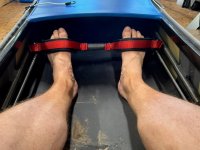
So I've logged some more time in my Advantage now, including in wind, current and waves. @tketcham and others had recommended adjusting trim to avoid weather-cocking. Do you slide the seat on the fly, or adjust ballast? If the former, how do you deal with the foot bar? I adjusted my footbar for level trim in calm conditions. If I slide the seat all the way up for a headwind, I'm chewing on my knees or need to put my feet under the bar. All the way back for a tailwind and I can barely reach the bar with my toes. Am I missing something obvious?

I was out with a friend on the tidal Hudson on a day with a fair bit of wind and tidal movement. I got blown around a lot , including sideways, despite trying to use drybags full of water as ballast. Much of the trouble came from our route, which necessitated turning at various angles to the wind, as well as shifting wind patterns (the Hudson is notoriously inconsistent in wind direction). It was often too rough to stop paddling and mess around moving dry bags too much, especially the heavier one. I was rather embarrased that my companion seemed to be having a much easier time of it in a 10ft Ocean Kayak compared to the Advantage, and that was even with probably 20-30L of water in the bags as ballast. (I was even more embarrased when I dumped myself out of the boat trying to haul the larger dry bag into the boat after filling it. Luckily we were in a side creek in about a foot of water depth. The stories of the Advantage dumping fast once you get past the primary stability are well warranted!)

Finally, on sit&switch vs single-sided, I can see the speed efficiency of the former. The boat likes to go fast. But for paddling with others in slower boats I found an otter- or beavertail and pitch strokes or underwater returns useful for a more relaxed pace. At slower speeds it seems like the sit&switch loses some of the benefits - the boat is designed for a pace alongside that paddling style, it seems to me.
 
So I've logged some more time in my Advantage now, including in wind, current and waves. @tketcham and others had recommended adjusting trim to avoid weather-cocking. Do you slide the seat on the fly, or adjust ballast?
Both, depending on conditions. I didn't (still don't) try to get perfect trim in windy conditions, for me it's more about making things better than doing nothing.

Added: Adjustments in trim are subtle. Mainly I just try to use the wind to my advantage (sorry for the pun) while paddling. As Alan mentions below, adjusting pitch doesn't entirely solve the problem of the canoe wandering around in windy conditions. I typically angle the canoe into the wind so it catches the bow and helps counter yaw or try to head straight into the wind and use fewer strokes per side. And with following waves you learn to keep a certain angle so that the canoe doesn't broach. (I think that's the correct term.) But I don't pitch the stern down much because I don't want waves coming over the shorter stern section.

I slide the seat forward some to pitch the bow down a bit or rearward some to lower the stern a bit, but usually don't slide the seat to the limits of travel. And yes, it screws up the foot bar ergonomics but I have long legs so the difference isn't too bad as long as I'm not paddling into or with the wind for too long. I also trimmed the seat and set the foot brace for calm water with a small day pack just in front of the foot bar. I can slide the pack forward or place it just in front of the seat frame (or toss it behind me) as needed so I don't have to slide the seat as much.

If I have to deal with wind for a longer stretch of water I reset the foot bar (near shore), which is a bit of a hassle using the older Wenonah "safety pins" and especially using little thumb screws and nuts. I now use Northstar's footbrace system in my canoes, which allows the foot bar to slide and the knobs on the locking bolts are easy to loosen and tighten. (And if I was going to buy another cruising canoe I'd order it with an integrated seat/footbrace system that slides as a unit.)

To use the Northstar footbrace in your Advantage, you could use pieces of aluminum angle as adapters between the rails pop-riveted into the hull and the Northstar rails. Just drill holes in the angle to match the holes in the rails. That's what I'm going to do with my GRB Newman Classic; I have the parts, I just need to take the time to get it done.
 
Last edited:
I set my seat and foot bar for good conditions and try to have enough knee bend that if the seat needs to be slid back I have some room to play with. It's not ideal but good enough for what will hopefully be a short stretch. If I'm tripping it's usually easy enough to shove the pack that's right behind my seat a little further back to help with trim. I honestly can't remember having to slide the seat forward much for head winds. They handle so poorly when bow heavy that I usually just make do with 'normal' trim.

I set my normal trim by incrementally moving the seat forward a little at a time until the bow feels like it's starting to pin and the stern feels loose. Then I move the seat back just a bit until it feels normal.

Alan
 
bit of a hassle using the older Wenonah "safety pins" and especially using little thumb screws and nuts.
Yeah mine has the little thumb screws and nuts - a hassle on the cradles in the garage, I certainly wouldn't want to mess with those on the water or even on shore where they'd be easy to lose if dropped in grass.

Thanks for the wind tips, tketcham and Alan. Alan, your boats that gamma1214 had at the PA rendezvous seem like they have shorter sheer and probably less windage than the Advantage? I go back and forth between thinking that high bow should help in waves and thinking it catches too much wind. But maybe the Advantage really should be paddled with a tripping load in wind conditions. But also, I I can guarantee I need more practice in it.

I do also feel like kneeling would help. Hearing that those hulls aren't strengthened properly to hang a bench seat, I keep thinking I should shape some minicell to fit over the tractor seat and add a little height for when I want to kneel, during rough conditions especially but also to stretch the back out when in the boat a long time. But again, obviously plenty of folks sit in them all the time crossing big water so maybe practice is still the key. (Or do most of those folks have a tripping load so kneeling doesn't affect the center of gravity that much?)
 
I do also feel like kneeling would help. Hearing that those hulls aren't strengthened properly to hang a bench seat, I keep thinking I should shape some minicell to fit over the tractor seat and add a little height for when I want to kneel, during rough conditions especially but also to stretch the back out when in the boat a long time. But again, obviously plenty of folks sit in them all the time crossing big water so maybe practice is still the key. (Or do most of those folks have a tripping load so kneeling doesn't affect the center of gravity that much?)

I think very few Advantage owners are actually tripping out of them. Not that it can't, and isn't, done but I don't think it's most people's first choice. I would also guess most Advantage paddlers are skipping the wind and rough water whenever possible.

I have no first hand experience with the Advantage but have a lot of experience in the boats in quick hulls where tripping is expected (such as a Magic and the Bloodvein I designed). I only ever paddled the Magic sitting, both empty and loaded, in all weather conditions. Kneeling wasn't an option at that seat height. I designed the pedestal of the Bloodvein to be narrow enough to kneel around and I would often drop to my knees in rough water. When day paddling I bring along an extra PFD or foam flotation cushion to raise the seating height a little. When tripping I just make do.

But those hulls have a little rocker at least and if I remember right the Advantage doesn't have any and is likely a little more tender. I can certainly see where battling the wind would be a little tougher and kneeling could certainly be a benefit. The added control and stability would let you commit more to hard correction strokes or sweeps as needed. I certainly think it would be worth experimenting with.

I also have some experience paddling racing C1 hulls (such as the J-180) and I did find them very difficult to control in the wind due to the hull shape and lack of stability. They were hard to correct once off course and the tenderness kept me from getting too carried away with hard correction strokes or anything that left me feeling a little vulnerable to sudden tipping.

But, that being said, I saw racers paddle those boats very quickly and efficiently in wind I wouldn't have been able to handle. One spring I entered a 75 mile race down the Missouri River. As usual there was a very strong (20+ mph) headwind blowing upstream and many parts of the river here are wide and exposed. That year I was paddling an 18' surfski with a rudder and was very thankful for the boat I'd chosen to bring. A friend of mine was paddling in his 18.5' racing C1 and I hadn't seen him since the start of the race. At about 5 hours into the race, in a particularly windy section, I was thinking how tough of a time he must be having and wondered how he was getting along. I was on the far side of the river that time and when I looked across the river I saw he had caught up to me! I paddled over to ride next to him, held on for a bit as we chatted, and then he pulled away from me and I could not keep up. I was in my 30's and he must have been in his 60's at that time. Kind of blew my mind.

Keep practicing, it can only get better. :)

Alan
 
They were hard to correct once off course and the tenderness kept me from getting too carried away with hard correction strokes or anything that left me feeling a little vulnerable to sudden tipping.
This is certainly me at present.
Keep practicing, it can only get better
Aye! 🙂

(Or I could sell the Advantage and keep my eyes peeled for a Magic or something similar....)
 
I have always liked canoes with lots of rocker and arched or V shaped hulls. Those two things solve a lot of performance problems with canoes no matter what length they are.

I have paddled tandem canoes solo for decades with no problems.. Trim becomes highly important with wind and or currents. Use your dunnage to trim the boat. In lots of wind you may have to kneel close to the middle of the boat.
 
Or I could sell the Advantage and keep my eyes peeled for a Magic or something similar....
OR... you can return to WPASCR next year, test paddle the Bloodvein again and decide that you like it enough to build one :)

much cheaper than buying & you could install a pedestal as Alan did or stay more conventional like me. Might even be able to convince Alan to bring the original & you could try both seat configurations. (he could check the WPASCR off the bucket list before hiding away in New Mexico for retirement(?) I'm figuring on bringing 2 cases of Yuengling... say the word & I'll bring 3).
 
This is certainly me at present.

Aye! 🙂

(Or I could sell the Advantage and keep my eyes peeled for a Magic or something similar....)

The good news is that I believe the difference between something like the Magic and an Advantage is relatively small while the jump up to a racing C1 is huge. I have paddled the Wenonah Whisper (billed as the little sister to the Advantage) and I thought it felt pretty 'normal'. Granted, that was on flat water with little wind.

But, realistically, if I was looking for a fast boat I could trip out of I'd probably look for something like a Magic or Blackwater. If I just wanted a boat that was fun to paddle when I wanted to move fast and get some exercise the Advantage would fit the bill almost perfectly. If it was windy I just wouldn't paddle at all or I'd pick a different boat for that day.

It will take a lot more than beer to get me to PA :)

Alan
 
Back
Top Bottom