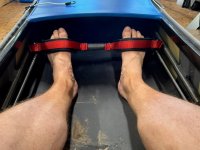
I do also feel like kneeling would help. Hearing that those hulls aren't strengthened properly to hang a bench seat, I keep thinking I should shape some minicell to fit over the tractor seat and add a little height for when I want to kneel, during rough conditions especially but also to stretch the back out when in the boat a long time. But again, obviously plenty of folks sit in them all the time crossing big water so maybe practice is still the key. (Or do most of those folks have a tripping load so kneeling doesn't affect the center of gravity that much?)
I think very few Advantage owners are actually tripping out of them. Not that it can't, and isn't, done but I don't think it's most people's first choice. I would also guess most Advantage paddlers are skipping the wind and rough water whenever possible.
I have no first hand experience with the Advantage but have a lot of experience in the boats in quick hulls where tripping is expected (such as a Magic and the Bloodvein I designed). I only ever paddled the Magic sitting, both empty and loaded, in all weather conditions. Kneeling wasn't an option at that seat height. I designed the pedestal of the Bloodvein to be narrow enough to kneel around and I would often drop to my knees in rough water. When day paddling I bring along an extra PFD or foam flotation cushion to raise the seating height a little. When tripping I just make do.
But those hulls have a little rocker at least and if I remember right the Advantage doesn't have any and is likely a little more tender. I can certainly see where battling the wind would be a little tougher and kneeling could certainly be a benefit. The added control and stability would let you commit more to hard correction strokes or sweeps as needed. I certainly think it would be worth experimenting with.
I also have some experience paddling racing C1 hulls (such as the J-180) and I did find them very difficult to control in the wind due to the hull shape and lack of stability. They were hard to correct once off course and the tenderness kept me from getting too carried away with hard correction strokes or anything that left me feeling a little vulnerable to sudden tipping.
But, that being said, I saw racers paddle those boats very quickly and efficiently in wind I wouldn't have been able to handle. One spring I entered a 75 mile race down the Missouri River. As usual there was a very strong (20+ mph) headwind blowing upstream and many parts of the river here are wide and exposed. That year I was paddling an 18' surfski with a rudder and was very thankful for the boat I'd chosen to bring. A friend of mine was paddling in his 18.5' racing C1 and I hadn't seen him since the start of the race. At about 5 hours into the race, in a particularly windy section, I was thinking how tough of a time he must be having and wondered how he was getting along. I was on the far side of the river that time and when I looked across the river I saw he had caught up to me! I paddled over to ride next to him, held on for a bit as we chatted, and then he pulled away from me and I could not keep up. I was in my 30's and he must have been in his 60's at that time. Kind of blew my mind.
Keep practicing, it can only get better.

Alan