
Come to think of it, paddling the Malecite in a tailwind with significant waves and doing it with the boat facing both directions should be quite educational. Gonna have to wait though. I'm BWCA bound in a week.


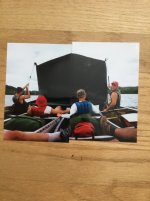

Scroll down to figure 10.1.3, and view the animation. This is what I imagine I'm feeling.

10.1 Wave Basics – Introduction to Oceanography
<p><em>Introduction to Oceanography</em> is a textbook appropriate to an introductory-level university course in oceanography. The book covers the fundamental geological, chemical, physical and biological processes in the ocean, with an emphasis on the North Atlantic region.</p><p>Last update...rwu.pressbooks.pub
There is movement in both directions, plus up and down. Under six miles of fetch, it's an interesting ride.
Yeah, because the wind isn't always aligned with the waves, what I have been doing is quartering slightly toward my onside and paddling hard with a little sweep when needed. Like I mentioned already, it forces me into a sprint. Not necessarily a bad thing, but not always ideal - especially after a long day.That's why quartering waves can be a viable option in that scenario: because you're effectively shortening the length of your boat relative to the vector of the wave, which reduces the force differential along the length of your boat. That said, if the waves are really that tight, even if you're quartering, you're still probably going to need to pry to keep your stern planted at the moment of the trailing wave's engagement with your boat because it is still going to meet your stern before the bow.
You just described the sailboat i finally sold last year. And come to think of it, it was always easy to sail DDW.By comparison, a seakindly sailboat would have a lot of volume amidships, with high ends that would gently lift the ship up and over the seas, rather than digging in.

The quest for another boat seems reasonable.

Saw that. Maybe something to experiment with. The only time I've even been around something like that being used was when I saw a couple in a rubber raft fighting up-canyon wind on the Snake River. The put a bucket on a line and got more help from the current that way.This post from @Boatman53 is relevant to the circumstances we're discussing in this thread, though not specifically boat design:
Sea anchors and drogues
Trying to distract from the fires ravaging my favorite canoe country I was thinking about a couple of other posts dealing with weighted anchors and rudders, and got me thinking about sea anchors and drogues. Any boat going in the ocean should have them and I had a sea anchor on my 32’ boat. A...www.canoetripping.net

Oh, good points! The waves I run from on the bigger lake are very different from what I was just on. Way more fetch. Way deeper water.The way waves behave in lakes that we'd normally paddle is really complicated. Without deep water and many miles of fetch ocean waves cannot form.
The most common conditions in smaller lakes, even deep lakes with three miles of fetch, are smaller, slower waves that are close together. These waves cannot effectively be surfed. A sharp stern allows them to go by with less interaction with the canoe.
Shallow water guarantees the waves will be close together and slow, so again, a sharp stern isn't much of a problem.
On lakes with a few miles of fetch and deep water, it's possible to transition to larger waves that can be pseudo-surfed. In these conditions, the wave has more time to interact with the back of the canoe, and has more energy to push you around. You need your weight far back. Rocker makes the stern easier to fight. These conditions are a blast if you're out for a day paddle in warm water. But lousy if you've got a loaded boat and cold water.
I don't have a long solo canoe yet, but I think I'd want one with a little rocker, like the Merlin.

That works very well in most situations where there is a tailwind. It's very obvious that the boat will weathervane with the light end downwind.Chrisresac describes what is going on quite well. Trim is key. You absolutely need the upwind end of the boat lower in the water than the downwind end.
I've been out in my Wildfire with strong tailwinds and no waves. My stern was light and the boat hung up 45 degrees off the tailwind. I could neither turn straight downwind nor turn further into yge wind. All I could do was lean into a feathered high brace and hang on.
It's dangerous because a side or quartering wind can capsize you by itself, especially when strong and gusty.
40 pounds of rocks in my stern trimmed it down and made it easy to maintain a downwind course.
I now bring several water bladders that I can quickly fill and deploy as ballast.
It's the trim much more than the boat design. Sure, some designs behave better than others but 30 knots will overwhelm even the best boat if poorly trimmed.


