• Happy Real Columbus Day (1492)! 🇮🇹 🇧🇸

Deciding which canoe

I have a Northwind Solo, kneeling seat, BlueHole Sunburst II, pedestal, and recently paddled the Swift Prospector 14. At 14' and more rocker the Prospector was considerably more nimble than the Northwind but tracked better than the Sunburst, logically...I was actually surprised at how playful it was while still being able to track straight. Nothing beats playing in boats to know what you like or need.

I have paddled sea kayaks and racing kayaks but have yet to double-blade a canoe. I would be inclined to double-blade at the same height as for a single-blade. I feel there would be more power and control at a greater height, also an opportunity for a more vertical stroke with the double blade, efficiency, power and control...though most kayak paddles are designed for a more horizontal stroke.

Are pack canoes designed for converts from kayaks to canoes? Providing the stability of a touring kayak but easier entry, exit and loading/unloading? If you are already comfortable in a canoe perhaps buy a canoe with a conventional seat and remove if you want to try pack style?

Again, more control, efficiency and speed from a higher seat and more vertical stroke, no? Is there something I am missing? I understand that a lower seat position is more stable but technique and experience provide more confidence in the boat... in racing kayaks for example, narrower craft are less stable but faster, as I became more comfortable in the boat I would elevate the seat position higher to improve performance.

It feels like I am missing something but not sure what, other than actually paddling a pack canoe or double blading a regular canoe.

Seat height a factor in stability and control...choose the boat that provides you with the maneuverability and weight that you seek and install a seat that meets your comfort level while retaining the option of changing it if you choose to.
 
I have a PB Rapidfire with a custom (1.5 in) higher than highest usual available optional seat. With one notable exception, I 99.99% paddle it single blade, the only .01% exception is in some races that require double blade to be used in the canoe class (solo-recreational, equal to or less than 16 feet long) that the RF and others of that category fit into. PB definitely markets the RF, Shadow, and others to kayak paddler converts.

But I paddle a canoe as a canoe should be paddled and maneuvered, with a single blade paddle. I also have a PB Shadow, a SR Blackwater, and a Swift Cruiser, and a couple of Hornbecks in my solo fleet. Only the Honrbecks, as bottom sitters, are a true double blade canoes. I tolerate and only use them as remote pond bushwhack carry boats. All the other solo canoes I own have at least 1.5 inch risers above the standard highest optional seats. My single blade single side power stroke incorporates a slight pitch stroke, (or a Canadian when using a straight wood paddle), with a gentle off-side heel for direction control. with little to no need to ever or very rarely incorporate anything stronger (such as J-stroke) for single side paddling long distance straight line travel.
 
I recently took a test drive in a packboat with the seat on the bottom of the canoe. About an hour after doing so, my left knee began hurting and still is hurting as I author this post. Not sure if I torqued it somehow by pressing too hard on the foot petal. I've never injured it before in all my hiking and backpacking adventures over the decades.

Regardless the cause, a low-seat profile is now out of the question as I'm not going to take a chance. I'm back to the high-seat, more conventional profile in an untralight canoe. Somehow, despite one's inclinations, nature has its own way of filtering out the better choice.
 
Take a look at the Swift Prospector14 in carbon fusion, 26 lbs. and lots of seating options. Raquette River Outfitters may have one for you to try out.
That one would be my suggestion too. When I tried it I was very impressed by how friendly that P14 is. Should be very comfortable as a first solo, yet not boring over time. Sporty, but stable enough to fish from.
 
I recently took a test drive in a packboat with the seat on the bottom of the canoe. About an hour after doing so, my left knee began hurting and still is hurting as I author this post. Not sure if I torqued it somehow by pressing too hard on the foot petal. I've never injured it before in all my hiking and backpacking adventures over the decades.

Regardless the cause, a low-seat profile is now out of the question as I'm not going to take a chance. I'm back to the high-seat, more conventional profile in an untralight canoe. Somehow, despite one's inclinations, nature has its own way of filtering out the better choice.
Canoewiia, what did you decide with respect to occasional tandem use? Have you decided to head down the path of a dedicated solo boat?
 
Canootrippa...yes, I finally came to the realization that one canoe cannot serve every master. So, just a dedicated fishing/poking-around canoe for one person with a single conventional seat.
 
Canootrippa...yes, I finally came to the realization that one canoe cannot serve every master. So, just a dedicated fishing/poking-around canoe for one person with a single conventional seat.
Though it’s a tandem, for small lake trout fishing and as you say poking around, I recently bought a used Wenonah Fisherman in kevlar. 14’5, 36#. I simply paddle it from bow seat facing stern.
My wife has been in it once used as a tandem, my lab every time I go out.
 
Canootrippa...yes, I finally came to the realization that one canoe cannot serve every master. So, just a dedicated fishing/poking-around canoe for one person with a single conventional seat.

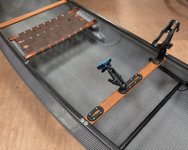
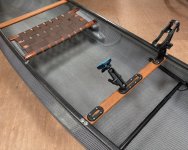
For a dedicated fishing / poking-around solo canoe, I'll join Geoboy and Steve in Idaho and be the third person to recommend a Swift Prospector 14. It's a great design by David Yost that has very nice side-to-side initial stability that gives the paddler nice feedback as it is heeled (leaned) further. I got the chance to speak with David Yost recently, and he mentioned that he is a firm believer that a boat should give the paddler proportionally increasing feedback as they lean the boat. As others have mentioned, it also strikes a nice balance between maneuverability and tracking in a straight line. It can be ordered with a universal mount package, which is essentially a set of Scotty low profile track mounts (see photo) that allow the paddler to easily attach things like rod holders, fish finders/transducer brackets, GPS mounts, phone holders, GoPro mounts, drink holders, etc. It can also be ordered with a carbon foot bar that provides a nice bracing point for one's feet.

There are three lengths offered by Swift in their solo Prospector Series : The Prospector 13, 14, and 15 Solo. The best one for you depends on the weight range needed based on paddler weight, pets, and gear. The Prospector 14 is set up for an optimal weight range of 150-400 pounds.

The Prospector 14 is a great boat. I have a 2024 model year Swift Prospector 14 in Carbon Fusion (base weight 26 pounds) with the epoxy resin upgrade option and carbon footbar option. I have the Swift cherry detachable yoke for portaging the boat. My boat has the multi-height seat pod option that allows for two seat height positions (see photo). It's very easy to change between seat heights. My boat did not come with the Scotty low profile track mounts, so I installed them myself. That allowed me to install a longer center track mount (see photo) so I can have multiple devices mounted in the center of the forward thwart. I use it for taking day trips on small lakes as well as multi-day trips with many portages.

Here's a photo showing the multi-height seat option, carbon foot bar, and the Scotty low profile track mounts with my GPS and a rod holder mounted :

IMG_4875.JPEG

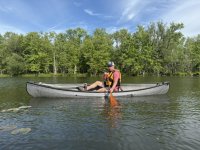
Here's a photo showing how easy it is to heel (lean) the boat when sitting in the high seat position and not kneeling on the floor :

IMG_7954 (1).JPEG

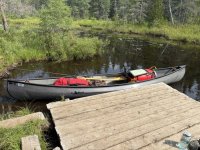
Here's a photo showing how much gear it will haul. The seat is in the low position in this photo :
IMG_5679 (2).JPEG
 
Both are gorgeous canoes. Thank you for sharing your throughts and pictures.
 
I was looking at the stats and weights for the Swift Prospector 13. The layup options include Carbon Fusion, which saves 2lbs over the Kevlar Fusion, and Expedition Carbon which saves 1lb over the Kevlar Lite.

Given that I am going to be on flat water almost all of the time, I'd prefer to save 2lbs with the Carbon Fusion. What am I giving up by making that choice? I assume the hull being more fragile but on flat water how likely is it to become a problem?
 
I was looking at the stats and weights for the Swift Prospector 13. The layup options include Carbon Fusion, which saves 2lbs over the Kevlar Fusion, and Expedition Carbon which saves 1lb over the Kevlar Lite.

Given that I am going to be on flat water almost all of the time, I'd prefer to save 2lbs with the Carbon Fusion. What am I giving up by making that choice? I assume the hull being more fragile but on flat water how likely is it to become a problem?
I would not hesitate to buy a carbon fusion Swift although my experience is with kevlar fusion. In principle the carbon adds a little stiffness and brittleness so if you hit rocks regularly or hard there could be a difference but if you don't abuse the boat there's nothing to worry about. I doubt many paddlers have ever regretted going for the lighter boat.
 
Given that I am going to be on flat water almost all of the time, I'd prefer to save 2lbs with the Carbon Fusion. What am I giving up by making that choice? I assume the hull being more fragile but on flat water how likely is it to become a problem?

I agree with your analysis and @gumpus: Carbon Fusion will be a weight advantage and will not likely present any disadvantage. I have a Swift Carbon Fusion Keewaydin 15 and I would not trade it for any laminate that is two pounds heavier. It performs just fine on lakes and I have even taken it down four rivers in the New Jersey Pine Barrens, where the bottom of the hull slid and see-sawed over dozens of logs, stumps and branches. No hint of damage to the hull. For example, I was next after Kurt and Marc to see-saw over this log:

1791829260541.png
 
I was looking at the stats and weights for the Swift Prospector 13. The layup options include Carbon Fusion, which saves 2lbs over the Kevlar Fusion, and Expedition Carbon which saves 1lb over the Kevlar Lite.

Given that I am going to be on flat water almost all of the time, I'd prefer to save 2lbs with the Carbon Fusion. What am I giving up by making that choice? I assume the hull being more fragile but on flat water how likely is it to become a problem?

If lower weight is more important to you than cost, I would suggest going with the Carbon Fusion laminate with the epoxy resin upgrade option. I have two Swift canoes in Carbon Fusion with Epoxy resin (2024 Prospector 14 and 2026 Cruiser 16.8) and I love that combination for almost all situations. I run my boats over low beaver dams, drag them over tall beaver dams without unloading my gear, scrape the hull on hidden rocks just beneath the surface of the water, and lightly beach the boats (slowly, not ramming speed) on sand and gravel, etc. without any significant issues.

100% Carbon laminate is very stiff and light, but it doesn't have the impact resistance that Kevlar (brand name for aramid fiber) does. However, in order to regain some impact resistance, Swift's Carbon Fusion laminate is not just 100% carbon. Their Carbon Fusion laminate is an H-weave pattern comprised mostly of carbon and Innegra fibers. The Innegra fibers are a polypropylene material and help regain some impact resistance.

Swift's standard vinyl ester resin is strong, but the higher percentage epoxy resin option is even stronger. To me, it is very much worth the $600 epoxy upgrade to reduce the likelihood of chips and cracks in the resin surface of the boat as well as reduce the chances of damage if I get the boat into a potentially catastrophic situation. I dropped my brand new Cruiser 16.8 on its side while on a portage and there wasn't a crack or even a mark on it as a result.

I would recommend against the two-tone gelcoat bottom in your situation, since you want to save weight and because the Carbon Fusion laminate hides scratches pretty well by itself (that is another advantage over Kevlar Fusion laminate). A light coating of 303 protectant makes light scratches pretty much become invisible (they are still present, but not very visible).

If you have any questions at all, reach out to Bill Swift directly. He is happy to answer specific questions that arise. His email address listed is under the 'about' / 'contact us' section of Swift's website.

I found this YouTube video from Swift to be very helpful in explaining the different laminate and resin options: Swift Product Launch

 
Back
Top Bottom