• Happy World Aquatic Animal Day! 🐟🦦🐊

bow repair on old town Pack (royalex)

Joined
Apr 2, 2026
Messages
3
Reaction score
2
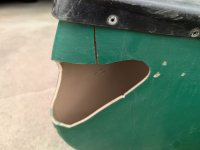
I'm trying to repair a major hole in the bow of my old town pack. This is my first major repair of this type so I seek the wisdom of the experts here. My end goal is function only. Aesthetics are unimportant as the boat is, like myself, beyond trying to look pretty.

Before prep:
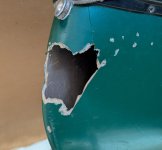
PXL_20260321_234957329 (1).jpg

After prep:

PXL_20260402_210231185.jpg

My plan was to patch the hole with fiberglass cloth wetted out with g/flex epoxy with an oversize fiberglass cloth layer over the outer vinyl of the hull. However, when I cleaned up the inner surface I found 3additional cracks 3-4" long at the bottom of the hole at the bow. 1 of the cracks penetrates the entire hull. The other 2 only penetrate the inner abs/vinyl layers and not the abs foam or outer abs/vinyl.

I would like to avoid cutting away more of the bow so my question is, " Can I structurally stabilize the cracks by covering them with the outer fiberglass cloth layer and an additional inner fiberglass cloth layer?"
 
" Can I structurally stabilize the cracks by covering them with the outer fiberglass cloth layer and an additional inner fiberglass cloth layer?"

I don't doubt others will be along with more info and advice particularly for adhesion to Royalex, but on this specific question: Yes. This is how some entire hulls (cedar strip) work. I doubt a single layer inside and out will be anywhere as tough as the original Royalex, but for basic water-holding, paddleable structure, it will work fine.
 
Your damage appears to be above the waterline. I made a similar repair once in the nose of a kevlar Sawyer. I used foam to fill the cavity and sanded it smooth to create the shape for the fiberglass and epoxy. It turned out great I painted the boat. It was hard to tell that it had been repaired.

Who has experience with g/flex epoxy bonding to Royalex? I have not tried it. If the bond is good you can build it up in layers and make some finish layers of fine weave cloth that covers the hole by 3-4 inches of extra cloth. Good luck.
 
I've never had to deal with such a large hole, a few small ones and lots of cracks is all I've done.

In general terms I would create a base from the inside using an oversized patch of s-glass / e-glass and let that cure, You might want to use peel-ply so that you can put some pressure on it to set the proper position and shape (no sag).

Eventually you would do similar for the final layer after you have filled the space formerly occupied by the Royalex.

To fill the gap just do layer after layer of fabric, make a template so you have the exact size/shape to be just right, not too big, not too small. You might consider using multiple smaller pieces for each layer. I would not try to fill the entire gap in one go, do a few and let it cure, then do another round until it's built up enough to match the thickness of the existing Royalex and really for the final outer layer(s).

That crack at the top, you could strengthen it by putting a couple of wire stitches (brass), you would end up with some little bumps....who cares!

Gflex will work, I'm not so sure you would wants to use the thickened version, it is easier to work with in some ways but the wetting out process is a bit more difficult since you wont be able to apply the usual amount of pressure. I think the wetting out will be critical for such a thick patch.

It occurred to me that for the fill-in work Kevlar felt might be a better option at it is much thicker and swells when absorbing epoxy. Unfortunately Kevlar felt as used on skid plates will break off in small chucks. Consider using multi-material sandwich, a couple of layers of glass, a layer of felt, more glass, more felt and so on.

Of course the usual stuff about preparing the surfaces, a quick sanding of the outer vinyl layer around the hole for good adhesion, clean with acetone, same for the inside.


I'll be interested to see how this goes for you. I have a boat that is missing a chunk (about 10" x 4") on the bottom of the hull. Fortunately the foam core and inner layer of Royalex are mostly undamaged.
 
Your damage appears to be above the waterline. I made a similar repair once in the nose of a kevlar Sawyer. I used foam to fill the cavity and sanded it smooth to create the shape for the fiberglass and epoxy. It turned out great I painted the boat. It was hard to tell that it had been repaired.

Who has experience with g/flex epoxy bonding to Royalex? I have not tried it. If the bond is good you can build it up in layers and make some finish layers of fine weave cloth that covers the hole by 3-4 inches of extra cloth. Good luck.
I didn't explain my planned repair procedure very well. I have zero experience with a repair like this and I can't find anyone locally who does so I cobbled together this plan based on a few hours of internet research on royalex repair and fiberglass boat hull repair:

Repair procedure

Phase 1 (hole prep):
  1. Remove all cracks and jagged edges and smooth out the edge of the hole with a jigsaw and Dremel.
  2. Open the crack at the top with a jigsaw and Dremel.
Phase 2 (hole backing):
  1. Clean the interior and exterior of the area around the hole. First with water and a scrubbie, then with denatured alcohol.
  2. Cover the interior of the hole and crack with 2-3 layers of aluminum foil tape to match the contour of the bow.
  3. Tape a piece of cardboard over the foil tape to provide stability?
  4. Mask around the exterior of the hole and crack.
  5. Sand outer vinyl surface with 120 grit sandpaper.
  6. Wipe sanded area clean.
Phase 3 (fill cracks)
  1. Fill upper crack with thickened G/Flex epoxy.

Phase 4 (patch hole):
  1. Mark the inner edge of the hole and the outer edge of the final fiberglass cloth layer on a mylar sheet.
  2. Using the marked mylar, cut 5 identical layers of biaxial fiberglass cloth to fill the hole. (see West Systems video here:
    )
  3. Cut out the larger final outer layer of 6 oz woven fiberglass cloth.
  4. Wet out fiberglass cloth layers with G-flex epoxy and lay on a sheet of peel-ply as shown in the West Systems video, but with the smaller layers on the inside as I am not beveling the edge of the hole.
  5. Wet the exterior of the hole with thickened G/Flex epoxy.
  6. Place the patch and wet out the peel-ply.
  7. Squeegee out air bubbles and lumps.
  8. Remove masking before epoxy sets up.
Phase 5 (cover inner cracks with fiberglass cloth):
  1. Mask around the area of the inner cracks.
  2. Sand the area with 120 grit sandpaper.
  3. Wipe sanded area clean.
  4. Mark the area to be covered around the cracks on a mylar sheet.
  5. Cut out the patch area of 6 oz woven fiberglass cloth.
  6. Wet out the cloth and apply over the interior cracks.
  7. Apply a final coat of epoxy.
  8. Remove masking before epoxy sets up.
 
Last edited:
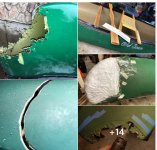
There was a guy in the Old Town Pack Canoe Forum on Facebook that a similar massive repair utilizing a paper mache mold. His results were pretty impressive. Apparently a bear had an appetite for Royalex. Pack.jpg
 
There was a guy in the Old Town Pack Canoe Forum on Facebook that a similar massive repair utilizing a paper mache mold. His results were pretty impressive. Apparently a bear had an appetite for Royalex.
Oh my! I joined that FB group but did not stumble across that post. Thanks!
 
Back
Top Bottom