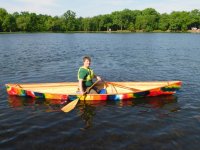
I find that the screws really help in pulling the inwale square to the sheer.
Today, however, when I checked the runs, they were still soft enough to scrape away. I pulled all of the clamps, used a discarded piece of strip to scrape away the squeezed-out epoxy and it cleaned up in less than 1/2 the time.
Well, I'm unsure which of these screwed me but this build continues to fight me (but I'm winning... I think). I've begun to wonder if the canoe Gods are hating me for the crazy color scheme.
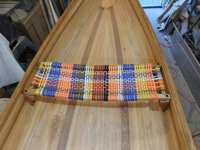
We machined the seat parts matching what we did to repair and reinforce the Bloodvein seat including the addition of a small tab under the seat to help prevent twisting. That tab becomes a PIA when fitting the seat supports so it will probably not be included in the future.
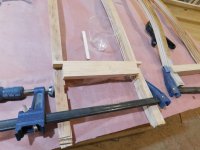
At any rate, we got the parts cut, mixed some thickened epoxy and clamped them together lightly. (for any future readers, I am now finishing this hull and the Bloodvein build at the same time so I may repeat things or might leave out some details because I covered them in that thread and can't recall what I put where)
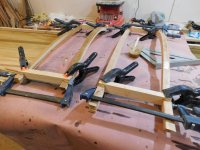
Like on the Bloodvein, I decided to mount the seat directly under the gunwales. Due to the depth of this hull, I'll be a little short of my preferred 9 inches above the floor (the seat has about 3 inches of drop on the front rail) but it made it easy to hold the seat (in the wrong position but we'll get to that) while I fit seat supports.
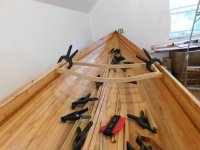
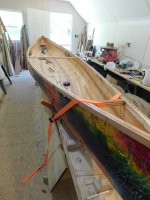
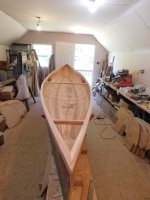
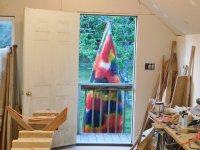
I need to clean the shop thoroughly before the next build (it's getting completely trashed... even more than usual...) but I'll need a bigger boat shop to build 2 at a time. I had my epoxy station, belt sander, etc on the infeed table of the shaper so I had to get creative shuffling boats. This included a brief look at what this color scheme will look like in the sunlight.
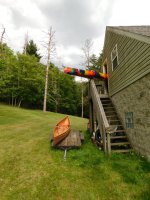
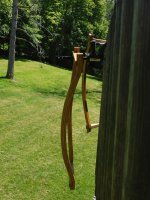
Sticking it out the door allowed me to move the Bloodvein to the off-loading table once the outer gunwales were installed and I could then move the Merlin to the strongback cradle.
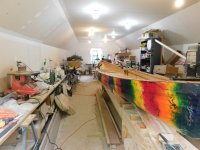
You may have guessed that I was fitting the seat supports (on the side that I could reach) while the boat was on the rear table. I could also reach those supports as the Merlin was hanging off of the porch so I used leftover thickened epoxy from the Bloodvein gunwales to glue those supports in place.
I should mention that (especially with asymmetrical hulls) it's really important pay attention to the boat's orientation or devise a system where the bow is always on the strongback in a certain direction. I did neither of those things and got really lucky that I didn't allow the epoxy to set up overnight.
As it was, I'd run short on clamps doing both sides of the Bloodvein so I made a run to Harbor Freight, ran a few errands for my Mom and the epoxy only had about 3 or 4 hours to cure before I could walk around the hull properly and noticed that something was wrong.
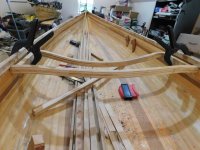
Yep, I'd installed the (highly contoured) seat facing the stern. Luckily, the short cure time allowed me to rip the supports off although it took quite a bit more effort than I'd have thought. I definitely know these aren't going anywhere once cured.
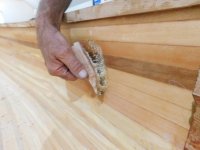
I used a scraper to clean off the hull and allowed the supports to dry figuring that I'd sand them off later.
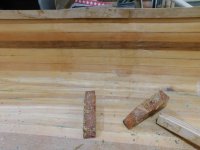
Note: in case anyone is wondering, I tell you about the stupid things, not because I need the world to know that I'm an idiot but because I want everyone to know that even idiots can build these boats. I sincerely hope that including the "oh, $hit" moments doesn't discourage anyone but instead encourages those interested to give it a try.
It certainly helps to get lucky (as I did here) but just about anything can be worked around. (and, if not, it'll still burn).
Anyway... back to the build. If you've been wondering about the quotes at the beginning of this entry, your curiosity ends here.
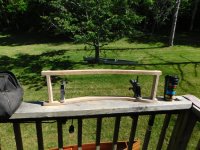
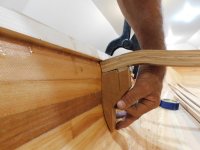
I've been using a jigged trim router (a 1/4 inch trim router screwed to a piece of aluminum bar stock) to trim the "cap" portion of the inner gunwales flush with the hull prior to installing the outer half of the gunwales.
The bearing at the bottom of the blade rides along the hull and (usually) produces a smooth cut that is perfectly flush with the hull. It's really important though, to double-check as you go instead of just throwing it on there and letting it eat.
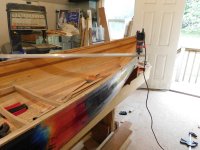
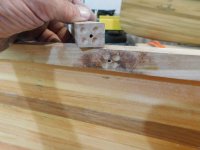
Whether the screws were insufficient to square the inwales or pulling the clamps early allowed them to twist (or both... most likely, it was both...), the inwales were twisted slightly and the router was gouging the hull wherever the blade touched before the bearing did. (not the best picture as I was also having other issues in this section but, hopefully, you get the idea...
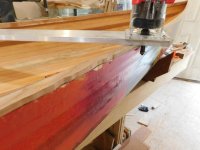
I tried manually holding the depth but couldn't watch the both depth of the cut (only visible from below) and pay attention to the grain (only visible from the top) at the same time and I knew from my Freedom build that the router will splinter the Cherry quickly if going against the grain.
My solution was to use a small spokeshave to get it close and then sand it flush with the horseshoeing rasp and the longboard.
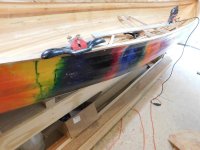
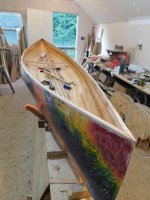
That worked really well even though it was slower than using power tools (faster than fixing disasters though).
I then started fitting the thwart and grab handles
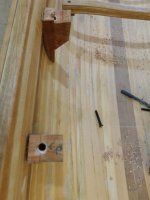
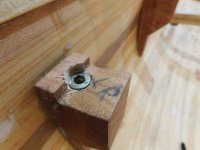
used a 1/4 inch drill bit to create a divot in the outer glass and then used a 1/8 inch drill bit to drill pilot holes through the hull and into the thwart & grab handles. The 1/4 inch bit was then used to cut small divots onto both the cross pieces and the inner gunwales. These increase the surface area of the joint but also should prevent twisting once cured.
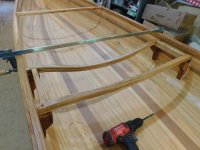
With every intention of attaching everything needing thickened epoxy this afternoon (seat supports, thwart, grab handles and outer gunwales), I needed a good way to hold the seat supports without reaching over the gunwales.
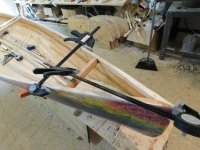
I solved that by cutting some leftover Poplar strips about 31 inches long and wedging them between the hull and the seat support (the lack of fill coats greatly increases traction for this operation)
PS: please ignore the air pockets under the glass. I meant to fill them with epoxy (using a hypodermic needle works pretty well) but don't really have time if this one is making the trip to WPASCR on Friday. (I mean, why not, right? Probably be the only one there)
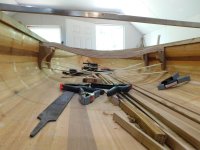
These strips DID try to force the top wider so a large bar clamp was needed to hold the correct dimension.
Next I fitted the outer gunwales starting at opposite ends, cutting the stock flush on one side and allowing it to run past on the other. (Sorry, I can't believe I didn't take a picture of that... it was the same as I did the Bloovein yesterday)
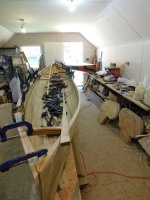
After all of that, I started mixing epoxy, thickening it with sawdust, buttered all surfaces liberally and slapped them in place. Thwart & grab handles got a 1 3/4 inch deck screw to hold them (pulled tight so the head would be below flush and covered by the outwale), seat supports anchored with Poplar and the gunwales clamped fast with any (and almost all) available clamps.
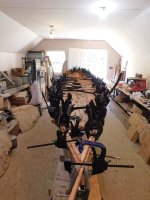
I'm headed over early in the am to clean up both hulls and I'm hoping to finish everything but lacing the seats by the end of tomorrow.