• Happy First Use of Insulin to Treat Diabetes (1922)! ⚕️💉

The camping trip that wasn't to be...

Joined
Oct 9, 2016
Messages
345
Reaction score
1,715
Location
Woonsocket, RI
How many days with temps in the teens does it take to freeze a river? Based on this weekend’s experience, the answer is three.

For the past couple of years, our local club has been doing a winter overnight at the Burlingame Canoe Campsites on the Pawcatuck River in Charlestown, RI. It’s been a lot of fun, and this year we had nine joining in, with one coming from as far away as NY.

In past years, temperatures for this trip have mild (days in the 30’s, nights in the 20’s), but this year we were having a cold snap. Day time highs were struggling to get out of the 20's, and night time lows were in the teens. Average temperatures had been in the 20’s for a couple of weeks, which is unusual for RI. We did have one of the locals check the river for ice on Wednesday, and he reported that the put in was ice-free. It is tough to see much else from shore.

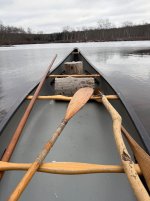
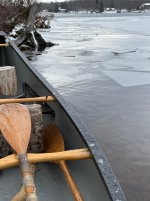
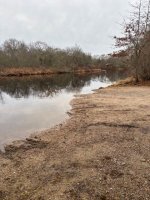
When we arrived at Bradford Landing on Saturday morning the put in was open, but there was solid ice downstream to a nearby dam. There was an open channel upstream so we loaded our boats and headed out. We didn’t get far. We paddled upstream a couple of hundred yards to find the river frozen solid – good half-inch of ice for as far as you could see. No way we were getting through that.

We paddled back to the put in to try to figure out our options. Was there a different section of the river that wouldn’t be iced-in - nope. Was there a campground or picnic area nearby that wasn’t closed for the season – nope. Unfortunately, we were out of luck. Best we could do was a picture and lunch at a nearby restaurant.
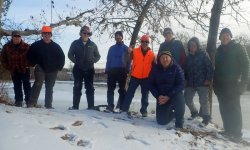
P1031908edit.jpg

Paddling in southern New England I get spoiled. Lakes freeze, but rivers with even a little current usually stay open all winter. Not this year, or at least this week. Forecast is for temps to go back in to the 40's next week.
 
Last edited:
Our daughter lives in Bristol, RI now but grew up in central NYS. She said this year's cold temperatures remind her of the winters of her childhood. She also admitted to growing "soft", living through southern New England winters.

That's all for now. Take care and until next time...be well.

snapper
 
We did one winter trip in Feb on the Colorado River. Lack of daylight is a challenge. We had unseasonable weather with frost every night. Hard to make a fire in the desert.

I did a long range plan to paddle the Rio Grande River in Big Bend NP with my brother in late Feb early Mar. We hit it just wrong and the forecast was snow and lots of wind. I tried to imagine being in a deep canyon in the snow with low winter sun angles and no way to build a fire. We cancelled the trip.
 
With the proper equipment and skills the trip may have still been possible. It would be different for sure, but traveling over and through ice is a fun challenge. All the info you need is in Garret Conover's book, "Beyond the Paddle"
 
With the proper equipment and skills the trip may have still been possible. It would be different for sure, but traveling over and through ice is a fun challenge. All the info you need is in Garret Conover's book, "Beyond the Paddle"
I have Garret Conover's book - best how-to on lining that there is. In terms of the ice, I'm not sure there was much we could do other than get to shore and walk around it. We definitely hadn't packed for a portage. Here is the ice – about a 1/2-inch thick and going on for a far as we could see.


It was too thick to easily break and paddle through, but not thick enough to stand on even using the boat for support. Another day or two and it probably would have been thick enough to walk on.

These days I tend to avoid ice, but there is one local trip that we do where ice is pretty common - the Branch. The deadwater behind two dams on this run often ices up. I went back and found this video from a trip in November of 2009.


Here are a few pictures from a trip in April 2014.


Tandem canoes are a lot easier to get up on the ice than kayaks. Once we have one boat on shore we often use a throw rope to pull other people up.

Anyone else have any ice adventures?
 
Yeah, at a certain point it may not be practical or possible to continue, that's why I said it "may" have been possible. I can see that you guys have experience with ice so you probably made the right decision.

I would think there are situations where if you could get past the frozen pools, the swifts would be ice free. Knowing the river would be a help. With 1/2 inch of ice I wouldn't try bashing through with my bow. I would approach it bow light, push as much of the boat on top as I could with the pole and then walk towards the bow, hoping my weight would break it.

When the ice is too thick to break through it is fun and exciting to push your boat across with your hands on the gunnels supporting a lot of your weight, ready to hop in if you start to break through. I don't think you could do this in a kayak. I also carry an ice hook as described in Conovers book. You can use it to push yourself across the ice, like you would with the pole, but it bites in better. It's also essential if you need to pull yourself onto ice in water too deep for the pole. I use my pole quite a bit when busting through ice, but I don't think Conover talks about this in his book.

Unfortunately this season the conditions weren't right for ice travel on my lake. When it froze it froze completely, leaving no open water to paddle. At least you got out on the water and can count it as a day you paddled.
 
I once took a trip through ice. I should have canceled. There was thin ice over the cove where I launched and I easily pushed through the first quarter mile of it. Then I encountered thicker ice, but got out on the marsh and pulled the boat along. Then the marsh ended, and at that point, I should have turned back. Eventually, I reached open water and continued to my destination where I ran into a lot more ice. There must be something wrong with me, because I really enjoyed the novelty of it. I easily could have qualified for a Darwin Award that day.

Thinking back, I don’t know why I brought a pole, but that’s what got me through the ice. It helped that I was paddling at Assateague where the water is shallow and the bottom is firm sand. I was in the Rendezvous, which is a twitchy boat to stand in, except when it is supported by ice, and I didn’t know there would be ice, so why did I bring the pole? It worked just as Lowangle described—push the boat up on the ice and wait for the ice to crack under the boat. Repeat. Not twitchy at all.

TR and photos.
 
It is surprisingly fun and if you're properly prepared I don't think you would qualify for a Darwin Award. If there is ice present on a lake but your launch is ice free and you can paddle to open water you should still have the right tools along. Even on my little lake I have been affected by shifting ice caused by the wind.

In shallow water (a good place to practice) I use the pole more than the hook. The hook also has a spike on the end that is good for pushing your boat across the top of the ice, as it bites in better than the pole.

IMG_1292.jpeg
Here you can see the pole, hook and paddle. I also had some extra weight in the boat, mostly for more stability, but it probably helped in breaking through the ice.

IMG_1299.jpeg
Here you get an idea of the thickness of the ice I was breaking through. You can also see the open water I was trying to get to, which is the reward for your efforts.
 
Back
Top Bottom