Thanks Benson for looping me into this thread. Though I'm not really familiar with Alaskan paddle designs, there is a long tradition of "pole-grip" style paddles across multiple indigenous cultures in Canada.
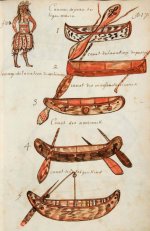
Louis Nicolas, a Jesuit Priest travelling in New France between 1664-1675, documented indigenous peoples in his personal notes which formed the basis of his manuscript the Codex Canadensis (1700). Though he never had any formal artistic training and was limited to his homemade natural inks and earth-toned dyes, his observations included sketches of canoes and paddles. This labelled sketch showcases designs from tribal groups he encountered including the "Porcupine Nation", the "Magoauchirinouek", the "Amicouek" and the Algonquin all of which have this pole style grip. The upper most example is an "Esquimaux" kayak made from seal skin and used with a familiar double blade paddle
In 1749, an 18ft bark canoe was brought back to England for a wealthy Lord. Although its whereabouts are unknown today, the British Admiralty commissioned a sketch documenting the plans of the canoe, including a scale drawing of the accompanying pole style grip paddle. A copy of this sketch survives in the Maritime Museum, Greenwich, London and was later documented in Adney's Bark Canoes book in Figure 4
This is further corroborated with artwork from an unknown artist (dated to 1850s) whose work accurately recorded the material culture of the time. Here is a closeup of the piece entitled "Micmac Indians" in the National Gallery of Canada:
Roughly in the same era, William Armstrong, a railway engineer and artist, documented indigenous scenes in his journey's west across the country. Included in his large body of work are watercolours reflective of indigenous life, fur trade outposts, trade canoes. Of particular note is is his rendering entitled, "The Distribution of the Government Bounty on Great Manitouling Island 1856" where he was present for this significant gathering of Ojibwe and Odawa peoples. Closeup of some of the figures also reveal this paddle style
As to the question about paddling technique, here's an image from Robert Pinkerton's book, (1914) explaining the indigenous method of gripping which showcases the way the paddles were often held.
Surviving photographic evidence shows this was still being used well into the 20th century. Here is a photo of Ojibwe Chief Busticogan in a bark canoe on the Big Fork River (MN):
In a photo of one of the last fur trade canoes in the Abitibi region of northern Quebec (1907), many of the indigenous paddle men are utilizing this technique which can be seen in these closeup:
A photo of guides from NW Ontario also showcases this style of paddle (Nipigon Museum):
As late as the 1930s, the Eastern Cree were still using this style of grip less paddle. A surviving sample is in the Musee de Quai Branly in Paris, France.
Pagaie
Géographie : Amérique – Amérique du Nord – Canada
Culture : Amérique – Cree
Date : 1930-1935
Dimensions et poids : 158.5cm x 12.5cm, 647 g
Donateur : Paul Coze
Précédente collection : Musée de l'Homme (Amérique)
Numéro d'inventaire : 71.1931.44.155
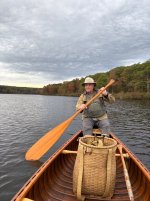
I happened to recreate the design of one of the c.1850 Mi'kmaw paddles from that earlier painting and have used it solo.
Like gumpus mentioned in his post, correction can be achieved with the "C" stroke or a variation of the "Northwoods", basically with the correction achieved while the paddle is partially underwater during the recovery. It does take some getting used to but not impossible and certainly isn't that exhausting. In the context of short term solo racing, I can see how the only option would be to switch sides while just muscling through for forward momentum. Sloppy and wet but it would get the job done.
However, given the surviving historical record, most canoes were larger and never really meant to be used exclusively as solo craft and certainly not just for leisure like today. Having a bow paddler (or multiple paddlers) changes the paddling dynamic and creates a need for fewer correction strokes. Like the image that Al posted, the stern paddler could just use some form of ruddering to steer.