• Happy Ferris Wheel and Valentine's Day! 🎡💝😍

Obsolete Stuff

This was my air navigation computer. it is a circular slide rule, among other flight calculation tools. The reverse side is used for wind drift calculations. I still have a couple of them with about 2000 flight hours of use on them, Definitely now obsolete as far as I am concerned.

View attachment 152907
I still have one somewhere. Think I last used it around 1982.
 
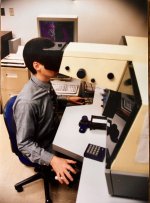
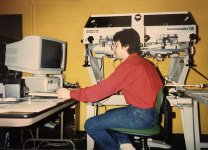
Here’s an analytical stereo plotter, connected to a CAD mapping systems. I was making my living running this on 2nd shift while attending graduate school. Totally obsolete now, but highly accurate. The methods have changed but some accuracy potential has been sacrificed. This was 1994ish. Swiss accuracy was the pinnacle of accuracy. My career took me from scribecoat drafting to aerial camera operation, to manual compilation to CAD system collection for GIS systems. That’s when firms started consolidating and many projects could get by with GIS products. Aerial mapping is still used for updates and refinement of databases, but the transfer technique uses different equipment. I also included an Italian manual plotter I converted to a digital collection too with x, y, z encoders and an AutuCAD interface. We had to hire an Italian firm to clean a calibrate. Got to know that guy well as he made his rotation through US mapping firms. Smoking while compiling was VERBOTTEN, and you didn’t mess with that guy if you were smart. He cleaned tar off the optics so there were no secrets. You can see the pantegraph arm in the lower right extending over a light table which is how the pencil manuscripts were compiled.IMG_6685.jpegIMG_2547.jpeg
 
Last edited:
Yup. Never seen one. What is it?
Planimeter, able to measure to hundreths of a square inch. It was used by foresters to measure the scaled mapping area of forest stands, timber sale units, post-sale activity units, and fire areas, among other things. You'd measure the square inch area of a unit drawn on a map and convert it to acres depending on the scale of the drawing. The planimeter was typically used for areas that needed higher accuracy, such as units in a timber sale contract or for double checking chain-and-compass surveys. Otherwise, if accuracy wasn't as important, we'd use a dot grid of varying precision for acreage measurement. Now they use heads-up screen digitizing in GIS (Geographical Information Systems) for "drawing" and measuring a unit.

Maybe I'll set it up to show how it works; haven't used it in ages.
 
Planimeter, able to measure to hundreths of a square inch. It was used by foresters to measure the scaled mapping area of forest stands, timber sale units, post-sale activity units, and fire areas, among other things. You'd measure the square inch area of a unit drawn on a map and convert it to acres depending on the scale of the drawing. The planimeter was typically used for areas that needed higher accuracy, such as units in a timber sale contract or for double checking chain-and-compass surveys. Otherwise, if accuracy wasn't as important, we'd use a dot grid of varying precision for acreage measurement. Now they use heads-up screen digitizing in GIS (Geographical Information Systems) for "drawing" and measuring a unit.

Maybe I'll set it up to show how it works; haven't used it in ages.

Nice one. I’ve used them many moons ago at work. CAD kinda made them obsolete, although I have a cheap one for trip planning. Set it up and let us see.
 
Nice one. I’ve used them many moons ago at work. CAD kinda made them obsolete, although I have a cheap one for trip planning.
I went from hand drawing units from stereo pair aerial photo interpretation and USGS topo mapping to using Autodesk AutoCAD and ESRI ArcGIS. The incremental improvements over that time, using a number of devices and technology, was not without a fair amount of frustration. At times we'd have to go back to manual methods because of software/hardware failures. It was fun to hand a newby a planimeter or dot grid and say: "Here, use this." :LOL:
 
How about this. Not an object, but a skill - or more accurately, a language. At the beginning of the train service stage of my career, we were still transitioning into radio communication. Much of our communication between the locomotive engineer and the ground crew was still with hand signs and lantern signs. The old heads could give and receive pretty detailed and lengthy instructions by hand and sight, and with enough crew members those instructions could be passed over a great distance. And there were colloquialisms unique to different regions. I had to learn all of that - just to abandon most of it as radio took over (and crew size shrunk) within a few years. The vocabulary was soon reduced to pretty much just "forward", "back", and "stop". You'd be hard pressed now to find anyone still working who could even sign those three instructions very well.
 
I use a map and compass for my navigation tools (no batteries to go dead). As nice as the GPSs are, they are battery hogs. I would have to bring an obscene number of batteries for me to depend on GPS on a long canoe trip.
For the five Yukon River races I have been on (both the 440 miler YRQ and 1000 miler Y1K), I planned and plotted the entire route using Google Earth with GPS turn waypoints to transfer to my two Garmin GPS 60csX units used during the race. Many river channels can and do change significantly every year or two, so I yearly updated my route based on new found map images and the previous year's race experience. Home trials indicated that the 60 unit’s batteries would last up to two days full time.

The Y1K race plan would take us six days to complete, so I brought batteries enough to change daily for two weeks if necessary. When I 'upgraded to the next level GPS 62, I almost threw the dang thing into the river after I discovered I could set my watch by its dead battery after only exactly 7 hours of run time. Luckily, I also brought my 60’s and could switch to using those. I had printed on paper map pages the entire route labeled with new heading directions indicated at each turn waypoint. So if necessary, I could use a magnetic compass I always had in case of complete GPS failure. By the way, race rules require a magnetic compass be personally physically carried on person by each crew member as part of a mandatory emergency equipment kit.
 
Last edited:
I went from hand drawing units from stereo pair aerial photo interpretation and USGS topo mapping to using Autodesk AutoCAD and ESRI ArcGIS. The incremental improvements over that time, using a number of devices and technology, was not without a fair amount of frustration. At times we'd have to go back to manual methods because of software/hardware failures. It was fun to hand a newby a planimeter or dot grid and say: "Here, use this." :LOL:
Over the years, I used Kern Maps 300, KORK, AutoCad, a few others. Started with SLOOOW computers that couldn’t drop points fast enough to pull contours at full speed. PCs didn’t even exist yet. First PC I used was an IBM 286 and that was an UPGRADE. Those were the days🤪.
 
Back
Top Bottom