

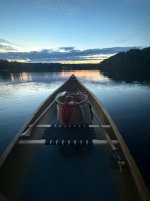
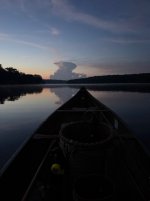
This paddling season I have done most of my paddling on my local lake in the evening. In the past I was typically a morning paddler but this isn't fitting in with my current situation. I have always enjoyed evening paddles but didn't expect they would be my preference now that I haven't been getting out in the morning. I try to get out around sunset, sometime early enough to get some sun and sometime not. Either way I enjoy the twilight.
Twilight lasts about an hour and a half at mid latitudes and is broken into three stages. Civil twilight is right after the sun sets and lasts until the sun is 6 degrees below the horizon. The first stars appear and you don't need artificial lighting to see well enough to do most activities. The next phase is Nautical twilight, when the sun is 6-12 degrees below the horizon. At this point you can paddle without a light, but it's too dark for fishing or most other activities without one. The third phase is Astronomical twilight and last until the sun is 18 degrees below the horizon. The sky is mostly dark with a faint glow in the west. Most of the stars are visible and you need a light to see obstacles like stumps and rocks.
There is also something photographers call the "blue hour." This start about 10 minutes after sunset and sometimes lasts for almost an hour. This is a great time to take photos as it creates interesting light. I've been at vacation spots where people gather to watch and photograph the sunset. Most leave right after the sun goes down and very often miss the best of it. Here is an example of that from a recent vacation.
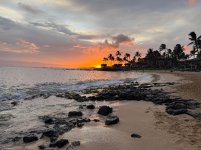
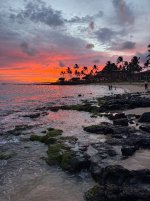
This is a couple minutes past sunset and the next one is almost 15 minutes later.
Paddling in the evening also has other advantages. It is usually more calm after sunset, wildlife is more active, and you typically have the lake to yourself. As the days get shorter I have found that starting in August I do a lot of twilight paddling. It's a great time to add some paddling opportunities.
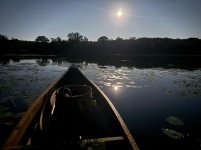
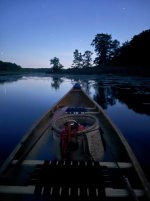
I've already posted some of my better night shots, but here are a few more from my local lake.
Twilight lasts about an hour and a half at mid latitudes and is broken into three stages. Civil twilight is right after the sun sets and lasts until the sun is 6 degrees below the horizon. The first stars appear and you don't need artificial lighting to see well enough to do most activities. The next phase is Nautical twilight, when the sun is 6-12 degrees below the horizon. At this point you can paddle without a light, but it's too dark for fishing or most other activities without one. The third phase is Astronomical twilight and last until the sun is 18 degrees below the horizon. The sky is mostly dark with a faint glow in the west. Most of the stars are visible and you need a light to see obstacles like stumps and rocks.
There is also something photographers call the "blue hour." This start about 10 minutes after sunset and sometimes lasts for almost an hour. This is a great time to take photos as it creates interesting light. I've been at vacation spots where people gather to watch and photograph the sunset. Most leave right after the sun goes down and very often miss the best of it. Here is an example of that from a recent vacation.
This is a couple minutes past sunset and the next one is almost 15 minutes later.
Paddling in the evening also has other advantages. It is usually more calm after sunset, wildlife is more active, and you typically have the lake to yourself. As the days get shorter I have found that starting in August I do a lot of twilight paddling. It's a great time to add some paddling opportunities.
I've already posted some of my better night shots, but here are a few more from my local lake.


