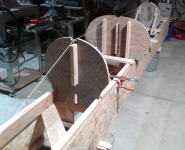
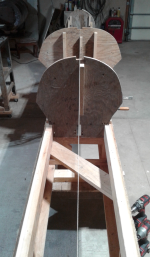
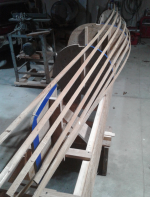
So, it's been over a year. I know I teased some of you over in the winter projects thread. I'm back to the basic hull shape that I attempted to build in this thread.
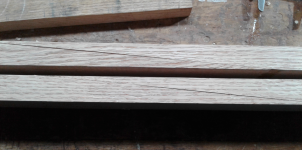
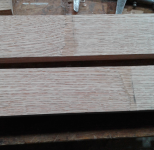
Plenty of contemplation, as well as multiple internet searches, have lead me to the conclusion that plank stock suitable for lapstrake boatbuilding is not available in my area at a cost I could justify. Alternatives considered:
A proper marine plywood would, of course, still be a superior material: probably get similar structural strength with 4mm BS1088, but would the weight savings be worth trippling (or more) the cost? Judge for yourself. For this project, I think not.
Likewise, I did maybe too much thinking about fastening methods. I decided to abandon the rivet method, which was intended to allow natural planks to shift a bit as they expand and contract. Typically, a glued lapstrake is done with epoxy. I went through multiple woodworking shop test reports, comparing pretty much everything from white elmers to polyurethane glues and old stuff like hide, weldwood, or cascamite.
What came out on top for the things I cared about: Titebond III.
Some of you might have feelings about this. Many have probably heard some horror stories. So have I. I looked up as many as I could. Findings among the TBIII failure reports:
I am willing to hear counter-arguments, but please base them on something more than "people say".
Thanks for reading so far - that's more of a wall of text than I intended. Pictures in the next post.
Plenty of contemplation, as well as multiple internet searches, have lead me to the conclusion that plank stock suitable for lapstrake boatbuilding is not available in my area at a cost I could justify. Alternatives considered:
- Elm, suggested by @Alan Gage at the end of the last thread. Very in-keeping with the original intent of the previous build: impact and weather resistant, bends smoothly, very not prone to splitting. Unfortunately, not available anymore. Dutch Elm disease has been rampant through the forests in my region since I was a kid, and in the last decade or so, has reached its ultimate conclusion: For all practical purposes, American Elm is gone. Not "at risk", not "rarer". Just no longer present. As far as I can tell, the resistant hybrid elms have never taken off as a replacement re-plant. They'd take at least a half-century to be worth harvesting. (Forestry Management in the area is mostly hands-off, people don't plant anything, unless they're trying for a walnut grove.)
- Port Orford Cedar would be lovely, but it's a west-coast import. Figure paying as much as you would for furniture-grade hardwood.
- Douglas Fir might do, if I could find any clear. It's almost all construction grade. #1 at best - and a rather poor #1 at that.
- For a while, I thought that I'd be able to get Southern Yellow Pine: Plentiful, grown in quantity on plantations, harder than most pines, (about the hardness of cherry, which isn't hard, but at least more resistant than the white pine junk or NWC, which is mostly what I'd find around here) as well as some rot resistance, and doesn't tend to split. Unfortunately, anything that's imported to the upper midwest is construction grade again. Rare to get anything better than #2. Direct ordering online, I could get clear stuff - for about $4-5 a board foot.
- Ordinary hardware store exterior grade plywood uses the exact same glue as marine grade plywoods (resorcinol formaldehyde - boil-proof)
- Untreated exterior plywood in the US is usually Southern Yellow Pine, which is actually more naturally rot resistant than the mahogany plies in many marine plywoods.
- The real place that the certified marine grade plys are superior is in the arrangement of the plies: BS1088 and similar require more, thinner plies, and have strict rules about joints, knots, and patches in the interior plies.
A proper marine plywood would, of course, still be a superior material: probably get similar structural strength with 4mm BS1088, but would the weight savings be worth trippling (or more) the cost? Judge for yourself. For this project, I think not.
Likewise, I did maybe too much thinking about fastening methods. I decided to abandon the rivet method, which was intended to allow natural planks to shift a bit as they expand and contract. Typically, a glued lapstrake is done with epoxy. I went through multiple woodworking shop test reports, comparing pretty much everything from white elmers to polyurethane glues and old stuff like hide, weldwood, or cascamite.
What came out on top for the things I cared about: Titebond III.
- Tensile strength in wood-wood joints isn't beat even by epoxies. We're talking well over a ton per square inch, and in some tests closing on two. The substrate will fail well before that.
- Properly waterproof. Many years-long unprotected outdoor projects. One short-term boiling test. Not to BS1088 or similar, but I'm not building a yacht that has to hold together while it's on fire. While it says "Not for below-waterline use" our canoes - especially with a waterproofing topcoat - are not ever "below the waterline" in the way they mean.
- Ease of use. It's a wood glue. I can clamp it like one, unlike epoxy that needs to be treated gingerly to prevent overclamping. Water cleanup. Low chances of sensitization.
- It's cheap and available everywhere. Literally at the local mall wart.
Some of you might have feelings about this. Many have probably heard some horror stories. So have I. I looked up as many as I could. Findings among the TBIII failure reports:
- Split about evenly between "Stale Glue" (TBIII does have a shelf life from date of manufacture) and "Bottle got frozen at some point before use." One good thing about these failure modes: they show up immediately upon putting a load of any kind on the glue-up. Not weeks or months of use later. Just do some test pieces and try to break them.
- One outlier where someone glued up some very oily exotic hardwood without using a solvent to strip the surface oil.
- "It's not certified for structural use": Well, neither is any other glue that we use. They're not worth certifying when the companies that are building structual beams already need the kinds of giant clamping and pressing jigs that enable RF, which is much more economical at that scale.
- "Glue Creep" - Yes, TBIII is slightly softer than the alternatives, and will non-elastically deform. When close to its failure strain. Again, if I get anywhere near those kinds of loads, the underlying substrate will be destroyed anyway.
I am willing to hear counter-arguments, but please base them on something more than "people say".
Thanks for reading so far - that's more of a wall of text than I intended. Pictures in the next post.