• Happy National Beach Day!🏖️🏄🏊🐚

Solo Racing Canoe

Joined
Sep 11, 2021
Messages
51
Reaction score
191
Location
West Fork, Arkansas
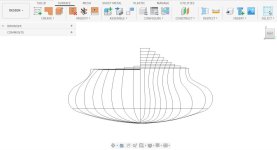
I'll add more information in the coming weeks, but I've been working on a solo racing canoe design. I plan to build this boat and to see how it feels to paddle and if my design goals were achieved. To make this project interesting I’ve been using AI to help me design it. I’ve been using AI more in my job so I thought I would test it with a boat design and see how it comes out. Call it a fun and interesting exercise. I created a preliminary design in Fusion360 (my best guess of what I wanted) and uploaded the file and put in all my parameters such as my paddling weight, estimated finished boat weight, racing items/gear, target cruising speeds, etc., and specifically mentioned the Texas Water Safari and MR340 as target races.

I built a canoe for the Texas Water Safari back in 2018 but it was very skinny and it was tippier than I expected at long distances. After 200 miles my core was shot. I continued to paddle that boat for a few more years before selling it. Since that time I paddled a C1 for years. I have never wanted to race the Safari in a C1 though.

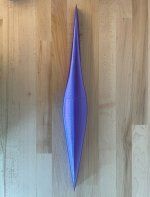
With that said my design is influenced by a C1 style boat but I’ve changed it quite a bit. I’ve removed the main wing (I still have a flare but not as pronounced like C1) and planned for more secondary stability. Of course I’ll have to build it to find out for sure. I’ve tried to take what I liked and disliked about the two boats (homemade solo and C1 Wenonah), and have come up with this design with input from AI. It would run hydrostatics and other calculations based on my inputs and give feedback. I would take those suggestions and change my CAD file and input back into AI. I went though multiple iterations of this intil I ended up with what you see here.

I will have a rudder on this boat and will paddle both single and double blade.

1787973992524.jpeg
1787974056475.jpeg
 

Attachments

  • IMG_6322.jpeg
    IMG_6322.jpeg
    277.4 KB · Views: 8
  • IMG_8858.jpeg
    IMG_8858.jpeg
    176.9 KB · Views: 8
Hi Texas river racer,
I have spend limited time in racing c1's ( and most of that time was in high kneelers. Mainly due to the lack ot these boats nearby. I am still fascinated by them. or bettes said i am fascinated byusing a effecient paddling platfomr that isa joy to paddle when i want to go fast/do a workout. as theree are no races around europe that interres me and have the same rules about the lxw ratio'sthat are in play in us racing. i look wtha cose eye to the people like you that think and do stuff in that direction.
there are 4 designs/boat/concepts that i know of that actually float and are paddled:
1
2
3
4

I look forward to see where ir brings you. I like to manny other things as well to successfully add a boats to this list.I guess someday i will buy or build one. or go the outrigger route, depending on where i live. ir the sea / big waters are the primaly paddling waters the outigger is thesaver route.
 
Hi Texas river racer,
I have spend limited time in racing c1's ( and most of that time was in high kneelers. Mainly due to the lack ot these boats nearby. I am still fascinated by them. or bettes said i am fascinated byusing a effecient paddling platfomr that isa joy to paddle when i want to go fast/do a workout. as theree are no races around europe that interres me and have the same rules about the lxw ratio'sthat are in play in us racing. i look wtha cose eye to the people like you that think and do stuff in that direction.
there are 4 designs/boat/concepts that i know of that actually float and are paddled:
1
2
3
4

I look forward to see where ir brings you. I like to manny other things as well to successfully add a boats to this list.I guess someday i will buy or build one. or go the outrigger route, depending on where i live. ir the sea / big waters are the primaly paddling waters the outigger is thesaver
I uploaded all of John Winters material and formulas into AI which was used to provide feedback during design.

About 7 or 8 years ago I had a Landick2 built for me. I loved it but when I moved into a downtown Houston townhome I didn’t have room for it. I wish I had never sold it.
 
Interesting boat and sounds like a fun project. I'll be interested to see it come to fruition. Are you thinking strip or composite build?

A few years back I embarked on a similar project. I wanted something to bridge the gap in terms of stability and speed between a fast recreational hull (Magic, Advantage, Blackwater) and a J-boat. I could just never get comfortable in my J-boat and there was no room for the dog. Designing was a difficult learning process but very enjoyable. I learned a lot (and subsequently forgot most of it) in the process of working out the design. It was very rewarding to get it on the water and have a boat that filled the niche I was looking for and had no equal in the world (that I'm aware of).

I always thought it would have made a nice long distance racing hull but I got out of competitive paddling before I had a chance to put that to the test.


Another user went all out with a mold and infusion when he built his racing boat:


Alan
 
Interesting boat and sounds like a fun project. I'll be interested to see it come to fruition. Are you thinking strip or composite build?

A few years back I embarked on a similar project. I wanted something to bridge the gap in terms of stability and speed between a fast recreational hull (Magic, Advantage, Blackwater) and a J-boat. I could just never get comfortable in my J-boat and there was no room for the dog. Designing was a difficult learning process but very enjoyable. I learned a lot (and subsequently forgot most of it) in the process of working out the design. It was very rewarding to get it on the water and have a boat that filled the niche I was looking for and had no equal in the world (that I'm aware of).

I always thought it would have made a nice long distance racing hull but I got out of competitive paddling before I had a chance to put that to the test.


Another user went all out with a mold and infusion when he built his racing boat:


Alan
I’m planning on woodstrip for this build. My last racing boat was marine grade foam that I skinned with Kevlar outside and in.

Since I’m not sure how I’ll like it until I paddle it one day, I don’t want to go to the trouble of a composite build.

I’ve seen the thread on the adventure race composite build which is amazing.

I’ll probably make a strong back and the station forms this year but with me planning on some big races next year I need to focus on training vs canoe building. Once the season is over I’ll shift to boat building.

A bucket list item for me is to complete the Texas Water Safari solo in a boat that I build. I’m about to turn 60 and my window for races like that is slowly closing so I’ll need to complete this boat sooner than later.
 
the regret of sold boats I can relate to. but alos the joy a number of people have with boats I sold to them.
enjoy the paddling in your current boat and the new one.
 
I believe Alan built a J. Winters Barracuda. I did as well. It wasn't a boat I liked, even though I really wanted too. Alan probably has a more refined opinion than mine.
 
I believe Alan built a J. Winters Barracuda. I did as well. It wasn't a boat I liked, even though I really wanted too. Alan probably has a more refined opinion than mine.

I still have it and it's probably my favorite boat for day paddles on flat water. The low sheer makes switches very easy and relaxed. It just wasn't as fast as I was looking for at the time. It's slightly quicker than hulls like the Magic but just marginally. Not something I'd want to paddle when tripping or on an adventure race though. I think it would take on water pretty easily.

Alan
 
Design Objective: Create a solo boat that I build and race. Specifically in the Texas Water Safari. The boat will have a rudder and be used in the unlimited class but could be paddled rudderless if desired.

I have plans for a solo racing canoe and plans for a solo tripping boat. Is it possible to blend the two

  • C1: extremely fine entry, low wetted surface, optimized for maximum flatwater speed at racing trim. The bow is very slender, with the widest point occurring well aft because of marathon racing rules.
  • Tripping solo: intended as an all-around cruising and tripping canoe, with more volume, more forgiving stability, better load carrying, and better behavior in waves.
My thought was what if I could somehow blend to two boats resulting in good cruising speed (not as fast as the C1), but pick up some of the forgiving stability (not as stable as the solo tripping canoe) so that I get a boat that works for my needs.

The last boat I built was fast but not as stable as it should have been. My previous C1 was raced for years but not for the Safari and I want more secondary stability. If I can design a boat that is slower than a racing canoe but more stable, I'll be more comfortable and overall faster in the boat over 260 miles compared to previous canoes.

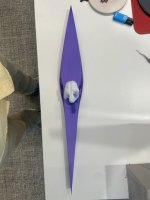
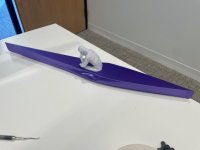
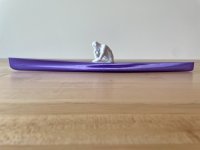
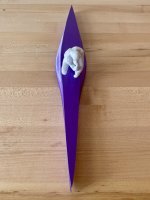
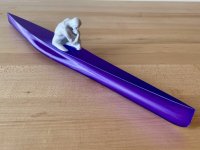
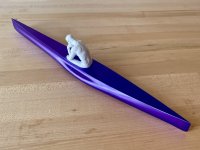
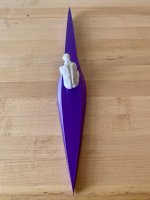
After I post this, I'll find some pictures of a hybrid design I put into CAD last year but had no idea what it might behave like. I 3D printed a scaled model that has been on my desk.

Over the past 1-2 years I've been using AI more in my job (not a lot) to be more efficient. I've been very impressed with how it has worked for me. I mainly use ChatGPT but I've dabbled in Claude. This year I went from using the free ChatGPT to the paid version.

Recently I decided to see what would happen if I tried to design a canoe in both platforms from the ground up and I didn't like what it was producing. The waterline may have been fine but both kept producing some strange hard chines in the hulls.

I decided to ditch that approach list specs for the C1 and tripping canoe. I input that the boat would be a hybrid of two designs and gave specs for both boats. I stated that when racing I normally weight 180lbs, was targeting a finished rigged boat weight of 40lbs, and gear would be dependent on what race I was doing. I put in a maximum displacement of 250-260lbs. Once all the data was input I hit enter.

After processing the data, AI came back with the following:

If you use the C1 front and Solo Tripper rear


This is actually the combination I would choose if I had to make a hybrid.


What will likely improve


Excellent entry


  • The C1 bow should reduce wave-making resistance.
  • It should feel noticeably easier to accelerate than the Solo Tripper.
  • At cruising speeds (3–5 mph) you'll probably gain some efficiency.

Dryer ride


  • The taller, finer racing bow tends to split waves nicely.

Good tracking


  • The C1 forebody resists wandering.
  • The Solo stern should still release reasonably well.

What you'll probably lose


Top-end speed


  • The Solo stern creates more turbulence than the racing stern.
  • At race speeds the stern contributes a surprising amount to total drag.

Perfect trim balance


  • The two hulls were designed around different longitudinal volume distributions.
  • Unless the splice occurs at identical station shapes, the canoe's center of buoyancy will shift.

That means seat location will probably need to move several inches from where either set of plans specifies.


Stability


I actually think stability may improve.


The racing canoe's instability comes primarily from:


  • narrow waterline
  • small midship volume
  • rounded sections

The Solo stern carries more immersed volume and generally broader sections.


My guess:


  • Initial stability: better than the C1
  • Secondary stability: close to the Solo
  • Overall: somewhere between the two


Turning


I'd expect


  • better than the C1
  • worse than the Solo

The bow will "lock on" to a course more strongly than the Solo.


One thing that worries me


The biggest engineering issue isn't hydrodynamics.


It's fairness of the hull.


If you literally cut the molds in half and join them:


  • rocker may change abruptly
  • keel line may develop a kink
  • chine flow may become unfair
  • waterline may have a bump

Even a 1/4-inch discontinuity can create considerably more drag than you'd expect.


Professional designers spend a lot of time ensuring the curvature changes smoothly.


A better splice location


Instead of joining exactly at center, I'd splice where the two boats have nearly identical sections.


Usually that's around


  • 45–55% of waterline length.

I'd compare:


  • section width
  • section depth
  • deadrise
  • rocker tangent

If the sections match closely, the transition can almost disappear.


What I would expect on the water


Compared to the Solo Tripper:


  • Cruising speed: 3–8% faster
  • Acceleration: noticeably quicker
  • Tracking: better
  • Load capacity: slightly reduced
  • Maneuverability: slightly reduced

Compared to the Marathon C1:


  • slower
  • much easier to paddle for long periods
  • much more forgiving
  • more capable with camping gear
I decided to process this information and come back to it after sleeping on it a day or two.

Next will be pics of the boat I drew up last year, combining the two boat mentioned already.
 
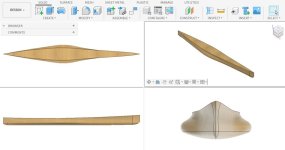
This is what I drew up last year. The areas around the seating position didn’t blend the way I wanted in my CAD program but I didn’t worry about fixing as I wasn’t going to build this boat as drawn. I knew there would be work needed.IMG_8455.jpegIMG_8456.jpeg
 
After the preliminary information that was provided I input all data and information I could fine related to John Winter's canoe design so that information and formulas would factor in. Other items I include were drawings of the two canoes I was referencing with a ruler in each image so that scale could be referenced.

This is what AI replied to my model:

C1 → begin blend → replace wing with naturally increasing Solo-derived section → Solo-derived stern

In other words, the hybrid shouldn't have a wing at all.
The waterline and sheer should simply flow through that region.
That could produce a really elegant hull.

Length presents us with a choice​

We have:
C1 = 221.5"
versus
Solo = 204"
That's a 17.5" difference.
I would not automatically shorten the C1 bow to make a 17' canoe.
Quite the opposite.
For this experiment I'd probably retain most of the C1's waterline length and make the resulting boat somewhere around:

17'9"–18'3"​

rather than 17'.
My first candidate would probably be around 18'0".
That preserves much of what you're after—the extraordinarily fine C1 entry and long waterline—but eliminates some wetted area and makes the boat less extreme.
Winters' warning is relevant here: extra length doesn't automatically mean less resistance because the additional wetted surface raises frictional resistance.
An 18-footer is therefore an interesting compromise.

I'd keep the C1 bow almost sacred​

Seeing the actual lines makes me even more convinced about this.
I wouldn't "average" the first 35–40% of these boats.
I'd use the C1 bow essentially unchanged.
That's the part of the design you're buying with this experiment.
The Solo's bow is already quite good, but if we're going to replace the C1 bow with 30% Solo influence, we're gradually designing our way back toward the Solo Tripper.
Instead:
C1 bow → C1 forebody → new midbody → Solo-derived afterbody → Solo stern
That has a clear design rationale.

But I'd modify the Solo stern somewhat​

This is where I differ from your original "back half of the Solo" idea.
I'd like the final stern to retain the Solo's section character and lateral plane, but be slightly finer.
Something like:
100% Solo section shape × ~95–97% transverse scale
may turn out to be appropriate.
That could pull the final waterline beam and wetted area downward without eliminating the stern's stabilizing characteristics.
We don't know the appropriate scaling yet, but the idea is important.

I think we can establish some preliminary targets​

If I were writing a design brief before drawing the first new station, I'd currently use approximately:
CharacteristicInitial target
LOA~18'0"
Design displacement230–245 lb
Draft~3.0–3.2"
BWL~28.0–28.5"
Cp~0.52–0.54
Wetted surface~23–24.5 ft²
Stability factorbetween 49 and 92; hopefully ~65–75
LCB~2–4% aft of center
Bowessentially C1
Midbodynew
SternSolo-derived, slightly refined
C1 racing wingeliminate
I wouldn't treat those as specifications yet. They're targets against which we can judge our first hull.
 
I'm going to keep the AI information simple at this point but there was a lot of back and forth information based on the feedback I received and what I would reply with (off and on over several days). Once I thought I was getting closer, I decided to load the model I designed last year (the 3D printed photos) to see what response I would get.

AI Response:

I analyzed the OBJ you uploaded against the criteria we've been developing. The result is more encouraging than I expected: the basic literal C1-front/Solo-back combination is quite close to several of our target numbers already. The main problem is not displacement or overall beam—it is the longitudinal fairness and volume transition near the splice.
I treated the OBJ units as centimeters, which makes the hull 563.9 cm = 18'6" long. That matches the C1 overall length almost exactly, so the scale appears sound.
Here is how the uploaded hull compares with the design we've been discussing:
ParameterUploaded literal hybridPrevious engineered targetComment
LOA18'6"~18'–18'4"Fine for Unlimited racing
255-lb draft~3.22"~3.2"Excellent
Max BWL @ 255 lb~28.15"~28.2"Almost exact
Max immersed section~62.27 in²~62.1 in²Almost exact
Cp~0.515~0.52–0.526More C1/race-like
LCB~10.5" aft of midships~6.6" aftToo far aft
LWL @ 255 lb~18'4.4"long as practicalExcellent
Weight to immerseroughly 106 lb/in~110-ish expectedReasonable
Those similarities are striking. Without intentionally designing to our hydrostatic targets, you've ended up very close on draft, maximum waterline beam, maximum sectional area, and displacement proportions.
That's a strong indication that the basic idea itself is viable.

The major issue is visible in the design waterline​

This is where I would focus your Fusion fairing effort.
Moving from the bow toward the stern, the current 255-lb DWL looks approximately like this around the middle of the boat:
% of hull from bowFull BWL
40.0%15.6"
42.5%16.8"
45.0%18.3"
47.5%19.9"
50.0%22.1"
52.5%24.6"
55.0%27.5"
57.5%27.9"
60.0%27.2"
62.5%26.3"
65.0%25.2"
That's the part I don't like.
The hull is still only about 22.1" wide at the design waterline at geometric midships, and then expands to about 27.5" only ~11" farther aft.
So most of the Solo Tripper's volume arrives relatively abruptly.
That's exactly the sort of thing Winters warns us to examine with the curve of sectional areas rather than judging the hull solely from its visible waterline; how rapidly displacement is introduced along the hull matters significantly.

This is where I'd blend—not everywhere​

I would not radically change the bow.
I would not radically change the Solo stern.
I would concentrate almost all of your Fusion work roughly between:

45% and 62% of hull length​

with the greatest correction around:

49–56%​

The current transition basically goes:
very fine C1 → narrow C1 middle → rapidly expanding Solo section → full Solo afterbody
I'd change it to:
very fine C1 → gradually filling C1 → hybrid maximum-section region → Solo afterbody
That sounds subtle, but geometrically it's a meaningful difference.

The waterline I'd aim for​

Our previous engineered version around this region was approximately:
24.8 → 26.5 → 27.8 → 28.2 → 27.9 → 26.8 → 25.1"
over successive 12" stations.
I would not force this new hull exactly onto those dimensions. I like the fact that the literal hybrid naturally ended up at Cp ≈ 0.515.
Instead, I'd split the difference.
For this hull I'd try a waterline progression around the center more like:
Hull position from bowCurrentSuggested fairing target
45%18.3"~19–20"
47.5%19.9"~21–22"
50%22.1"~24–25"
52.5%24.6"~26–27"
55%27.5"~27.7–28.0"
57.5%27.9"~28.0"
60%27.2"~27.2–27.5"
That means you're adding breadth to the C1 side of the transition rather than widening the Solo side further.
That is exactly how I'd fair this version.

Think of it as pulling the Solo forward​

Instead of pushing the C1 sternward into the Solo, conceptually do the opposite:
Extend the Solo Tripper's shoulder and volume progressively forward into the C1.
Leave the extreme C1 forebody alone.
That will make the area curve develop gradually rather than suddenly.

LCB is the second issue​

The calculated LCB on the current hull is approximately:

10.5" aft of geometric center​

Our previous target was about:

6–7" aft​

I'm not alarmed by 10.5", especially because you're using a slider seat and will trim with external waterline marks.
But I would still reduce it.
Fortunately, the same modification that improves the waterline does exactly that.
Adding some sectional area around 48–53% of length, forward of the present maximum-volume region, will shift buoyancy forward.
So I would not try to solve LCB independently.
Fair the transition properly first. I suspect LCB will naturally move from ~10.5" aft toward 7–8" aft, which I'd consider excellent for this boat.
Your sliding seat can deal with the rest.

Cp is interesting​

Your current hull calculates to roughly:

Cp ≈ 0.515​

Compare:
  • original C1: 0.505
  • literal hybrid: ~0.515
  • our earlier optimized hybrid: ~0.526
  • Solo Tripper: 0.565
For your TWS/MR340 application, I'm inclined to keep this new design nearer 0.515–0.520 rather than deliberately pushing it back toward .526.
Why?
Because this new hull already has:
  • almost exactly our desired waterline beam,
  • almost exactly our required maximum section,
  • adequate 255-lb displacement,
  • an extremely long waterline,
  • and the rudder removes some of the need for additional stern fullness.
So I'd let this version remain more C1-like.
Winters' discussion makes the broader point that longitudinal coefficient/fullness has to be matched to intended speed rather than assuming fuller or finer is universally better.
For an Unlimited endurance racer, ~.515–.520 strikes me as worth exploring.

The 18'6" length doesn't bother me​

Earlier I was talking about ~18'0".
Having now evaluated this actual hull, I wouldn't shorten it simply to meet that earlier idea.
At 255 lb, I'm getting an estimated waterline length of approximately:

18'4.4"​

That's excellent.
You're using the length rather than carrying decorative overhang.
The downside is increased wetted surface/friction, which Winters correctly emphasizes is the penalty associated with adding length.
But you're designing specifically for very long endurance races and aren't constrained by C1 class dimensions. I'd leave it 18'6" for now and only revisit length if later resistance modeling gives us a compelling reason.

I also like the stern more than I expected​

This was my biggest uncertainty when you proposed the literal hybrid.
I expected the Solo stern might look excessively full relative to the C1 bow.
Numerically, it doesn't.
At 255 lb the stern-side area distribution tapers down fairly steadily. The real concentration of fullness is around the maximum-section/transition area, not all the way aft.
Because you'll have an over-stern rudder, I might ultimately fine the last third very slightly, but that's a secondary refinement.
I would absolutely deal with the midbody transition first.

What I'd change in Fusion 360​

If this were my Fusion file, I would preserve the stem and much of the parent geometry and work with a handful of longitudinal guide curves.
I would put strong attention on four curves:
1. Design waterline
This is the most important one. Remove the rapid increase in breadth around 50–55%.
2. Waterline approximately 2" above DWL
This controls much of the useful fatigue stability. It should transition toward the Solo shoulder earlier than the current splice does.
3. Lower bilge/buttock lines
Don't just widen the waterline. Start introducing some Solo-derived fullness lower in the section so the cross-sectional area increases smoothly.
4. Sheer / maximum-beam line
This should look almost boringly fair. No hint that two different boats were joined.
And I'd repeatedly inspect the model using curvature combs, not merely shaded surfaces. A hull can look perfectly smooth in rendered mode while still having a nasty acceleration in curvature.

My preferred revised geometry​

I'd now characterize the design roughly this way:
0–40%: essentially C1
40–47%: very subtle transition
47–55%: primary blending zone
55–62%: Solo-dominant but still being faired
62–100%: predominantly Solo Tripper, with perhaps minor race-oriented refinement later
That is considerably closer to your original idea than our earlier highly engineered version was.

And I think that's a good thing.​

The hydrostatic analysis of your actual OBJ suggests that the original instinct—C1 front, Solo back—is fundamentally sound.
What it needs isn't a complete redesign.
It needs a better marriage in the middle.
The most significant change I'd make is to fill the current narrow C1 section before it reaches the Solo, creating a long gradual increase toward the ~28.1" maximum BWL. If you can accomplish that while keeping the final hull near roughly Cp .515–.520, LCB 7–8" aft, BWL ~28.1", draft ~3.2" at 255 lb, I think this version may actually be a better direction for your race boat than the more heavily modified V3 concept we developed earlier.

I'm done posting tonight. I'll pick up with more information in the next day or two.

 
Back
Top Bottom