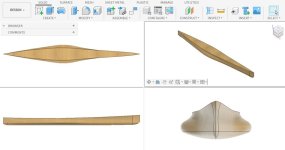
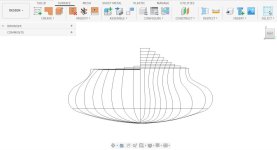
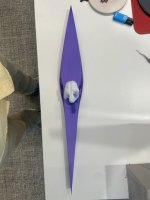
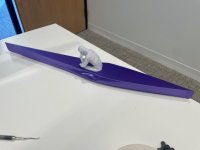
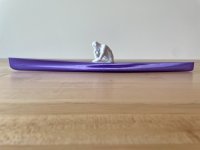
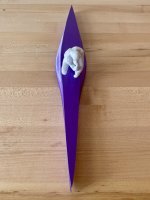
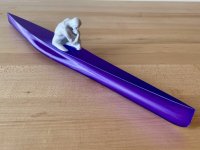
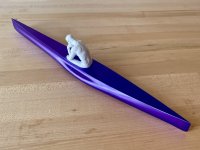
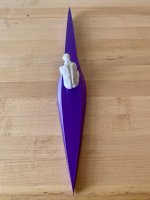
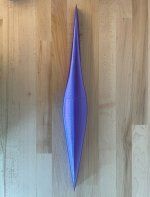
I'm going to keep the AI information simple at this point but there was a lot of back and forth information based on the feedback I received and what I would reply with (off and on over several days). Once I thought I was getting closer, I decided to load the model I designed last year (the 3D printed photos) to see what response I would get.
AI Response:
I analyzed the OBJ you uploaded against the criteria we've been developing. The result is more encouraging than I expected:
the basic literal C1-front/Solo-back combination is quite close to several of our target numbers already. The main problem is not displacement or overall beam—it is the longitudinal fairness and volume transition near the splice.
I treated the OBJ units as centimeters, which makes the hull
563.9 cm = 18'6" long. That matches the C1 overall length almost exactly, so the scale appears sound.
Here is how the uploaded hull compares with the design we've been discussing:
| Parameter | Uploaded literal hybrid | Previous engineered target | Comment |
|---|
| LOA | 18'6" | ~18'–18'4" | Fine for Unlimited racing |
| 255-lb draft | ~3.22" | ~3.2" | Excellent |
| Max BWL @ 255 lb | ~28.15" | ~28.2" | Almost exact |
| Max immersed section | ~62.27 in² | ~62.1 in² | Almost exact |
| Cp | ~0.515 | ~0.52–0.526 | More C1/race-like |
| LCB | ~10.5" aft of midships | ~6.6" aft | Too far aft |
| LWL @ 255 lb | ~18'4.4" | long as practical | Excellent |
| Weight to immerse | roughly 106 lb/in | ~110-ish expected | Reasonable |
Those similarities are striking. Without intentionally designing to our hydrostatic targets, you've ended up very close on
draft, maximum waterline beam, maximum sectional area, and displacement proportions.
That's a strong indication that the basic idea itself is viable.
The major issue is visible in the design waterline
This is where I would focus your Fusion fairing effort.
Moving from the
bow toward the stern, the current 255-lb DWL looks approximately like this around the middle of the boat:
| % of hull from bow | Full BWL |
|---|
| 40.0% | 15.6" |
| 42.5% | 16.8" |
| 45.0% | 18.3" |
| 47.5% | 19.9" |
| 50.0% | 22.1" |
| 52.5% | 24.6" |
| 55.0% | 27.5" |
| 57.5% | 27.9" |
| 60.0% | 27.2" |
| 62.5% | 26.3" |
| 65.0% | 25.2" |
That's the part I don't like.
The hull is still only about
22.1" wide at the design waterline at geometric midships, and then expands to about
27.5" only ~11" farther aft.
So most of the Solo Tripper's volume arrives relatively abruptly.
That's exactly the sort of thing Winters warns us to examine with the
curve of sectional areas rather than judging the hull solely from its visible waterline; how rapidly displacement is introduced along the hull matters significantly.
This is where I'd blend—not everywhere
I would
not radically change the bow.
I would
not radically change the Solo stern.
I would concentrate almost all of your Fusion work roughly between:
45% and 62% of hull length
with the greatest correction around:
49–56%
The current transition basically goes:
very fine C1 → narrow C1 middle → rapidly expanding Solo section → full Solo afterbody
I'd change it to:
very fine C1 → gradually filling C1 → hybrid maximum-section region → Solo afterbody
That sounds subtle, but geometrically it's a meaningful difference.
The waterline I'd aim for
Our previous engineered version around this region was approximately:
24.8 → 26.5 → 27.8 → 28.2 → 27.9 → 26.8 → 25.1"
over successive 12" stations.
I would
not force this new hull exactly onto those dimensions. I like the fact that the literal hybrid naturally ended up at Cp ≈
0.515.
Instead, I'd split the difference.
For this hull I'd try a waterline progression around the center more like:
| Hull position from bow | Current | Suggested fairing target |
|---|
| 45% | 18.3" | ~19–20" |
| 47.5% | 19.9" | ~21–22" |
| 50% | 22.1" | ~24–25" |
| 52.5% | 24.6" | ~26–27" |
| 55% | 27.5" | ~27.7–28.0" |
| 57.5% | 27.9" | ~28.0" |
| 60% | 27.2" | ~27.2–27.5" |
That means you're
adding breadth to the C1 side of the transition rather than widening the Solo side further.
That is exactly how I'd fair this version.
Think of it as pulling the Solo forward
Instead of pushing the C1 sternward into the Solo, conceptually do the opposite:
Extend the Solo Tripper's shoulder and volume progressively forward into the C1.
Leave the extreme C1 forebody alone.
That will make the area curve develop gradually rather than suddenly.
LCB is the second issue
The calculated LCB on the current hull is approximately:
10.5" aft of geometric center
Our previous target was about:
6–7" aft
I'm not alarmed by 10.5", especially because you're using a slider seat and will trim with external waterline marks.
But I would still reduce it.
Fortunately, the same modification that improves the waterline does exactly that.
Adding some sectional area around
48–53% of length, forward of the present maximum-volume region, will shift buoyancy forward.
So I would
not try to solve LCB independently.
Fair the transition properly first. I suspect LCB will naturally move from ~10.5" aft toward
7–8" aft, which I'd consider excellent for this boat.
Your sliding seat can deal with the rest.
Cp is interesting
Your current hull calculates to roughly:
Cp ≈ 0.515
Compare:
- original C1: 0.505
- literal hybrid: ~0.515
- our earlier optimized hybrid: ~0.526
- Solo Tripper: 0.565
For your TWS/MR340 application, I'm inclined to
keep this new design nearer 0.515–0.520 rather than deliberately pushing it back toward .526.
Why?
Because this new hull already has:
- almost exactly our desired waterline beam,
- almost exactly our required maximum section,
- adequate 255-lb displacement,
- an extremely long waterline,
- and the rudder removes some of the need for additional stern fullness.
So I'd let this version remain more C1-like.
Winters' discussion makes the broader point that longitudinal coefficient/fullness has to be matched to intended speed rather than assuming fuller or finer is universally better.
For an Unlimited endurance racer,
~.515–.520 strikes me as worth exploring.
The 18'6" length doesn't bother me
Earlier I was talking about ~18'0".
Having now evaluated this actual hull, I wouldn't shorten it simply to meet that earlier idea.
At 255 lb, I'm getting an estimated waterline length of approximately:
18'4.4"
That's excellent.
You're using the length rather than carrying decorative overhang.
The downside is increased wetted surface/friction, which Winters correctly emphasizes is the penalty associated with adding length.
But you're designing specifically for very long endurance races and aren't constrained by C1 class dimensions. I'd leave it
18'6" for now and only revisit length if later resistance modeling gives us a compelling reason.
I also like the stern more than I expected
This was my biggest uncertainty when you proposed the literal hybrid.
I expected the Solo stern might look excessively full relative to the C1 bow.
Numerically, it doesn't.
At 255 lb the stern-side area distribution tapers down fairly steadily. The real concentration of fullness is around the maximum-section/transition area, not all the way aft.
Because you'll have an over-stern rudder, I might ultimately fine the last third very slightly, but that's a
secondary refinement.
I would absolutely deal with the midbody transition first.
What I'd change in Fusion 360
If this were my Fusion file, I would preserve the stem and much of the parent geometry and work with a handful of longitudinal guide curves.
I would put strong attention on four curves:
1. Design waterline
This is the most important one. Remove the rapid increase in breadth around 50–55%.
2. Waterline approximately 2" above DWL
This controls much of the useful fatigue stability. It should transition toward the Solo shoulder earlier than the current splice does.
3. Lower bilge/buttock lines
Don't just widen the waterline. Start introducing some Solo-derived fullness lower in the section so the cross-sectional area increases smoothly.
4. Sheer / maximum-beam line
This should look almost boringly fair. No hint that two different boats were joined.
And I'd repeatedly inspect the model using
curvature combs, not merely shaded surfaces. A hull can look perfectly smooth in rendered mode while still having a nasty acceleration in curvature.
My preferred revised geometry
I'd now characterize the design roughly this way:
0–40%: essentially C1
40–47%: very subtle transition
47–55%: primary blending zone
55–62%: Solo-dominant but still being faired
62–100%: predominantly Solo Tripper, with perhaps minor race-oriented refinement later
That is considerably closer to your original idea than our earlier highly engineered version was.
And I think that's a good thing.
The hydrostatic analysis of your actual OBJ suggests that
the original instinct—C1 front, Solo back—is fundamentally sound.
What it needs isn't a complete redesign.
It needs a
better marriage in the middle.
The most significant change I'd make is to fill the current narrow C1 section
before it reaches the Solo, creating a long gradual increase toward the ~28.1" maximum BWL. If you can accomplish that while keeping the final hull near roughly
Cp .515–.520, LCB 7–8" aft, BWL ~28.1", draft ~3.2" at 255 lb, I think this version may actually be a better direction for your race boat than the more heavily modified V3 concept we developed earlier.
I'm done posting tonight. I'll pick up with more information in the next day or two.