In prep for my week in the Jersey Pine Barrens, one short paddle last week was not enough for me to familiarize myself with the Illusion. But windy and other bad weather has kept me off the water. So, to beat the wind, I paddled early this morning from my local put-in on the Housatonic River — Addis Park (where @Pseudonym went huli in a torrential downpour).
Arghh! The boat ramp is corrugated concrete. Bye, bye, virgin Textreme bottom.
Instead of paddling downstream through Lovers Leap Gorge, I paddled upstream to the low head dam, then turned around and went downstream to the Still River, which comes in on river right at the bottom of this map:

The water started out glass, and I saw a sculler paddling to the GMS Rowing Center.
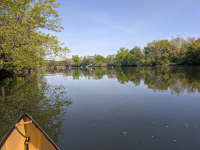
Do you see him putting his shell on his shoulder. It may even be lighter than my 21.8 lb (9.8 kg) Illusion.
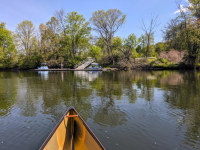
Continuing upstream, the wind picks up and I see the low head dam.
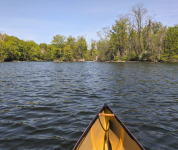
It has drowned people. I'm not getting close with my tender Illusion, but I can feel the roiling current.
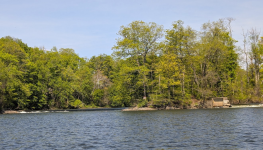
Turning around to go downstream, I see a train slowly going over the trestle.
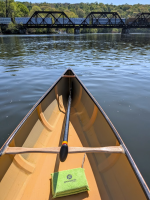
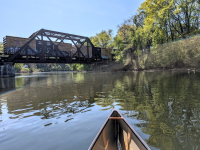
This train follows the river for a while. Clickety-clack. Rumble, rumble. Squealing of brakes. It must stop in New Milford to drop something off.
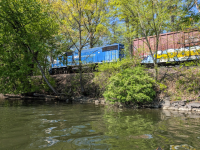
I tucked into a wood-choked side creek and it passed me again.
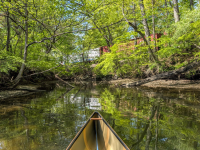
I finally reach the confluence with the Still River, a tributary of the Housatonic sometimes called "Nile of New Milford" because it flows north. It was once severely polluted but is now somewhat better. I turn into the Still to paddle upstream under the train tracks. No sign of the choo-choo anymore.
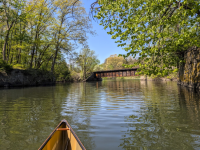
I approach a road bridge on the way to Harrybrook Park. The water has flecks of foam all over. A tattooed and be-ringed girl is watching a fish on the other side of the bridge. I express wonder that a fish can live in this water.
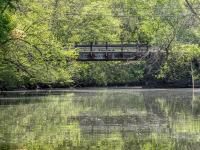
Further upstream, I see Harrybrook Rapid, which churns the water into foam. The foam could be caused by dissolved organic matter, which is particularly likely after windy days when plants are losing their buds or leaves in the spring and fall. In any event, the rapid blocks further upstream travel for me.
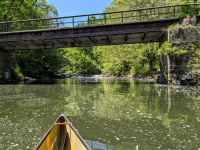
But I approach closer because this is a play spot. There are good eddies on both sides of the river below the rapid. I've often practiced ferrying from one side of the river to the other and peeling out.
Dare I do that in the Illusion, which has tender initial stability and secondary stability that I've not yet stress tested? Oh, why not! The ferrying is easy in the Illusion, but I was very careful with the peel-outs because I'm still learning the Illusion's personality and also because my balance in my ninth decade is not as superlative as it used to be.
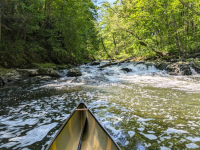
After that play, I paddle back down the Still and up the Housatonic to the put-in at Addis Park. A stiff wind was now up and was at my back the entire time, so it didn't take me long to get back.
I'll do a full performance review of the Illusion after my Pine Barrens trip next week. But some things are clear to me already. The Illusion turns easier than my Bell black-gold Wildfire. It doesn't seem to have as much keel rocker as the Wildfire, but with its bubble-sided tumblehome, it has more chine and side rocker than the shouldered Wildfire.
The Wildfire has more initial stability than the Illusion and can be paddled sitting. It would be more of a balancing act to paddle the Illusion sitting, which I only tried in shallow water near the shore. Of course, Savage River can make an Illusion for half the weight of a Bell Wildfire, and four or five pounds less than a Swift Wildfire of similar strength.
You have to have a very good arsenal of single-sided corrections to paddle the Illusion forward, especially in wind, because it is so turny-responsive to every stroke. That's a feature not a bug. If you have very good and automatic correction stroke sensitivity, a light correction can bring the boat immediately back on track. In other words, it is very easy to track if you are an accomplished single-sided corrector. If you're not, the Illusion will teach you if you don't get frustrated.
WIND! The Illusion is a good wind boat from all quarters. Being perfectly symmetrical in all dimensions in the Freestyle Package — unlike the asymmetrical sheer line of the Standard Package (and Wildfire) — the canoe is very predictable in the wind. It's affected, of course, but predictably affected — unlike many asymmetrical hulls, such as my Hemlock SRT, which goes all weirdo in rear quartering winds. Its easy turnability makes the Illusion significantly above average to nudge back on track in wind if you have sensitive water feel and automatic corrective reactions.
Back to the corrugated concrete of the boat ramp. Because my legs have lost strength with age, I have difficulty standing up to exit the canoe while attempting to keep it stable and not scratching the bottom. This isn't the best news for me, but hopefully is irrelevant for thee.
Arghh! The boat ramp is corrugated concrete. Bye, bye, virgin Textreme bottom.
Instead of paddling downstream through Lovers Leap Gorge, I paddled upstream to the low head dam, then turned around and went downstream to the Still River, which comes in on river right at the bottom of this map:
The water started out glass, and I saw a sculler paddling to the GMS Rowing Center.
Do you see him putting his shell on his shoulder. It may even be lighter than my 21.8 lb (9.8 kg) Illusion.
Continuing upstream, the wind picks up and I see the low head dam.
It has drowned people. I'm not getting close with my tender Illusion, but I can feel the roiling current.
Turning around to go downstream, I see a train slowly going over the trestle.
This train follows the river for a while. Clickety-clack. Rumble, rumble. Squealing of brakes. It must stop in New Milford to drop something off.
I tucked into a wood-choked side creek and it passed me again.
I finally reach the confluence with the Still River, a tributary of the Housatonic sometimes called "Nile of New Milford" because it flows north. It was once severely polluted but is now somewhat better. I turn into the Still to paddle upstream under the train tracks. No sign of the choo-choo anymore.
I approach a road bridge on the way to Harrybrook Park. The water has flecks of foam all over. A tattooed and be-ringed girl is watching a fish on the other side of the bridge. I express wonder that a fish can live in this water.
Further upstream, I see Harrybrook Rapid, which churns the water into foam. The foam could be caused by dissolved organic matter, which is particularly likely after windy days when plants are losing their buds or leaves in the spring and fall. In any event, the rapid blocks further upstream travel for me.
But I approach closer because this is a play spot. There are good eddies on both sides of the river below the rapid. I've often practiced ferrying from one side of the river to the other and peeling out.
Dare I do that in the Illusion, which has tender initial stability and secondary stability that I've not yet stress tested? Oh, why not! The ferrying is easy in the Illusion, but I was very careful with the peel-outs because I'm still learning the Illusion's personality and also because my balance in my ninth decade is not as superlative as it used to be.
After that play, I paddle back down the Still and up the Housatonic to the put-in at Addis Park. A stiff wind was now up and was at my back the entire time, so it didn't take me long to get back.
I'll do a full performance review of the Illusion after my Pine Barrens trip next week. But some things are clear to me already. The Illusion turns easier than my Bell black-gold Wildfire. It doesn't seem to have as much keel rocker as the Wildfire, but with its bubble-sided tumblehome, it has more chine and side rocker than the shouldered Wildfire.
The Wildfire has more initial stability than the Illusion and can be paddled sitting. It would be more of a balancing act to paddle the Illusion sitting, which I only tried in shallow water near the shore. Of course, Savage River can make an Illusion for half the weight of a Bell Wildfire, and four or five pounds less than a Swift Wildfire of similar strength.
You have to have a very good arsenal of single-sided corrections to paddle the Illusion forward, especially in wind, because it is so turny-responsive to every stroke. That's a feature not a bug. If you have very good and automatic correction stroke sensitivity, a light correction can bring the boat immediately back on track. In other words, it is very easy to track if you are an accomplished single-sided corrector. If you're not, the Illusion will teach you if you don't get frustrated.
WIND! The Illusion is a good wind boat from all quarters. Being perfectly symmetrical in all dimensions in the Freestyle Package — unlike the asymmetrical sheer line of the Standard Package (and Wildfire) — the canoe is very predictable in the wind. It's affected, of course, but predictably affected — unlike many asymmetrical hulls, such as my Hemlock SRT, which goes all weirdo in rear quartering winds. Its easy turnability makes the Illusion significantly above average to nudge back on track in wind if you have sensitive water feel and automatic corrective reactions.
Back to the corrugated concrete of the boat ramp. Because my legs have lost strength with age, I have difficulty standing up to exit the canoe while attempting to keep it stable and not scratching the bottom. This isn't the best news for me, but hopefully is irrelevant for thee.