

A lot has been written here about paddling with alligators in Florida (and other southeastern states), with many northerners commenting that paddling among gators would be scary. Although a gator sank my outrigger canoe once, they don't usually bother me physically or psychologically. I've always been more mentally concerned about Florida's six species of venomous snakes, even though I have encountered them far, far less than gators. After all, the danger of snakes is as old as Adam and Eve.
Here's an article about Florida's venomous snakes and how to differentiate them.
"Florida is home to about 50 species of native snakes, six of which are venomous (snakes are not poisonous—"poisonous" refers to something that is toxic when ingested). The venomous species include five pit vipers (eastern diamondback rattlesnake, timber rattlesnake, pygmy rattlesnake, copperhead, and cottonmouth) and the coral snake. Copperheads and timber rattlesnakes have a limited range in Florida. Copperheads only occur in a small area just west of Tallahassee as well as in a few counties in the western Panhandle, and timber rattlesnakes are usually only found in northern Florida as far south as Gainesville, although there are few known a little further south. The other three venomous species are found throughout the state. Florida's venomous snakes occur in a variety of natural habitats, ranging from swamps to dry woods."
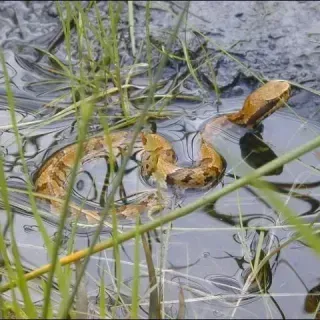
 ask.ifas.ufl.edu
Here's an article about Florida's venomous snakes and how to differentiate them.
"Florida is home to about 50 species of native snakes, six of which are venomous (snakes are not poisonous—"poisonous" refers to something that is toxic when ingested). The venomous species include five pit vipers (eastern diamondback rattlesnake, timber rattlesnake, pygmy rattlesnake, copperhead, and cottonmouth) and the coral snake. Copperheads and timber rattlesnakes have a limited range in Florida. Copperheads only occur in a small area just west of Tallahassee as well as in a few counties in the western Panhandle, and timber rattlesnakes are usually only found in northern Florida as far south as Gainesville, although there are few known a little further south. The other three venomous species are found throughout the state. Florida's venomous snakes occur in a variety of natural habitats, ranging from swamps to dry woods."
WEC 202/UW229: Recognizing Florida's Venomous Snakes
Florida is home to 45 species of native snakes, six of which are venomous (poisonous). The venomous species include five pit vipers (Eastern Diamond-backed Rattlesnake, Timber Rattlesnake, Pygmy Rattlesnake, Copperhead, and Cottonmouth) and the Coral Snake. Although each of the six venomous...


 .
.


