• Happy Birthday, Helen Hayes (1900-93)!🎭 🇪 🇬 🇴 🇹

New Savage River Solo Coming Soon

I'm pasting Glenn's response from the "Photo of the Day" thread since it pertains to this hull and gives some good information:

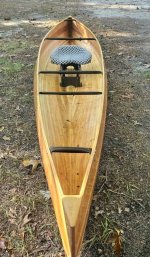
@RPATCH test paddling a wood strip prototype of a new Savage River 14' solo canoe, tentatively named the Shenandoah, on a Mullica River water prairie on October 6, 2026. This prototype had adjustable gunwale width so as to adjust the rocker. It also had a bottom-mounted bucket seat, which could be sat-upon or kneeled-off, slid fore and aft, and raised or lowered in the front or back to adjust the height and cant angle. Feedback was provided to the Savage River team by several paddlers (including yours truly) on different rivers and a lake this week in the New Jersey Pine Barrens.

1791645124680.png
 
it also had a bottom-mounted bucket seat, which could be sat-upon or kneeled-off, slid fore and aft, and raised or lowered in the front or back to adjust the height and cant angle.

@Glenn MacGrady I would be very interested in hearing more on the details of this seat if you can provide them. All of my homebuilt solo canoes have had a sliding bucket to allow an easy transition from sitting to kneeling and I've often contemplated a height adjustable version but never was able to come up with something that was practical enough to easily fabricate and operate. How was the performance of this seat in the field? Was it held secure or would it rattle around/come loose if inverted for portaging/car topping?

Alan
 
I'm pasting Glenn's response from the "Photo of the Day" thread since it pertains to this hull and gives some good information:
Oh, I get it now - thanks. So if I understand correctly, it must have only one thwart, which is adjustable in length (I wonder how much). And for that to work, the seat is necessarily floor mounted.

Very interesting.
 
@Glenn MacGrady I would be very interested in hearing more on the details of this seat if you can provide them. All of my homebuilt solo canoes have had a sliding bucket to allow an easy transition from sitting to kneeling and I've often contemplated a height adjustable version but never was able to come up with something that was practical enough to easily fabricate and operate. How was the performance of this seat in the field? Was it held secure or would it rattle around/come loose if inverted for portaging/car topping?

Alan

Alan, my rented Prism had Wenonah's floor mounted sliding seat. Other than the fact that the bucket wasn't as comfortable as the one in my Solitude (minor difference in shape or angle), I thought it was a clever and very practical design. Wasn't crazy about the Prism, but I'd like to see more seats like that (room for improvement, of course).

Oh, that's right.....it wasn't a bucket. It had a chopped bench where the bucket is supposed to be (outfitter mod?). That's why it wasn't as comfortable.
 
I would be very interested in hearing more on the details of this seat if you can provide them. All of my homebuilt solo canoes have had a sliding bucket to allow an easy transition from sitting to kneeling and I've often contemplated a height adjustable version but never was able to come up with something that was practical enough to easily fabricate and operate. How was the performance of this seat in the field? Was it held secure or would it rattle around/come loose if inverted for portaging/car topping?

I've been a kneeler not a bucket seat sitter most of my canoeing career, but the seat was well-padded and comfortable to sit on. It traveled quite a ways fore and aft and was held in place just with body weight friction. If you raised your weight slightly off the seat you could slide it on the fly. It was also comfortable to kneel off of, but the undercarriage mechanism would keep your knees locked into a spread position, so some of the feedback was to offer a bench seat as an option.

I didn't inspect the seat mechanism closely. I believe the seat height and cant adjustments were accomplished by bolts or pins through perforations in vertical, telescoping tube supports under the seat. Maybe there was also some sort of hinge mechanism to accommodate the seat slant. That couldn't be adjusted on the fly; it had to be done manually while out of the canoe.

it must have only one thwart

There were two adjustable length thwarts made from telescoping tubes with hole perforations and a stop button or pin. I don't know what everyone's feedback was. I preferred the wider thwart, more rocker setting. I also wasn't sure whether the Dillers were going to market the canoe with adjustable thwarts/rocker like the prototype, or just offer two different fixed thwart/rocker models of the hull. I believe they said they could do it either way from the mold they have. From their Facebook post, it sounds as if they will market it with the adjustable thwarts.

Here is direct LINK to the FB post.
 
It traveled quite a ways fore and aft and was held in place just with body weight friction. If you raised your weight slightly off the seat you could slide it on the fly. It was also comfortable to kneel off of, but the undercarriage mechanism would keep your knees locked into a spread position,
Exactly how the seat in my Solitude works. Similarly, I have to get out of the boat to adjust the hight. The Solitude seat, however, is suspended from the sides rather than floor mounted. I'm pretty sure that mounting on the floor saves significant weight. And of course, it eliminates any danger of entrapment.

There were two adjustable length thwarts made from telescoping tubes with hole perforations and a stop button or pin.

That sounds kind of fiddly. Maybe not as much as I'd guess. It sure does sound like the "impossible thing" that has been the dream for as long as I've been thinking about canoes, and before that for sure.
 
I can see the adjustable thwart idea making it possible to live with one canoe for everything....up to a point. (Perish the thought)

Edit: I wonder if this will be carried into a 15' model. Hmmm.....
 
Savage River had a team of four people, and a trailer with at least four different Savage River canoe models, camping and paddling with our freestyle-oriented group this past week in the NJ Pine Barrens. I'll post pictures and a report of the trip when I collect some more photos from people, many of whom are right now instructors or students at the Pine Barrens Functional Freestyle Canoe Symposium.

This is much more tentative project than the Savage River Shenandoah prototype, but I know Marc Ornstein and Ben Diller came closer to a proposal to design and build a "Grand Illusion" canoe, based on Marc's successful June Bug and Illusion design. The general concept seems to be to add perhaps half a foot of length and some width to the Illusion, for larger paddlers or heavier gear loads, while maintaining all the June Bug/Illusion handling characteristics. This would require Marc to build a wood strip plug for Savage River, which would take a while if the deal is consummated.
 
Or if possible to adapt it to an existing canoe that has enough flex in the hull to accept such.

Paddlers forever have been playing with the installation of shorter or longer fixed-length thwarts to adjust rocker, but I've never before seen telescoping, adjustable length thwarts. It worked to adjust the rocker on the thin wood strip Shenandoah prototype and presumably on a lightweight composite laminate hull, but it may not work the same on a plastic or wood/canvas hull.
 
Now that it's been done, it makes me wonder why it took so long. The material for rigging an adjustable thwart exists in great and cheap supply at thrift stores everywhere. It's the same material I've used for adjustable foot bars - aluminum crutches.
 
Lol, my heart dropped when I saw the title of this thread. I literally just placed an order for a new solo this week and that seems to be how things go. Fortunately, this is a hull type in which I have no current interest. 😄
 
can see the adjustable thwart idea making it possible to live with one canoe for everything....up to a point.

Let's not go overboard or hyperbolic.

Even if a canoe's rocker can be adjusted 1⅛ inch, one still has to like the basic canoe design for one's purposes and circumstances. If there are 100 canoe models on the market, which is a very conservative assumption, the vast majority of people don't buy any given one of those designs—say, #27. How much more demand will there be for #27 if its rocker can be adjusted 1⅛ inch? I don't know, but it certainly will not make #27 a canoe for everybody or everything.
 
Paddlers forever have been playing with the installation of shorter or longer fixed-length thwarts to adjust rocker, but I've never before seen telescoping, adjustable length thwarts. It worked to adjust the rocker on the thin wood strip Shenandoah prototype and presumably on a lightweight composite laminate hull, but it may not work the same on a plastic or wood/canvas hull.
Actually, I was thinking kevlar to gain tumblehome, not really needing rocker.
 
Now that it's been done, it makes me wonder why it took so long. The material for rigging an adjustable thwart exists in great and cheap supply at thrift stores everywhere. It's the same material I've used for adjustable foot bars - aluminum crutches.

It’s actually a very simplistic, elegant thing.
And your idea of crutches matches. Better than a tent pole.
 
Back
Top Bottom
