• Happy First Sighting of Manatees by Columbus (1493)! 💧🐘

Mégiscane River, Québec

Hey Erica, hope you are doing well. We really are looking forward to the next episode of your Megiscane River adventure one of these days! Your canoe tripping prose is simply mesmerising!

Gail
 
I’m working on it. Some parts are easier than others.
 
Pondering and Plans A, B, C, and D

Early morning, raindrops splat on the tent. I jump up and spread the fly over the tent. There's no room to stake it. So it just lies there. I listen to the droplets hit the tent and hope it won't leak.

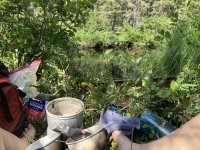
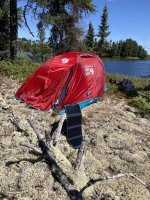
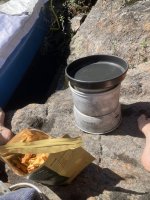
The forest is quiet. The falls burble. I’m out boiling some water. The canoe, tent and Trangia are all clumped together as if we are guarding ourselves. The canoe is just above my right foot, hiding in the dense brush.

IMG_5329.jpeg

Time to Think:

Plan A, Enter a period of depression. I had failed. I should just turn around, haul myself up the embankment and wait for a train to take me back to Senneterre. I could drive home with my tail between my legs and what, oh what, would I tell the canoetripping.net forum? Maybe if I just didn't mention it at all, everyone would forget about it..

After cogitating briefly, I realized how utterly stupid this plan was. I was here in beautiful near North Quebec with a canoe and everything I needed for a trip. It was just plain idiotic. Mindless. Dumb. Foolish. Thick. Moronic. OK. Done with Plan A and negative talk.

A few months before I left for this trip, I was reading "River of Doubt" by Candice Millard. The subtitle is "Theodore Rooseveldt's Darkest Journey" which may explain why I stopped reading it as the death toll rose higher and higher. If you haven't read it, it would make good reading for northern climes in winter when there is little chance of starting a major expedition.

RiverofDoubt.png

What did grab me about this book, and tales of other early explorers, is that they went where they had no idea of where they were going. Just an idea like, "I heard there is a tributary to the Amazon over there. Let's go see if we can find it." Or, "There must be a way to boat through the arctic, a northern passage as it were. Let's go find it." I found myself wishing I could be on a trip where I didn't know where I was going, just a compass and map (or maybe not a map) and some sense of what the geography was like. Maybe I was being offered this experience?

The rain has stopped and blue sky appeared.

Plan B: I suspected that all these rivers ran north into the Megiscane at some point. In theory, I could just keep going, find the Megiscane and get on with my trip, a la Theodore and Kermit but without the hundreds of support staff. Intriguing...

But, I had no map covering my current location. For the first time in more than 30 years I have cut off the parts of the map that I didn't need, in order to save weight. Note to self: do not do that again. Also, how would I know when I found the Megiscane? It's not like there are neon lights, or even rough wood signs. Large portions of the Megiscane River camouflage themselves as lakes. I could make this stab at a real exploration and if worse came to worse, I could push the SOS button on the SPOT and be rescued.

Uh, no. That is way too irresponsible. That is an abuse of the rescue system. Can't do that.

Plan C. There had been a bridge over the water, presumably with a road running over it. I just barely noted it as I whisked by in a small riverine rapid. Maybe it was a road. Maybe the road was still used. Maybe someone would help me get to Monet. Maybe someone fueled with alcohol would beat me up and rob me and leave me to crawl back into the woods.

I'd been sitting still for quite some time, next to the Trangia and the canoe, trying to decide what to do. A little brown bird suddenly landed on a gunwale and looked at me. I looked at the bird and we looked at each other in silence. The bird was so close I could see individual feathers. The bird then flapped just a couple of feet into an adler bush, but still looking at me. Then flitted over to another branch and then flew away. A curious bird. It made not a sound.

Plan D. I could retrace my route, all the way back up to the railroad, flag down a train and let it take me to Monet. Except I don't know which way Monet is, therefore, which side of the train to be on. I could not bear the idea of hauling the gear and the canoe back upstream and back up the nearly verticle railroad embankment.

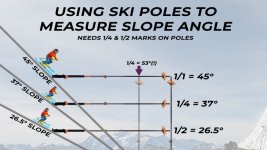
Just for the sake of fun, I decided to try to figure out the slope of the railroad embankment. According to ChatGPT, the steepest angle permitted in railroad embankments in Canada is approximately 27 degrees. I took a look at diagrams of 26 degree angles, and it was steeper than that. I could not walk down it. Most of the time I had to carefully scoot because there were grapefruit sized rocks, soccer ball sized rocks and larger boulders, large downed branches, and gullies. Standing up without having a tree to prop me up was impossible. And this was the easy side. The other side of the embankment went almost straight down.

My best judgment here, something like the length of a fish, is that the slope was at 45 degrees. It was at least 45 degrees near the top and near the bottom it leveled out some, but that wording gives the impression it was level at all and it wasn't. It was always a contest to stay upright.

ce737-b328-f654-d481-322ceb3afc8_poles_for_steepness_2.jpg

Just the thought of trying to do this was bringing me to tears, so I turned my focus back to Plan C.

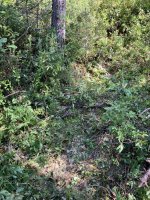
I took down the tent and threw the bags into the boat. I forgot to take a photo of the tent before I took it down, but if you look closely, you can see the coffin shaped mat where I slept.

IMG_5332.jpeg

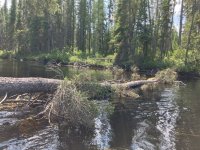
Having checked for gators, I slid into the water. At two to three feet deep, I couldn't step in without swamping the boat. We swam together, Dancer and I, up this little river. I viewed the tree crossing the entire river with a sinking feeling. It felt impossible—like every part of me was giving out. I felt completely worn out—rest no longer seemed to help.

The barrier. There is not enough room under on river-right (left in the photo) and the tree extends all the way across and up the other side.

IMG_5336.jpeg

But I had just been reading one of Michael Pitt's book in which he chortles about sneaking around unrunnable rapids. He claims that one of the finest pleasures in life is tricking a river out of the work it expects you to do on a portage.

With Michael as inspiration, I took the boat with me to the far river-left where the tippy top of the tree had landed. I squirmed my way onto the trunk so that I was sitting on it, with my full weight on the tree. Once I sat on the branch, it sagged under my weight (This had to be the only time I had been glad for the weight I gained when older.) I was able to pull and then push the boat over the trunk. Hurray. Michael was right. And I was inordinately pleased with myself.

I wish now I had taken more photos of this part of the trip, because it was quite beautiful and it would also document just how decrepit and delapidated the anticipated bridge was. It was concrete. From below, there were no visible railings. And lush bushes and forbs sprouted out of all the cracks. Worse yet, a tree some 7 feet tall appeared to be growing in the middle of it. It looked so awful and I was so tired, I almost decided not to hike up the very steep embankment which, after a brief level section, was almost straight up.

But I also didn't want to climb up the railway embankment either, so I tied off the boat and slowly scrambled my way to the top.

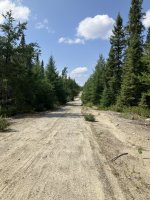
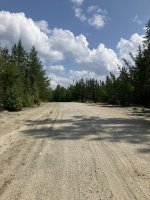
My goodness. It was a road and a wide one at that. The bridge was in less than peak condition, but it was a road. Maybe I would get lucky.

IMG_5347.jpg

IMG_5348.jpeg

I still had to plan. What would I do if no one came today? There were some flat places near the road. I could set up the tent. What if no one came tomorrow? How many days would I give it here? What if someone came and didn't want to help? What would I do if the people who saw me were aggressive? Run? Hide?

My plan was to ask someone where Monet was and if it was walkable, I would walk there. If not, I could ask for a ride. I would not expect someone to load up my canoe and all gear. I would go to the pourvoirie in Monet and ask for help there and expect to pay someone.

I needed to get up at least a day pack of stuff from the canoe. What if I left for the canoe and someone came while I wasn't up there watching? I tried writing by scratching in the gravel that I needed help. But it was completely invisible to a vehicle.

If this didn't work, I could still get the train. But which way? Forward or back? What if.... One thing at a time, I said to myself. You don't need to have Plan D totally worked out when you were so far into Plan C. I scooted down to the canoe, packed up a few things and then crawled back up.

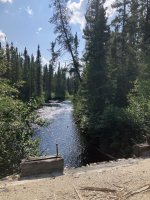
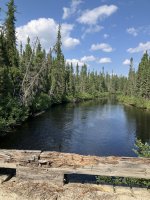
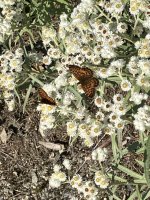
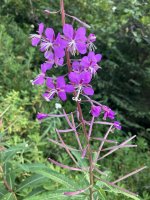
I got up to the road and settled in to wait. I walked to the bridge and up the other side a bit. I took some pictures. I looked at the butterflies and the flowers. Below are snaps of upstream and downstream with a bit of the deteriorated rails which were only a foot tall, if that. And also two flowers.

IMG_5349.jpeg

IMG_5350.jpeg

IMG_5343.jpeg

IMG_5353.jpeg

Time ticked by. It was getting late in the day. Would anyone come by?
 
I'm finally catching up on this thread today. Great story telling so far. I certainly did not expect this turn of events!

Alan
 
oh Erica - you could also sum it all up with the headline:

"me and myself or the force of emotions"

I have the utmost respect for your achievement!
 
I don’t know my flowers very well, however did recognize the fireweed. The fireweed plant’s leaves make a great decaf tea. Some good tutorials on the interweb on how it is processed, like real tea leaves, that tastes like black tea, At one time in mankind’s dim past Fireweed Tea was a Russian staple before black tea was traded from the far east.
 
I don’t know my flowers very well, however did recognize the fireweed. The fireweed plant’s leaves make a great decaf tea. Some good tutorials on the interweb on how it is processed, like real tea leaves, that tastes like black tea, At one time in mankind’s dim past Fireweed Tea was a Russian staple before black tea was traded from the far east.
I did know that about the leaves making tea. I will have to try it. Fireweed is a pioneeer species, so named because it is one of the first plants to grow in disturbed areas such a land burned by fire, or a road cut, or a railroad bed.

Several different plants have Fireweed as their common name. This Fireweed is native to North America. Other fireweeds are not native and at least one is considered invasive, but it is yellow and looks nothing like this one.

The other flower, I think, is Pearly Everlasting. I may have this wrong. Maybe Michael can tell us for sure. I don’t know much about it. Google says it can be used for poultices for treatment of sores, boiling in tea or a steam bath for rheumatism, or smoked to treat colds. The plant is also among many native species used as a tobacco substitute.
 
You are correct, Erica. Pearly Everlasting!

Fireweed is one of my many favourite Northern plants. It has an interesting reputation among Northern travellers for predicting the beginning of winter, as explained in the following quote from AI:

“The phrase "fireweed time to head south" refers to a popular saying in Alaska and other northern regions: "When the fireweed turns to cotton, summer's forgotten"
. The saying means that when the fireweed plants go to seed with their characteristic white, fluffy "cotton" (pappus), winter is imminent, and it's time for seasonal travelers or migratory animals to start heading south.
The fireweed acts as a natural calendar. Its bloom cycle progresses as follows:
  • Early Summer (Late June–Early July): Blooms begin at the bottom of the stalk.
  • Late Summer (August): The final flowers at the very top of the stalk bloom.
  • Early Fall (Late August–September): The blooms are replaced by the white, cottony seed heads that disperse in the wind, signaling that snow could arrive within six weeks.
Therefore, seeing the fireweed "turn to cotton" is a traditional sign that the warm season is ending and preparations for winter, or heading to warmer climates, should begin.“
 
You are correct, Erica. Pearly Everlasting!

Fireweed is one of my many favourite Northern plants. It has an interesting reputation among Northern travellers for predicting the beginning of winter, as explained in the following quote from AI:

“The phrase "fireweed time to head south" refers to a popular saying in Alaska and other northern regions: "When the fireweed turns to cotton, summer's forgotten"
. The saying means that when the fireweed plants go to seed with their characteristic white, fluffy "cotton" (pappus), winter is imminent, and it's time for seasonal travelers or migratory animals to start heading south.
The fireweed acts as a natural calendar. Its bloom cycle progresses as follows:
  • Early Summer (Late June–Early July): Blooms begin at the bottom of the stalk.
  • Late Summer (August): The final flowers at the very top of the stalk bloom.
  • Early Fall (Late August–September): The blooms are replaced by the white, cottony seed heads that disperse in the wind, signaling that snow could arrive within six weeks.
Therefore, seeing the fireweed "turn to cotton" is a traditional sign that the warm season is ending and preparations for winter, or heading to warmer climates, should begin.“
Thank you Michael, for the extra details. When I was in the Adirondacks, it was the blooming of goldenrod that told me the summer was coming to an end.

Fireweed has such a lovely color. I don’t think I’ve ever seen it “turn to cotton.”
 
Monet

It's been a good 50 years since I last hitch-hiked, all over Europe and the US. I believe the last stint was from Yellowstone to Chicago. The situation I found myself in, on this remote road in Quebec, was similar. I was a bit jumpy. I was rehearsing my French to explain my situation and what I needed. And I was watching the sun sink lower in the sky.

I don't like to set up camp in the dark. It was after 5 pm and I thought about hauling a tent and sleeping bag up to the road, when a truck came around the bend to the east. I grabbed my hat, moved to the middle of the road and waved it. The truck slowed and stopped.

I popped over to the driver's side. After the bonjours, the conversation (in French) went something like this:

Me: Which way is Monet?

Him: Points back where he came from .

Me: How many kilometers to Monet?

Him: Uh, uh, he wasn't sure.

Me: I am canoeing; my things are down there (pointing.)

Him: looking greatly relieved and nodding. [Ah! a reason this women is alone in the middle of nowhere]

Me: The train left me off at the wrong river (pointing back toward the trestle.) This seemed to puzzle him. I'm sure it was a noun or verb I was not getting correct.


I got the impression he was willing to bring me and my gear back to Monet, but I was thinking Monet was a big pourvoirie (it’s not) and I could pay someone there to come back and help me with my stuff. This was not satisfactory to him. So we went back and forth on this for a while.

At this point, the conversation disintegrated until neither of us knew what the other was saying. He told me clearly, more than once, that he couldn't speak English, but if I spoke English, he could understand me. In spite of this [hint, hint crazy woman, speak English. Your French makes no sense] I kept speaking French. It's like I'd gotten into a groove with French and did not know how to get out of it.

New plan: He is going to call his daughter who speaks English. I wondered how he can get cell phone reception here and he pointed to an antenna on his truck. He descended from the cab with his phone to get better reception. I got a better look at my potential rescuer.

He was in his forties or early fifties, compact in stature and about my height. He had short brown hair with touches with gray. I don’t have a photo and I regret that because it’s hard for me to visualize people and faces. His build was stocky and solid, shaped by work rather than vanity, giving the impression of real, dependable strength. He had a quiet confidence, an ease in how he carried himself, as though he knows what he can handle and doesn’t feel the need to prove it. I felt entirely comfortable with him.

His name, I found out later, was Eric. He spoke quietly. Once he understood my situation, he was calm and solution focused.

He did get hold of his daughter, whose name I can't remember. She patiently listened to him and listened to me. She told me that "Papa" could drive me and my stuff back to Monet, but he would have to park the big machine he was towing first. He told me, through her, that it was stupid to take me to Monet and then have to come back for my things. It was hard to argue with that logic. I could see at this point it would be easier to accept this offer than try to explain further my ideas.

My rescuer went to park his machine and I descended to the river to face the unbearable task of hauling all my stuff up yet another steep slope and worrying about how long that was going to take, thus straining his good will.

I need not have worried. He followed me down the slope and grabbed two of the heaviest packs and walked back up the hill as if unencumbered. I stood in the water and handed out the packs. He hauled all my gear and the canoe up before I could turn around. My packs went into the pickup bed. I was wondering if he would have straps for the canoe, if he knew how to tie a canoe on tightly and before I could even form these thoughts, the canoe was strapped on securely.

Once en route, we chatted as well as we could. His daughter was 17 and she was a champion cheer leader. He said she was the best in Quebec and was going to the nationals. He was very proud of her. He himself was a forester. He did not cut down the trees. He ran the heavy machinery. While working in this region he stayed in his camp down the road.

We came to a fork in the road and he indicated that this was the way to Monet. The road was blocked and had big no trespassing signs on it. I asked him if he was sure this was okay and he said it was. He got out, opened the gate, we drove through, he got out and closed the gate. A bit further on there was yet another sign saying only Monet people could go further. Again, my rescuer said not to worry. We went across the train tracks and suddenly we were at Monet. We pulled up behind a pickup truck and he indicated to me that was his boss. The man he pointed out was much younger, but was confirmed as boss of the three older men.

Eric got out of the truck and spoke to the them. I sat in the truck, virtually ignored. At some point, he gestured I should come out. I was introduced to Floran, the team leader, Maximillian, and I can't remember the third man's name. They were all foresters and were staying at Monet while working in this area. The patron, the manager, of the pourvoirie was not there. He was out catching baitfish for tomorrow's fishing clients. He wasn't going to be back until 8 or 9 pm, well after dark.

I expressed concern about getting permission to camp and Floran assured me it was fine, camp anywhere, no problem. Why Floran would have the authority to grant permission was something beyond my linguistic abilities to decipher.

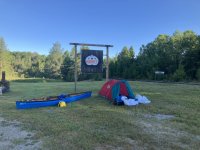
As my grandmother would say, they were all tickled pink at the idea the train had left me at the wrong river. This engendered a lot of fast accented French from which I gathered their opinion of the rail service was not high. The French continued, so I placed my tent at the exact spot Floran pointed. You can see the train track just to the right of the tent.

IMG_5357.jpeg

I was here twice before. Granted it was 30 years ago, but it all looked totally different.

It looked like Eric was planning to leave so I jumped up from the tent to thank him again before he took off for his camp. I regretted I would not see him again.

Shortly thereafter the men entered the main house. As he was headed up the stairs to the main house, Floran invited me in. I declined. For one thing, I am very shy and have no idea what to say when in a group of more than, say, two people. I am one of the least social people I know. Plus, my mother taught me that you never accept an invitation the first time it is offered. You must decline twice and be asked a third time before you may accept. Floran must have grown up near my mother because he offered twice more, throwing in, we have internet! to sweeten the pot.

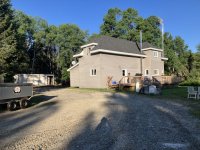
The Main House of Pourvoirie Monet.

IMG_5358.jpeg


So I grabbed my phone and my leftover dinner from last night and went into the house. I was able to send a text to my sister-in-law who theoretically was keeping rough track of me and a quick email to a friend. Then I moved over to the table where the men were eating.

To my left was Floran, the youngest of the men. He clearly had some education, and directed the operation. He told me the Quebec government decides what areas to log and sends them instructions on where and what to cut. Floran sitting to my left, spoke English, but I also tried out my French with him and he was courteous enough not to mock me. I noticed I was using the extended formal method of asking questions, saying "Est-ce que vous avez fait du canôt?"

-----------------------------------------------------------------------------------------------------

Notes on French language:

*Corrections welcomed. I am self-taught and certainly get things wrong.*

In France, canoe= canoë. In Québéc, canoe = canôt

1. Est-ce que vous avez fait du canôt? Schoolgirl French, very formal. Literally, Is this that you have done canoeing?

2. Avez-vous fait du canôt? Less formal, but still not used among friends or peer group, family, etc.

Literally: Have you done canoeing? We would say, have you gone canoeing and you can also say that exactly: Avez-vous aller fait du canot?"

3. Tu as fait du canôt? Informal, normal conversation

4. The way #3 _sounds_ in conversation: T’affait’d’canôt? (Swallow that “d”. Three and 1/2 syllables instead of five.)

5. The way French Canadians pronounce it, I don’t know. But almost all the Canadian French I heard on this trip was heavily accented and only minimally understandable to me, trained in Parisian French.

-----------------------------------------------------------------------------------------

So as you can see, I was speaking formally. I’ve been told since then this could be interpreted as rude among peers. But there was nothing I could do to loosen things up. My brain was already operating at maximum capacity.

I'm not social, but I have painstakingly learned some social conventions which I try to practice. One convention is not to leave a person out of the conversation. I noticed that neither Maximillian nor Forester #3 was participating. I thought it was perhaps because they spoke no English. So I turned to Max and nervously asked him, in my best schoolgirl French: "Est-ce que vous avez fait du canôt?"

Max was sitting at my right shoulder. He turned to face me. His face was much closer to mine than I am used to. (I prefer a decent social distance with strangers.) Anyway, Max moved his face close to mine and very loudly shouted "YES!"

This startled me so I collapsed. I covered my face with my hands and bent over, purely mortified. I didn't know what social convention I had violated, but surely it was a big one to be yelled at, in English, while I was speaking French. As I huddled almost under the table, I heard French flying back and forth above me ending up with Floran saying he thought I was confused because Max answered in English. My guess was that whatever happened, they were mystified by my reaction. Now you see why I have trouble in social situations. For me, it's like walking through a minefield.

At Floran's request, I explained where I was going. He had his laptop open and was perusing topos of the Mégiscane. He showed real interest in the maps and the route. I volunteered to bring my topos in for him. I was a bit tired and unsure of myself. I would have preferred tomorrow morning, but they were leaving at 6 am, so I went out and brought the maps in. Everyone was interested in the maps.

In retrospect, I realized I had been the evening’s entertainment. These men worked all day, came back to the house, ate dinner and went to bed. There was no TV. They did have internet, but in some sense, that is always the same too. Here I was, a bright spot in an otherwise dreary evening.

Floran went over the entire set of maps and my route. He told me I did not have enough time to finish my proposed route. I had allotted three weeks, but one of those was already used up on the wrong river. He added it up and said it was 280 kilometers to Lac Faillon, my planned take-out, or about 20 K per day, with lots of portages which would surely slow me down. Others huddled over the maps and agreed. It was too ambitious a trip for me.

"You all are supposed to be building me up, telling me I can do it, be supportive," I objected. No one laughed. They all looked dead serious.

Unwilling to give up, I said, "Ok, let's go over the maps and figure out where my bail out points are." The first one was just off Lac du Poet, in the Reservoir Gouin. This would be on the east side of the Barrage Mégiscane (Mégiscane Dam.) That seemed much too early. More to the point, the best part of the river was beyond the Barrage Mégiscane.

But the next bail out point was a new pourvoirie a quite a bit further downstream; worse, it came after a long portage. It was unlikely I could get there in two weeks.

Around this point, Jean, le patron (manager of the pourvoirie) returned with his girlfriend and a bucketful of large whitefish. There was chatter about who I was and the train had dropped me off on the wrong river. He turned to me and asked me where I was going and I told him Lac Faillon. He laughed and said if I wanted to go to Lac Faillon, he could bring me there in his truck in two hours. There was no reason to go down the river. I explained the point was to enjoy the paddling and the countryside. He asked my name and I told him. He said, "Well, Emma. You are one visitor I will remember always."

I wasn't sure if this was because I wanted to canoe in the area, or if the train had dropped me off at the wrong spot, or some other anomaly of which I was unaware. I just smiled and hoped for the best. I was invited for dinner, but declined because I had already eaten. Jean said it was fine for me to camp on the property. Floran showed Jean my proposed route and his concerns. Jean said he was very busy tomorrow morning, but he could take me to Lac Octavie in the morning and I should be ready to go at 8 am.

I excused myself and went out to the tent. The grounds were as flat as a soccer pitch. My sleeping surface was flat. But for all that, it was the most uncomfortable sleep of the entire trip. All the miserable tent sites I had (and would continue to have) were at least soft with vegetation, bent bushes, etc. This site was hard as a rock. It was like sleeping on a concrete floor. But I am not complaining. I know where I am. It is not raining. I met some good people. And with any luck, I'll be starting out on the Mégiscane River tomorrow.

To be continued…
 
Last edited:
Looking forward to tomorrow s breakfast .
This is one of the best trip report i have read. Hope the next day has a bit of paddling. It sounds like another big dissission day..
 
We met Jean and the girlfriend this spring. Nice folks. They gave us and our gear a lift from the sign where you tented (and where the train dropped us) to their put-in. Interested to hear how the rest of your journey unfolded.
 
I am really enjoying these installments. Thank you.
My French is basic at best but my experience in Quebec is that my Anglo effort to try to speak French is very appreciated no matter how badly I mangle the language or if a use a formal style or not.
I have to agree that the Quebecois accent and expressions can be confusing to my ear and brain. Short story: While trying to hold a French conversation with a Quebecois bus driver, at one point he said "Mosee" or something resembling that. For my overtaxed brain, trying to follow what he was saying, it proved to be a road block - I could not understand what that meant and I lost the rest of what he said. Later, while talking to some more bilingual Quebecois, I asked them and they said that he was saying "Moi aussi" (Me, too) in Quebecois. I would have understood "Moi aussi" but "mosee" lost me so I understand your trouble with the accent.
 
Back
Top Bottom