I had to look at the maps, and I am fairly certain where you were dropped off, but will wait for the reveal. A GPS is a wonderful thing, I don't leave home without it.




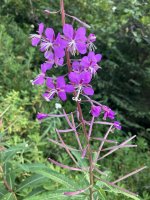

I did know that about the leaves making tea. I will have to try it. Fireweed is a pioneeer species, so named because it is one of the first plants to grow in disturbed areas such a land burned by fire, or a road cut, or a railroad bed.I don’t know my flowers very well, however did recognize the fireweed. The fireweed plant’s leaves make a great decaf tea. Some good tutorials on the interweb on how it is processed, like real tea leaves, that tastes like black tea, At one time in mankind’s dim past Fireweed Tea was a Russian staple before black tea was traded from the far east.

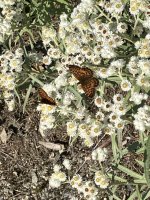
Thank you Michael, for the extra details. When I was in the Adirondacks, it was the blooming of goldenrod that told me the summer was coming to an end.You are correct, Erica. Pearly Everlasting!
Fireweed is one of my many favourite Northern plants. It has an interesting reputation among Northern travellers for predicting the beginning of winter, as explained in the following quote from AI:
“The phrase "fireweed time to head south" refers to a popular saying in Alaska and other northern regions: "When the fireweed turns to cotton, summer's forgotten"
. The saying means that when the fireweed plants go to seed with their characteristic white, fluffy "cotton" (pappus), winter is imminent, and it's time for seasonal travelers or migratory animals to start heading south.
The fireweed acts as a natural calendar. Its bloom cycle progresses as follows:
Therefore, seeing the fireweed "turn to cotton" is a traditional sign that the warm season is ending and preparations for winter, or heading to warmer climates, should begin.“
- Early Summer (Late June–Early July): Blooms begin at the bottom of the stalk.
- Late Summer (August): The final flowers at the very top of the stalk bloom.
- Early Fall (Late August–September): The blooms are replaced by the white, cottony seed heads that disperse in the wind, signaling that snow could arrive within six weeks.


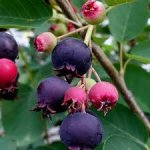
The look is similar, but they are not the same.Red berries look like Serviceberries or "Saskatoons", they darken as they ripen and taste and feel like a sweet rosehip.
Erica, Just wonderful reading! If you are looking for another Curtis Dragonfly, Dustin Noel has one as well as other Curtis/Hemlock canoes: https://www.facebook.com/marketplace/profile/1198170380The first blissful day
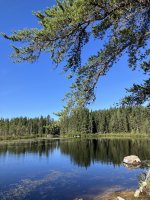
I cruised out over the beautiful blue water, shouldered with dark spruces. I don't know if they are black spruce or white spruce because I did not even realize there was a white spruce until Paddling Pit pointed out his peeve of incorrect naming, which I completely understand as I was once a a taxonomic botanist. So, dark spruces lined the banks.
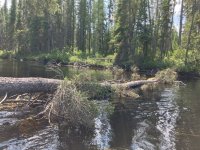
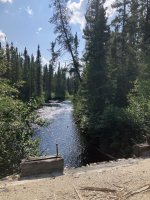
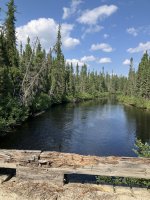
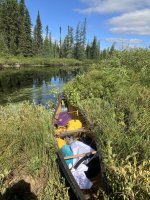
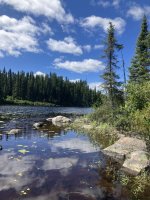
A lovely moment: clear blue skies spangled with clouds, a slight tang in the air, the smooth wood of the paddle and the whisper of water. Occasional boulders began to appear along the verge. My body falls into the rhythm of the stroke. It is one of those moments one wished could go on forever.
A definitive bend on river right helps me locate myself on the map. I knew where I was! It wasn't raining! I had all my body parts intact! The canoe didn't leak!
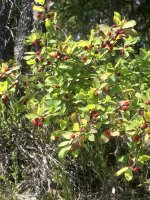
I was pleased enough to stop along the way for things that drew my interest. Like this brilliantly colored red berry. I'd never seen anything like it. Further downstream, I would see even more robust specimens. When I got home, I learned this was a relative of our Christmas decorations: the Mountain Holly, a shrubby plant of moist and acid soils in the north or upside of mountains.
View attachment 152362
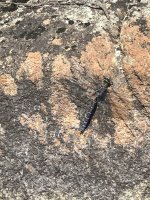
I was also pleased to see more granite outcroppings with lichen and moss displays. I also saw a small colony of my favorite lichen, but more robust groups will be found downstream, so I’ll wait till then.
View attachment 152363
And the blue skies and blue waters.
View attachment 152364
It didn't take long, though, for the weariness to break through. I decided to stop at the first reasonable camp site, dearly hoping better camps would be possible now that I was on the river. So far, nothing obvious had presented itself for consideration.
As the river widened, I saw there was an island. I like camping on islands. No particular rational reason. This island clearly had a large rock shoulder facing south with good potential.
Shallow water filled with hull-scraping rocks, many pointy, guarded the island, but we made our way as best we could, finally arriving at a fairly low shelf of rock to use as a dock. I tied up the boat and went looking. It was a sickening familiar scramble up the rock face. The granite swell was large, but not flat. So I walked back and forth, from east to west (the wooded north was badly pitted with deadfall and hollows), kicking some driftwood here, examining under some laurel bushes there. No matter how many times I walked back and forth, the rock did not lie flat. But close enough!
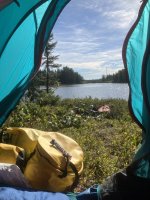
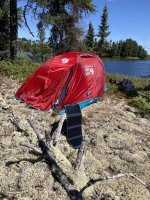
I pondered the minimum amount of work necessary to be safe for the night. Set up the tent, sleeping bags, etc. These needed to be hauled up the rock face by pushing them up as high as I could and then clambering up beside them to heave them over the edge. I pitched the tent, released the sleeping bag and attendant night time supplies. As you can see, it is not level. And the wind gave it a comical lean from time to time.
View attachment 152365
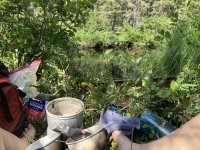
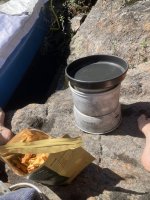
I returned to the height of rock to view the canoe and remaining gear. Sliding down, I set up a tiny kitchen on my small stone dock to heat water for a freeze dried meal of some sort. I purchased most of the freeze dried food in 2021 just before the pandemic for my planned trip to the Liard. Because it was late in the season, there wasn't much left that I liked, so I had many, many dinners of Three Cheese Macaroni and Cheese. I did not tire of it.
View attachment 152366
At the very beginning of this trip report, I mentioned that I broke some of my long standing safety rules. I was breaking them within a couple of hours of disembarking from the train. I spent several nights with my canoe and gear and me in different locations. The first, closest to the trestle, had stuff spread out all over. Indeed, the first night, I could not find my tent, which I had spread out over the ground in preparation for set up.The second, was where I made my camp, and the third at the planned put-in. I was lucky. Nothing was lost.
Tonight, I was going to violate a major rule; the canoe is always on land and securely tied bow and stern. I was just too tired to even see how I could get the canoe up the sharp incline. And there were no trees or cooperative rocks to tie to. I took the longest rope and brought it some 50 yards back to the nearest tree and secured it tightly. The stern was tied to Labrador Tea bushes. The branches are skinny and there's no real trunk. So I looped the rope around and around in intricate patterns to secure it as best I could.
What I didn't realize at the time, again when one gets really tired not all the neurons are working at their best, was that the canoe was alongside the rock face and even gentle waves were pushing the canoe back and forth, up and down, leaving a pattern of white lines along the beautiful blue finish. Later, I put a bit of Ridge Rest between the rock and the canoe to act as a bumper to prevent further damage. I left the canoe in the water! I never do that.
Packs and gear not immediately needed were left in the canoe, another rule I broke.
After dinner, I crawled into the tent, admired the view, curled up and went to sleep.
Tomorrow should be a rest day.