• Happy National Blueberry Pie Day! 🫐🥧

How to recruit new canoe paddlers?

This is a little off topic, but I'm following up here because it's in the context of recruiting new paddlers. Apologies in advance if the mods think it would be better suited by its own thread:

The couple I mentioned in a previous comment on this thread is split on whether to buy a canoe ahead of our upcoming paddle camping trip in the ADKs. Wife wants a canoe, so family (couple + 2 toddlers) can make it to the island with their gear in one trip and stay together as a family. Husband wants to stick with the kayaks they already have--doesn't mind making multiple trips and values his comfort with taking out they kayaks for outings from base camp.

I mentioned to them how you can generally get your money back if you buy the right used canoe and decide to resell it, and I also mentioned that I wouldn't mind acquiring another tandem myself. So long story short, I'm shopping for a used tandem that would suit their needs--in case they want to buy it off me for whatever I paid after the trip--and that I would also like to keep if they're not interested (I don't love the idea of buying a canoe with the intentions of reselling it to a stranger). Plus, my wife and I are thinking of growing our family as well as branching out for some longer trips, so we'd like something a little bigger than our Penobscot 16.

So I guess the question is this: If you were shopping for a used tandem with the aim of helping a young family fall in love with the single blade side of the moon, what would you be looking for? I've been eyeing up a Swift Algonquin 17 in Goldenglass that's for sale not too far away. It already has a center seat installed. Looks to be in excellent condition, asking $1k. Think something like this could be on the right track?
 
In response to the original question I try to take 2 or 3 new paddlers out each year. I put them in quality boats with a comfortable paddling pfd. I take them all to the same quiet boat launch and stretch of lake where there's rarely wind. I try to time it for a weekday morning with little boat traffic and keep the paddle under 5kms. I start them with an inexpensive paddle and once away from shore and they've had a bit of time to get a feel for it I trade paddles with them. After they get a feel for a good paddle I trade them back to the inexpensive one. When people can feel the difference like that they understand that some gear is worth spending money on. Everyone seems to understand the price difference between a department store bicycle and a high quality mountain bike but put their blinders on when it comes to paddle craft.

I've had a few successes getting people to become regular paddlers, even outfitting their families for tripping. It's a difficult sport for young people to get into. Most young people don't have a place to keep a boat even if they have the means to purchase one. If they get out and have a good experience hopefully the seed is planted in their brain that perhaps this is a sport worth investing in.
 
This is an excellent thread topic on a very difficult issue.

As a member of the board of directors of the Wooden Canoe Heritage Association, I can say that we and many boards before us constantly struggle with the even more niche question: How to get more people interested in and involved with wood canoes, which mainly means wood/canvas canoes. I have not yet heard any magic answer to this, and I have none.

One common phenomenon expressed by the confirmed canoeists on this forum is exposure to canoes at a formative early age, either with family or scouting or summer camps. Those institutions used to use wood/canvas canoes exclusively before WW2. After the war, lots of us were exposed to aluminum canoes as children, particularly from airplane maker Grumman. Then fiberglass canoes in the 1950s and 1960s, but still canoes.

I suspect that young kids today, consumed as they are with electronic socializing and screen time, to the extent they even are exposed to outdoor activities at all, will find mostly kayaks in the former canoeing institutions. Especially in the U.S., where day tripping far, far exceeds overnight wilderness tripping.

In the late 1970s and 1980s, the whitewater canoe clubs in the northeast U.S. had success in recruiting newbies into whitewater canoeing in Royalex canoes, which was a time when rotomolded plastic kayaks were just coming into the market. As those kayaks became more and more available, running whitewater in open canoes began to diminish. In the early 90s, sea kayaks began also began to become more available and popular.

As many above have pointed out, newbies seem to be driven to inexpensive kayaks because they are cheaper to buy, easier to propel forward, and are more stable and easier to self-rescue.

I'd be interested in any statistics that show the trend of all paddle sports over time, normalized for population growth, if anyone can find such data.
 
This is an excellent thread topic on a very difficult issue.

As a member of the board of directors of the Wooden Canoe Heritage Association, I can say that we and many boards before us constantly struggle with the even more niche question: How to get more people interested in and involved with wood canoes, which mainly means wood/canvas canoes. I have not yet heard any magic answer to this, and I have none.

One common phenomenon expressed by the confirmed canoeists on this forum is exposure to canoes at a formative early age, either with family or scouting or summer camps. Those institutions used to use wood/canvas canoes exclusively before WW2. After the war, lots of us were exposed to aluminum canoes as children, particularly from airplane maker Grumman. Then fiberglass canoes in the 1950s and 1960s, but still canoes.

I suspect that young kids today, consumed as they are with electronic socializing and screen time, to the extent they even are exposed to outdoor activities at all, will find mostly kayaks in the former canoeing institutions. Especially in the U.S., where day tripping far, far exceeds overnight wilderness tripping.

In the late 1970s and 1980s, the whitewater canoe clubs in the northeast U.S. had success in recruiting newbies into whitewater canoeing in Royalex canoes, which was a time when rotomolded plastic kayaks were just coming into the market. As those kayaks became more and more available, running whitewater in open canoes began to diminish. In the early 90s, sea kayaks began also began to become more available and popular.

As many above have pointed out, newbies seem to be driven to inexpensive kayaks because they are cheaper to buy, easier to propel forward, and are more stable and easier to self-rescue.

I'd be interested in any statistics that show the trend of all paddle sports over time, normalized for population growth, if anyone can find such data.
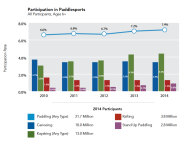
The Outdoor Industry Association has some data on this. Most of it is behind a paywall, but their 2015 special report on paddle sports (attached) is public. It only covers 2010-2014. According to the report, canoe participation dropped from about 10.6 million people to 10 million people in the US during that window, so an absolute decrease as well as a relative decrease. It's also losing share to other paddle sports, and--demographically--trends older and whiter. None of this is particularly surprising. I'll keep an eye out for wider data.

This is purely anecdotal, but I spent most of my summers from 2012-2018 working at a state park that rents canoes and kayaks. Many (more than half) of our weekend visitors were Hispanic, and they almost always rented canoes instead of kayaks. White visitors, on the other hand, drifted towards kayaks. I'm not sure if there's anything meaningful there or not; I just bring it up as an interesting contrast to the 'legacy' image of canoeing.
 

Attachments

The Outdoor Industry Association has some data on this. Most of it is behind a paywall, but their 2015 special report on paddle sports (attached) is public. It only covers 2010-2014. According to the report, canoe participation dropped from about 10.6 million people to 10 million people in the US during that window, so an absolute decrease as well as a relative decrease.

Thanks. For those who don't want to open the PDF, here's the opening graph:

Paddling Stats.png
 
Back
Top Bottom