• Happy Blueberry Pancake Day! 🫐🥞🍁

Building Laminated Canoe Paddles

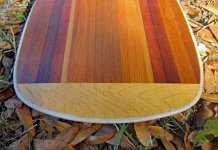
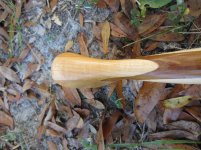
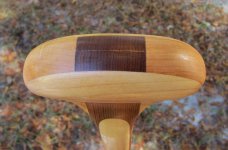
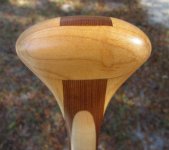
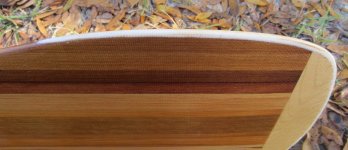
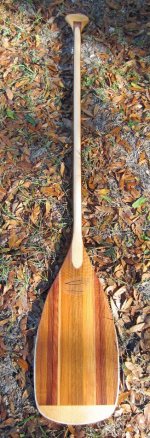
I finally got a chance to finish the "recycled" paddle, made from repurposed western red cedar (from old utility poles) and hard maple (from salvaged flooring). It's a SHALLOW WATER SPECIAL. LOA is 51". Since I have no personal need for it, it will become one of the few "stock" paddles that I occasionally have available. (Note: Shallow water specials are generally sized approximately 4" shorter LOA than the paddler generally uses."
IMG_1660 cr en sml.jpgIMG_1662 cr en sml.jpgIMG_1665.JPGIMG_1667 cr en sml.jpgIMG_1670 cr en sml.jpgIMG_1671 cr en sml.jpg
 
DOGPADDLE CANOE AND WOODWORKS
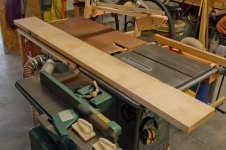
The paddle blank is glued up and I've run it through the planer. I've marked it from my pattern (this blade will be a shallow water special) and am cutting it out on the bandsaw.View attachment 150988
Hi there. I was interested to see this photo as it shows a block glued on for the tip. Most other builds I’ve seen photos of use thin veneers over the tip, which is an extension of the primary blade lamination, presumably to improve durability and minimize seam splitting.

Uninformed question just curious if you’d be able to comment on your approach and long term outcomes. Thanks!
 
Hi there. I was interested to see this photo as it shows a block glued on for the tip. Most other builds I’ve seen photos of use thin veneers over the tip, which is an extension of the primary blade lamination, presumably to improve durability and minimize seam splitting.

Uninformed question just curious if you’d be able to comment on your approach and long term outcomes. Thanks!
Interesting questions. As to the method: The entire blade is sheathed with epoxy saturated fiberglass. As such, the various wood laminations are fully protected from the water. The very tip of the blade is an epoxy compound with various fillers, so even a chip in the tip, would not result in moisture penetration. As for long term outcomes, I've been using this and similar methods for 40+- years and too many paddles to count. I've never had or been informed of a failure.
 
Interesting questions. As to the method: The entire blade is sheathed with epoxy saturated fiberglass. As such, the various wood laminations are fully protected from the water. The very tip of the blade is an epoxy compound with various fillers, so even a chip in the tip, would not result in moisture penetration. As for long term outcomes, I've been using this and similar methods for 40+- years and too many paddles to count. I've never had or been informed of a failure.
Awesome. Thanks for the rapid response! Cool and interesting. The whitewater specific paddles I have from Backlund and Snyder and Silver Creek, as well as those from Quimby use the veneer approach. Other flatwater paddles from those like Moore, Ibis, Cricket do not, at least for the sticks in my pile.

At one of his memorial gatherings, I got to handle the paddle you made for Dan Cooke a few years ago. It was lovely. Hoping to check out one or two more that I understand might be in Minnesota!
 
Back
Top Bottom