• Happy First Circulation of Canadian Coins (1858)! 🇨🇦 🪙

La Verendrye - Nicobyzard

Joined
Nov 9, 2025
Messages
11
Reaction score
42
Location
Germany
Most of the online information we found specific to circuit 33 is fairly old, so I thought we would post our experiences here, in the hope they’ll be helpful to others. This trip took place in mid-August 2025.

This was a family trip with my wife and our three kids, now all young adults. Although I am American, we have lived in Germany for a long time, and I don’t often have the opportunity to paddle in near wilderness conditions. This was only our third trip over 5 days in length, so we are relative amateurs. All of us are in good to excellent physical condition. We took seven days, but much of day 1 and 7 were driving time. The circuit is doable in five days with a little extra effort.

Enough introductions. On with the trip report..

Map 1

Map 2
 
Last edited:
Day 1

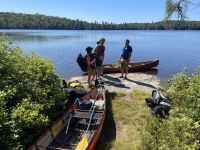
Our begins early just outside of Montreal. We are on the road before 7am and drive nearly 4 hours to reach Le Domaine. After first visiting the store, we check in at the office, pick up some maps, and are told by the friendly young lady at the desk that we were the first group she has sent out on Circuit 33 in several days—although she can’t speak for her colleagues. After a few formalities, we walk over to the boathouse and pick up the gear we are renting for the trip: a 16 ft Langford Prospect canoe, paddles for everyone with a couple of extras, and five PFDs.

I would prefer our own paddles and jackets, but you can only pack so much on a flight. We did bring all our other gear, plus a Pakboat 165 canoe, so we already had some bulky bags to contend with on the flight over from Germany.

An aside for anyone flying with a canoe, I was pleased to pay no luggage fees at all for the boat. The big pack-bag qualified as “sporting equipment” and flew for free. This left me with warm fuzzy feelings for Air Canada. Feelings which did not survive the return flight. But that’s a topic for later.

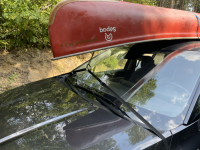
Back to the boathouse. We also rent a kit for strapping the rental canoe to the top of our car—basically some large, foam blocks and accompanying ratchet straps. We strap down the canoe and are on our way.

Another aside: I’ve noticed that Sepaq doesn’t have the best reputation on these boards, and I don’t know enough to comment on that one way or another, but I can report that everyone we spoke with was friendly and helpful, and spoke very good English. All of them quite young though. They do not offer, for whatever reason, three-seaters for rental, which is inconvenient for a group of five, and the main reason we ended up bringing our boat. I really didn’t want to be underway in 3 boats. As it turns out, with the shipping for my Pakboat being free, we ended up saving a fair bit in rental fees.

The route out to the launch at Lac Nichcotéa takes the better part of another hour. The howl of the wind over our rented canoe up on the roof during the highway section is a little unnerving for us, so we drive slow, and I keep an even slower pace on the last section, which is 30km of up and down on a gravel road.

IMG_5327.png


The launch at Nichcotéa is also a campground, and on a Sunday afternoon in mid-August most of the sites are taken. We eat a quick late lunch then find an empty site near the water to build up our boat. An extended family with 2 small kids arrives. They unload two canoes not far away from us. I mean to ask them their destination, but we’re distracted with loading, and they soon move down the beach and the moment slips away. By the time everything is done and our two boats are loaded, it’s almost 3pm.

Lac Nichotéa can get windy. There is a stiff breeze, but nothing too bothersome in this northern neck of the lake. It’s a hot one though—over 30 Celsius (90F) and blazing sunshine.

That won’t bother us today. We set off and paddle to the southeast, towards the closest possible campsite. Our goal isn’t to make distance but just get out on the water and get a spot for the night.

Barely a half hour later, we round the east side of the island and arrive at site 30-56.

One glance, and none of us really likes the look of it. It is set back in the trees, full of deadfall, lacks a beach, and looks rough with poor seating opportunities. It also looks a bit buggy.

There follows a debate about moving on. The island site at 30-50 is supposed to be nice. Two things speak against it. One, the other paddlers had set off behind us and we’d last seen them heading south along the western side of the island, quite possibly to the same site. Not wanting to compete with them, I regret not having asked them. Second, outside of our wind-sheltered spot, it is getting quite breezy. Finally, we’re all tired after a hectic day and just want to settle down for the night.

In the end, it’s unanimous. We pull the boats up and stay the night. As it turns out, there is enough breeze to keep away the worst of the mosquitoes until fairly late.

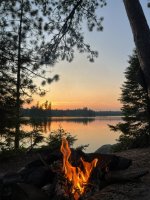
Dinner is sausages grilled over the campfire. The mood is good. After so much planning and preparation, and the long journey from Germany, it is good to finally be underway.

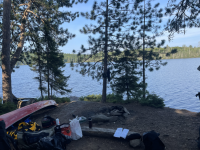
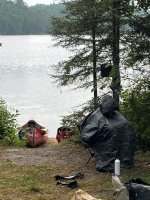
IMG_4108.JPG
IMG_4107.JPG

IMG_4129.JPG
 
Day 2

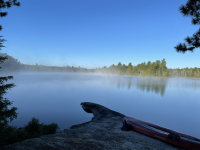
Wake up at 6 or so and am out of the tent by 7. Up through the trees, surrounding our campsite, I can see clear blue skies. The mild, almost warm early morning temperatures hold the promise of a hot day. Our last forecast before setting out predicted very hot temperatures for our first three days.

Our small, flying friends are up and about as well, but spray and a moderate breeze allows me to skip the bug net. I keep my arms and legs covered but the boys are already in shorts. I point out that this might not be wise, but they shrug it off and seem content enough. A symphony of hands slapping exposed skin accompanies our breakfast of coffee and oatmeal.

Striking camp has its usual first day slowness. With five people and accompanying bags, there are always a lot of questions up front as to what goes where. I have tried to improve our packaging strategy in comparison to the previous year and am fairly opinionated and insistent in getting everything into its rightful place. My winter planning has called for 6 bags with a total of 495 liters of storage space—just under 100 liters per person. A fair bit of weight and there’s a complication..

The reality is that we set out from Montreal the previous day with a number of things left over from our time there. Cereals. Chips. An extra sausage. A massive box of granola bars. A liter of maple syrup. All things not on the pack list. My sons—whose greatest worry is not bad weather nor bears nor hard portages—but that their father may not have planned enough food—hurriedly baptize an additional portage bag. Henceforth known as the “Overflow Bag”, it is a large and cumbersome grocery bag that makes for awkward carrying on the trail.

The sad thing is that I can’t even complain, since several beers of mine leftover from our time in Montreal have also made their way in there. Sigh..

As we busily break camp, we see a canoe with two paddlers pass by the island. Then at last, near 9am, we finally set off. Rounding the island, we see their boat again, a kilometer ahead, paddling west like us, into the wind.

We cross Nichotéa without incident and head south on Lac Nicolas. The other paddlers disappear to the west, towards Lac Desty. Probably on the #35 circuit.

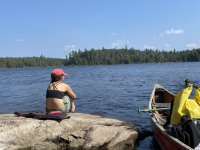
By noon, the blazing sun is beating down, and the water bottles are empty. We find a rocky outcrop stop for a swim and to filter water. As we wait for the water to run, we eat a few granola bars.

IMG_5339.png

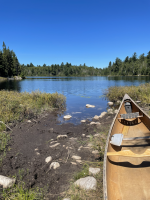
The wind picks up, so after a short break, we are on the way again. Coming roughly from the southwest, it feels like we have a headwind the whole way south down Lac Nicolas. Sweaty and tired, we are happy to spot the portage at the bottom of the lake in the early afternoon. The headwind and especially the heat have turned it into a real slog.

IMG_5340.png


The portage also has a campsite, 33-90, but the little information I’d turned up online doesn’t have much good to say about it. Our real target is 33-86 on Lac Paget, with 33-90 serving as backup if our preferred site is already occupied.

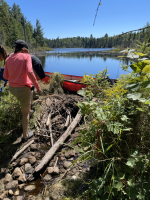
Paddling up to 33-90, the first thing we notice is a motorboat pulled up at the site. This is a surprise. First, since we haven’t seen any boat of any type since seeing off the paddlers in the morning. Secondly, motorboats are not allowed to use the campsites. Two Quebecois stroll out and greet us. A father and an adult son. Both are very friendly, and maybe a little sheepish at having been caught on a campsite. I’m not sure what they were doing, probably having lunch, but in any event they are soon off, leaving us to the muddy little 30-90. As it turns out, they are the last people we see this day.

The site is the same mold as yesterday’s 30-56, with the added perk of being in a swampy area. Judging from the thunderboxes, it gets very little use. All of us are eager to press on, but I am reluctant to commit to 33-86 without knowing if it’s already taken—a long portage stands between the two sites and there is nothing afterwards. So we decide to portage over a single boat and the kids volunteer to do some scouting.

IMG_5343.png

Have I mentioned how great it is to travel with three college-aged kids? Their energy is seemingly limitless.

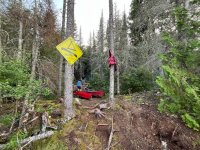
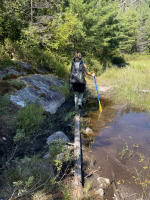
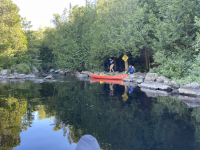
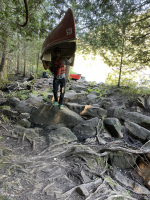
The 620m portage is fairly straightforward apart from a 30m stretch that requires a fair bit of acrobatic skill to dance your way along the thin and decaying logs that someone has thrown down in the knee-deep muck. We do make it through without losing any shoes, so that’s an accomplishment. The humidity and stifling heat is the hardest.

We ship the canoe over and the kids set off on to Lac Paget. I stand there, watching them until they pass out of sight. Then, assailed by mosquitoes, I judge it better to take the trail back and hop over the logs again. Sometimes it’s better to keep moving.

IMG_5347.png

My two sons deposit my daughter on the empty Lac Paget site and are back across the portage in half an hour—raving that they’ve found a good site. We team leapfrog the remaining boat and the gear and eventually have everything across the portage. Then we are out on Lac Paget. It is a pleasant enough lake, a bit swampy in places, but overall peaceful and with a very isolated feel. The winds we had felt out on the water earlier come at us from the side now and have diminished, so it is a pleasant paddle across.

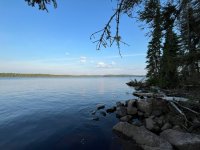
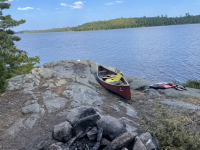
The site I like at once. Good views with a spacious fireplace area and rocks out front for sunbathing. The kids swim while I retire to the shade for an hour, a full water bottle and electrolyte pills in hand. I’ve begun to get a headache and am pretty sure I have not drunk enough in the long hours under the sun. I am fit by dinner though. We make grill skewers with fresh veggies and meat that we packed frozen at the start of the trip.

IMG_5354.png

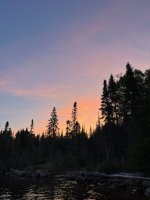
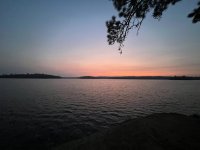
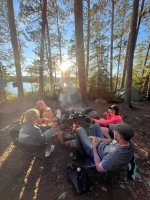
That evening we sit out for a long time, enjoying our own private lake, listening to the lonely call of a loon out on the water. Finally, the darkness and the bloodsuckers chase us into our tents.

IMG_4172.JPG

IMG_4202.JPG
 
Great report! I’m liking your style. La Verendrye is a favorite place of mine.
 
Day 3

My wife and I are up by seven. We quietly sip our coffee and watch the peaceful lake, enjoying the mild temperature that we know won’t last long. The kids appear one by one, and by eight we are all eating our usual oatmeal breakfast. Our version of oatmeal is not cooked, but rather is simply oats, steeped in hot water for a few minutes, accompanied by nuts, fruit, milk powder and a dash of that prolific supply of maple syrup we are carrying around. Tasty and filling.

It is tempting to linger and enjoy the blissful peace of Lac Paget, although we have a long day ahead of us. It is again past nine before we get underway.

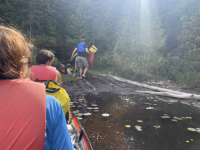
The first stretch is a short hop a few hundred meters down the lake. Our first portage of the day awaits. At over a kilometer, it is also the longest of the trip.
IMG_5357.png

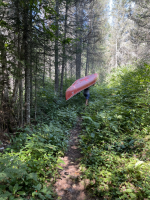
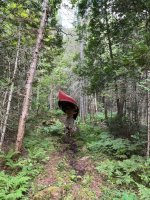
The portage trail is not overly challenging, but it’s muddy and there are a couple of fallen trees to clamber over. Underneath the tree canopy, with no breeze, it's already muggy and hot.
IMG_4207.JPG

Midway through we spot a large family of ground-walking birds of a species unknown to us. They certainly aren’t Eastern Wild Turkeys, which we’ve seen. (Looking online, after the trip, I think they were Ruffled Grouse.)

We do what I call a team leapfrog of the bags again: i.e. a couple of us carry our load to the very end, then come back and pick up bags that two of us have deposited at the halfway point. This works well. We have trouble with the Pakboat, which is proving awkward to carry overhead on rough terrain without a portage yoke. We have never had it on a wilderness trip. At times, we give up on the overhead carry and it takes two of us to portage it.

By the end of the trail, we are sweaty and hot, and the early mildness of the morning is long forgotten.

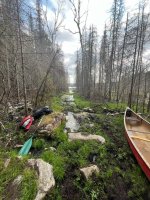
The portage trail—decent enough most of the way—has a soggy ending.
IMG_4233.JPG

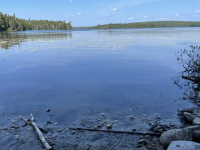
Parts of Lac du Noyer look like a flooded world. The decaying trunks of dead trees sprout from the water all along the edges, some of them 20 meters or more from the present shoreline. At some point, years back, water levels have risen here substantially. Beavers at work, I suppose.

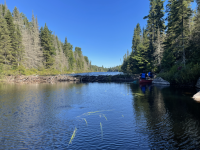
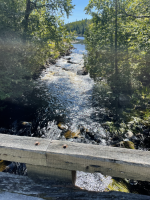
The portage to Lac du Sceptre certainly starts with a beaver dam. There is the remnant of an old logging road in this section. A section of the road (or bridge) has at some point been removed, leaving a gap which the beavers have filled quite well.

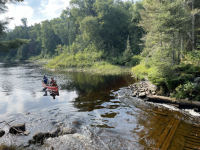
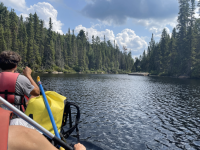
After portaging our stuff around the dam, we are soon underway again, following a narrow and shallow channel. But not for long, less than a kilometer later comes the next portage. That portage drops us into Lac du Sceptre, a small but pretty lake.
IMG_5371.png

We fill up the dirty bag with water for filtering at the next portage. Our water bottles are already empty. In this heat, we are chugging water laced with electrolytes. The remaining portage and the two additional beaver dams leave images that swim together in my memory—we are too busy to pause and make many pictures.

I remember it being hot, muggy and quite muddy in places. The last beaver dam shows no signs of anyone landing in recent times and requires a fair bit of bushwhacking to get around it. My original hope of simply lifting the boats over the dams proves misplaced. There is too much deadfall and debris around them. And finding a good landing is not always easy.
IMG_5367.png

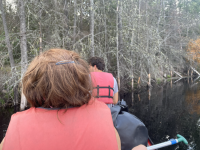
After the last dam, we put the boats back in on a small, winding channel. This is too shallow for paddling at the outset, so we line the boats for 50m or so. Given all the muck wading we are doing, I’m beginning to wish we’d packed a pair of wading boots. Afterwards we paddle and pole our way along.

In retrospect, this is a pretty strenuous section for us. Not for my sons, they almost seem to relish these tough portages and their good spirits never fail. They are truly the bedrock of these expeditions. But the women are flagging.

“You picked this route?” my wife asks at one point. There is a slight edge to her voice that one picks up on after 25 years of marriage. Uh oh.

A beaver dam later, I see my daughter looking tired and dejected. “Don’t worry, this is the hardest day,” I assure her.

“You said that yesterday.”

Oops, I did.

My women are hard-working paddlers and wonderful to have in camp. They usually portage without complaint. A trip wouldn’t be the same without them. I am grateful every day for their presence. But they are different than us men in the family. Much less interested in the whole "pain and suffering" aspect of canoe camping. Amazingly, they have the notion that pain and suffering shouldn’t be required at all!

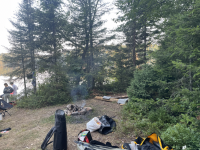
We finish the day’s padding with a roughly 8km journey down the northern half of Baie Mclaurin, ending at site 33-71. We are all hoping for a splendid campsite as a reward for our day’s labor, but it is not to be. It is more open, slightly prettier, and has marginally better views than the site of our first night, but it also suffers from poor seating opportunities and has a swampy area nearby that breeds a large number of mosquitoes.
IMG_5377.png

Everyone is in amazingly good spirits at dinner—a testament to our resilience, I think to myself. We cook, as every night, over an open campfire. Eggs, paprika and chorizo topped with an improvised salsa and wrapped in tortillas. Though the view is limited, our section of the lake is pretty enough. In the evening, a motorboat crosses down the lake to the south of us. It’s the closest we have come to seeing anyone else all day long.

IMG_5378.png
 
Whenever I read travel reports like this, I get really jealous!

You know why, since you've lived in Germany too, right?
The landscapes, rivers and lakes rich in water, and wildlife - simply magnificent!
 
Day 4

I wake at 3am to the pitter-patter of rain on the tent. I dash out to check that no clothes or anything else has been forgotten the previous evening when we hurriedly retired, chased into the tents by a cloud of mosquitoes, but it turns out everything has been properly stowed away. But we have been lazy and not bothered to set up the tarp for the hammock. We are traveling with two 3-person tents and a hammock, which the kids take turns using. Tonight, my younger son is there. He hurriedly unhooks the hammock and throws it into the outer foyer of our tent. Then he takes his gear and retires to the remaining tent, forced to squeeze in among his siblings. I listen to their groans of dismay for a while and fall back asleep.
My wife and I wake again just after 6. Comfy in our bags—we listen to the continued sound of rain. It eventually tapers off and before 7 we are out of the tent, getting the cooker going and preparing coffee.

The mosquitoes are pretty bad this morning, so for the first time during the trip some of us have put on face nets. My sons even cover their legs! It rains on and off during breakfast before finally clearing off for good around 8.

IMG_4242.JPG

We eat our usual bowls of oatmeal and soon strike camp. We have some open water to cross, and my inclination is to do it early, before the wind picks up. So we are off shortly before 9, not exactly early when I think of last year’s dawn departures, but about as good as we manage on this trip. My worries, as it turns out, are misplaced on this day. We paddle down the southern half of Baie Mclaurin in good time and out on to the open waters of Lac Byrd, where the wind is thankfully at our back. Strong enough to give us a good push and nothing worse.

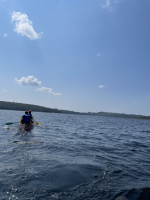
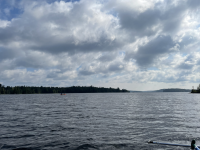
I am not sure what to expect with Lac Byrd, but have been fearing a lot of boat traffic. There is a launch on the lake, and my pre-trip research indicates it to be a popular fishing spot. As it turns out, two boats roar by, close enough to exchange waves. Another bobs along the shoreline in the far distance. But mostly it feels peaceful, open and empty. I zone out, lost in the pleasure of an easy paddle in cloudy almost cool weather. Last night’s storm seems to have broken the heat wave. We are so lost in the moment that I only take a single picture out on the lake.

IMG_5387.png

This is the first longer trip that we’ve done with purely “paper” navigation. My wife, sitting in the middle bench, is doing most of the navigating. We have occasional debates about which piece of land we’re staring at, but this is quickly settled. The route is also fairly straightforward.
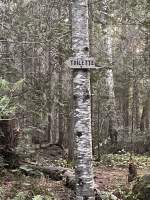
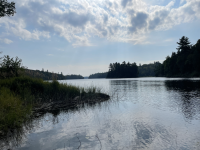
We pass 33-38, which looks like a nice site from the distance with good views and a gentle, rocky slope out front. We pass it by but decide to check 16-11 out. We have paddled for under 3 hours but have made good progress. All of us are looking forward to a relaxed day today. I am keen to keep everyone happy. But I am also determined to snag a good campsite.

The 16-11 site is, as expected, empty. We haven’t seen another canoe for a couple of days. It’s a big site with good tent pads, but a bit set back in the trees. Someone has been there recently and left a heap of cooked spaghetti noodles in the firepit.

We press on. Next up is 16-08. This area is where we overlap circuit 16. I almost picked 16 for our trip—it sounded scenic—but our lack of white water experience and the larger number of portages deterred me.

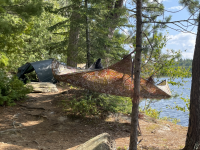
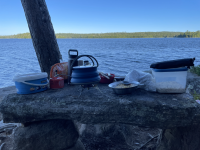
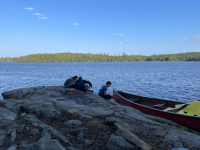
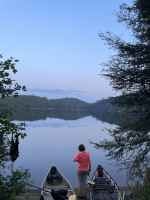
This site is also empty and it’s spectacular. There’s a comfortable, sheltered landing with room for a couple boats. Then you move progressively up a gentle bluff with views in three directions. There’s a pleasant seating area and an improvised stone table for cooking duties. Rocks for sunbathing and swimming. Tentpads with impressive views. Wow.

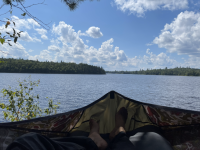
After eating lunch, I retire to the hammock for an afternoon nap while the rest of the family goes swimming. Later, I join them.

IMG_5390.png


IMG_5397.png

IMG_5400.png

In the late afternoon, we see a group with 2 canoes battling their way southeast into what is by then a strong headwind. They are strong paddlers and battle through. I suspect they ended up at the site with the spaghetti.

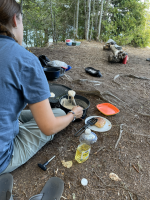
Tonight we make bannock as an appetizer and stuff little pieces of sausage into the dough. Then I put together the last of the “fresh” ingredients for dinner. Couscous, sausage, paprika and a bit of pesto. Probably the weakest meal of the trip, but as usual everything is eaten. As of tomorrow, the dinners are dehydrated.

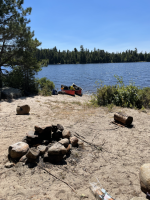
In the evening, we sit and chat for a long time, and the wife and I work down a couple cans from the beer surplus. Tomorrow we will repack things. The “overflow” bag is down to the jug of maple syrup (no longer full!) and 4 beers. We’ll find room for those elsewhere and it can be stuffed away. Hurrah — one less bag to portage! The Ice Mule backpack, where we’ve kept fresh things, becomes the trash bag.

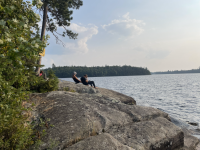
Everyone is in good spirits. The women are smiling. My wife tells me how much she has enjoyed the day. We take selfies of ourselves down on the rocks and watch the sun go down before finally retiring to bed.

IMG_4300.JPG
 
Day 1

Our begins early just outside of Montreal. We are on the road before 7am and drive nearly 4 hours to reach Le Domaine. After first visiting the store, we check in at the office, pick up some maps, and are told by the friendly young lady at the desk that we were the first group she has sent out on Circuit 33 in several days—although she can’t speak for her colleagues. After a few formalities, we walk over to the boathouse and pick up the gear we are renting for the trip: a 16 ft Langford Prospect canoe, paddles for everyone with a couple of extras, and five PFDs.

I would prefer our own paddles and jackets, but you can only pack so much on a flight. We did bring all our other gear, plus a Pakboat 165 canoe, so we already had some bulky bags to contend with on the flight over from Germany.

An aside for anyone flying with a canoe, I was pleased to pay no luggage fees at all for the boat. The big pack-bag qualified as “sporting equipment” and flew for free. This left me with warm fuzzy feelings for Air Canada. Feelings which did not survive the return flight. But that’s a topic for later.

Back to the boathouse. We also rent a kit for strapping the rental canoe to the top of our car—basically some large, foam blocks and accompanying ratchet straps. We strap down the canoe and are on our way.

Another aside: I’ve noticed that Sepaq doesn’t have the best reputation on these boards, and I don’t know enough to comment on that one way or another, but I can report that everyone we spoke with was friendly and helpful, and spoke very good English. All of them quite young though. They do not offer, for whatever reason, three-seaters for rental, which is inconvenient for a group of five, and the main reason we ended up bringing our boat. I really didn’t want to be underway in 3 boats. As it turns out, with the shipping for my Pakboat being free, we ended up saving a fair bit in rental fees.

The route out to the launch at Lac Nichcotéa takes the better part of another hour. The howl of the wind over our rented canoe up on the roof during the highway section is a little unnerving for us, so we drive slow, and I keep an even slower pace on the last section, which is 30km of up and down on a gravel road.

View attachment 151724


The launch at Nichcotéa is also a campground, and on a Sunday afternoon in mid-August most of the sites are taken. We eat a quick late lunch then find an empty site near the water to build up our boat. An extended family with 2 small kids arrives. They unload two canoes not far away from us. I mean to ask them their destination, but we’re distracted with loading, and they soon move down the beach and the moment slips away. By the time everything is done and our two boats are loaded, it’s almost 3pm.

Lac Nichotéa can get windy. There is a stiff breeze, but nothing too bothersome in this northern neck of the lake. It’s a hot one though—over 30 Celsius (90F) and blazing sunshine.

That won’t bother us today. We set off and paddle to the southeast, towards the closest possible campsite. Our goal isn’t to make distance but just get out on the water and get a spot for the night.

Barely a half hour later, we round the east side of the island and arrive at site 30-56.

One glance, and none of us really likes the look of it. It is set back in the trees, full of deadfall, lacks a beach, and looks rough with poor seating opportunities. It also looks a bit buggy.

There follows a debate about moving on. The island site at 30-50 is supposed to be nice. Two things speak against it. One, the other paddlers had set off behind us and we’d last seen them heading south along the western side of the island, quite possibly to the same site. Not wanting to compete with them, I regret not having asked them. Second, outside of our wind-sheltered spot, it is getting quite breezy. Finally, we’re all tired after a hectic day and just want to settle down for the night.

In the end, it’s unanimous. We pull the boats up and stay the night. As it turns out, there is enough breeze to keep away the worst of the mosquitoes until fairly late.

Dinner is sausages grilled over the campfire. The mood is good. After so much planning and preparation, and the long journey from Germany, it is good to finally be underway.

View attachment 151725
View attachment 151726

View attachment 151727
Interesting trip.. I had never heard of that outfitter before..
Im glad you had a good experience with them. And ..
amazing that your canoe flew for free!
 
Whenever I read travel reports like this, I get really jealous!

You know why, since you've lived in Germany too, right?
The landscapes, rivers and lakes rich in water, and wildlife - simply magnificent!
Yeah, that’s what I miss the most about the other side of the Atlantic. The wide open spaces.

We did get up to Sweden, which is nice. But such big trips are just too costly to fit them in regularly.

We do get a lot of vacation here in Germany though, so we have that advantage. I also enjoy our river trips here in Germany. It’s just a different type of trip. Not wilderness, but still often beautiful. It’s fun to stop for lunch in a Biergarten. When we do that, my son says it feels like we are “cheating.”
 
Interesting trip.. I had never heard of that outfitter before..
Im glad you had a good experience with them. And ..
amazing that your canoe flew for free!
Le Domaine is just the park headquarters at La Verendrye. Managed by a firm called Sepaq. You can rent boats and barrels there, but nothing else. Otherwise this was all self-organized. Yes, Air Canada has a nice policy for sporting equipment. I will give them that.
 
Last edited:
Nice trip report. I have done a few trips in and around that area, but my last trips were mostly north around circuit 77. Thanks for pleasant memories.
 
Back
Top Bottom