• Happy National Scotch [Whisky] Day! 🏴󠁧󠁢󠁳󠁣󠁴󠁿🥃🚱

Boating Lights

Joined
Oct 29, 2025
Messages
112
Reaction score
433
Location
Lansdale, PA
Pennsylvania requires all boaters (including unpowered boats) to carry a light. I've quoted the description of what's required below.

Night Lights. Paddlers must carry a white light that is either hand-held or installed and ready to be displayed in time to avoid collision. All boats must show required lights between the hours of sunset and sunrise and during periods of restricted visibility, such as fog and heavy rain.

I'm having a tough time figuring out what I can use to meet this requirement. Does anyone have any suggestions or want to talk about what you use for paddling during evening/night hours?
 
In Canada, we must have 50 feet of floating rope (throw bag), a water bailer, and a flashlight. For regular boaters, they sell enclosed kits, a plastic bucket thing that holds the rope and the flashlight. It's just a cheap battery powered flashlight. Those three criteria must be on the water craft at all hours of the day.

However, for canoeing, I usually carry a quality throw bag, a bailer of some sort and a high quality head light. There are lots of headlights out there now that can throw a very strong beam. I'm fairly certain a quality headlight would fulfil your night light requirement.
 
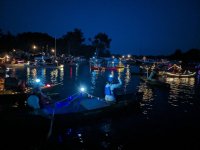
Ideally no lights at night and let your eyes get used to the dark. If I had to display the light all the time, a weak head torch worn above the brim of a hat. If needed just to avoid collision then a good head torch worn above the brim ready to switch on.. ..... Or you could go over the top as at the Dutch canoe festivalPXL_20230909_185723185.jpg
 
Interesting. Although I don't do it, I've always thought that PA required a white stern light & the red / green navigation lights on the bow (not a bad idea if you're paddling someplace that sees powerboat traffic).

If you're just looking for a white light to satisfy the requirement as quoted, a headlamp (which I do wear after dark although it's rarely on) should do nicely. Imagine that; I'm more legal than I thought.

Wait... quoted text says "hand-held" and "ready to be displayed". Throw a small mag light in your pocket & you should be good to go.
 
Amazon sells kits with 3 bike lights and vinyl pouches to keep them dry, Tie a thick stick or chunk of broom handle across your bow cap and slide them on the ends, and put the white one on a piece of flat elastic or attach it to the back of your headlamp- you don't get quite the 270° most places call for, but It's been enough to make every cop or ranger I've bumped into happy, even when running my outboard...
 
Interesting. Although I don't do it, I've always thought that PA required a white stern light & the red / green navigation lights on the bow (not a bad idea if you're paddling someplace that sees powerboat traffic).

If you're just looking for a white light to satisfy the requirement as quoted, a headlamp (which I do wear after dark although it's rarely on) should do nicely. Imagine that; I'm more legal than I thought.

Wait... quoted text says "hand-held" and "ready to be displayed". Throw a small mag light in your pocket & you should be good to go.
well, it COULD be hand held if needed, and it IS readily accessible, so there's that...
 
These are a go-to for the MR340, which takes place on a commercially navigable waterway. You can use tape to shield the portions of the light that face or backlight the paddler.

 
Im not night paddling anymore, but when I did, I just carried a flashlight. There were usually no boats where I was paddling. When I heard a motor, I’d pull aside and shine the flashlight. I can’t remember more than one or two times this happened.
 
I've run into the Canada 50' throw line requirement when canoeing in BC. As a solo canoer I don't see myself ever using a line to help someone by throwing them a line. Seems like a good recipe for ending up in the water with them.
 
Just put a bunch of kids through a WWR course taught by some very good instructors. They spent a lot of time on releasing canoes from pinned or broached situations, using throw bag ropes and carabiners. It is most certainly a valuable skill, particularly if you are solo. There is always a chance you could pin your canoe, even in sedate river runs if your attention lapses. Even if you don't need to use the mechanical advantage of a few carabiners to get your canoe unpinned, it's good to have the long rope attached to your canoe and anchored on shore so it will eddy out or be able to be pulled back once released.

They also taught some very interesting rescue swimming skills, when combined with throw bags, that were very appropriate for solo canoeists. in one case, the throw bag was anchored to one side, then the swimmer powered over to the other side. The rope could be tied off on the other side and used as either something to hang onto in shallow but swift water, or used as a diagonal travers of the river, if your canoe was pinned in the middle, you could position the diagonal rope in front of it and then use the rope to get back to the canoe.

Lots of other things that were really cool.

And of course, if you do happen to meet another canoeist in your solo adventures, and they take a drink, or get stuck in the middle of the river, there are a variety of techniques to assist him/her back to safety.

I've taken quite a few canoe courses, I have to say the WWR course is one of the most demanding, but also valuable courses I have been involved with.
 
My experience with headlamps is you spoil your night vision when you raise your hands at the beginning of the stroke.

If I needed to run lights on my canoe, I'd use a marine light on a pole that has 360 degree view, but does not cast downward.

Practically, I very rarely paddle at night where there are motorboats. I have a headlamp to comply with the law in nc. But i haven't needed to turn the light on in over a decade.

And carrying the throw rope is a really good idea, both for yourself and fellow river users. I've also used mine to extract sunken canoes and tires.
 
I've taken quite a few canoe courses, I have to say the WWR course is one of the most demanding, but also valuable courses I have been involved with.
I'll have to see if any are offered locally. With my Wabakimi trip canceled, I could get into something like that (I'm another who carries the floating line because Canada says I must- and I'm far more likely to follow the laws in another state or country than I am while in my own- but I've always wondered who they thought I might be throwing it to)
 
My experience with headlamps is you spoil your night vision when you raise your hands at the beginning of the stroke.


Try it in heavy fog sometime.

My team and I (or just I solo) like to paddle the unofficial Adirondack "cannonball", which is the entire old traditional 90 mile route to be completed all within the same calendar day (as opposed to the official 3- day staged 90 mile race). To do so I like to begin paddling at the exact stroke of midnight, which puts me at the finish an hour or two before sunset (if it is in mid-June). In the calm totally dark night there are as many stars visible on the broad lake surface of the water as there are stars shining in the sky above. Pick one star as a guide to my direction until I need another. Such a treat unspoiled by lights.

Rarely is there any motor boat traffic roaring in the distance on the bigger lakes in the beginning hours of our route, but those who are out at that hour are probably drunk. Thus, we have lights for such an instance if one approaches. Light is also necessary for areas of shallows and the not quite sunken stumps that we must negotiate with light (at the end of 7th lake in particular). Often that tricky area in the cool pre-dawn hours will have pea-soup thick fog. A headlamp will instantly blind my night vision as the reflection of my pale hand of the paddle grip glares with every stroke. Sometimes we mount a switched light on the bow deck in front of me, but it only helps if we are too close and too late, about to crash into an exposed stump, reserved only for distant drunk motor boat drivers.
 
I went for an evening paddle last night, so that's what got me thinking about it. The lake I usually paddle on has a 20hp restriction on motor boats, but it turns out if they're enthusiastic they can still get moving pretty fast. I didn't have any trouble last night, but still. The wakes were fun though.

Looks like I have some research to do, thanks for all the ideas. My thinking is that if I'm going to carry a light to meet this requirement then I might as well make it useful. But I also don't want to have it take up a ton of space so I can keep in with the pack I always have in my canoe.

@yknpdlr I don't think I'll ever do anything like that, but it sounds amazing. I have definitely found some of those hidden stumps between Flowers and Oseetah, and that was in broad daylight.
 
I'll have to see if any are offered locally. With my Wabakimi trip canceled, I could get into something like that (I'm another who carries the floating line because Canada says I must- and I'm far more likely to follow the laws in another state or country than I am while in my own- but I've always wondered who they thought I might be throwing it to)
I didn’t know that was a rule/law. I wonder what other violations I’ve unwittingly committed.
 
They used to sell boat nav lights that were basically a 2-D flashlight with a split red/green lens, probably something like that is still available.

Canoes aren't allowed on our lake after dark but powerboats aren't allowed at all, so on the rare occasion I break the rules and go out after dark I don't worry about lights.
 
Back
Top Bottom