

You are using an out of date browser. It may not display this or other websites correctly.
You should upgrade or use an alternative browser.
You should upgrade or use an alternative browser.
Ash gunnel $26 ea., Maine
- Thread starter Robin
- Start date


I’m buying 4 rails, $28 planned to your specs, pretty good deal for me as I will need outwales for a couple of canoes.

I wonder if he has any spruce rails. I need two pairs of inwales.
Jim
Jim
I wonder if he has any spruce rails. I need two pairs of inwales.
Jim
I’m waiting to hear back from him as to when I can pick up my gunnels, I’ll ask him if he has or can get spruce.
Thanks Robin.
Jim
Jim

I just bought some rift sawn 16' Sitka Spruce stock for gunnels. True 2'x6'x16'. It will yield 12 pieces, or enough for 3 canoes if I choose to use them for inwales and outwales. My cost per piece, materials only- no labor, is $22.25. Sourcing the materials is half the battle of building or restoring!
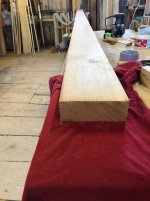
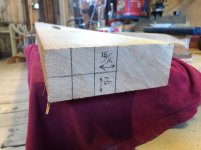
I’ve tried Sitka spruce for inwales on an Old Town OTCA and even with steam could not get them to take the bend at the ends, they broke on me.
Have you had luck with that wood before?
Its stiffness is what it is known for hence musical instrument bracing and masts and spars.
Jim
Have you had luck with that wood before?
Its stiffness is what it is known for hence musical instrument bracing and masts and spars.
Jim
No... but I tend to pre-soak for a long time-even a week or ten days- then steam in a plastic bag/tube. Full disclosure, none of the canoes on which I will use it have a dramatic upsweep to the stems. I have 3 Old Town 50#ers that will use these, for inwales at a minimum. Outwales either Ash or Mahogany (for a little flair!).Have you had luck with that wood before?
Good luck, I’ll be following along, you have the right plan it sounds like.
Jim
Jim

Working at the Chicagoland Canoe Base in Chicago back in the day (early '70s for me), sitka spruce was used for the birch bark replica gunnels, the boats with the high up-swept ends. The trick Ralph Frese, the boss, came up with for that problem was to slit with a bandsaw (thinnest kerf we could get) for the length of the bend (and a little more?), then slit each of those also. Three cuts leaves four thin "leaves" that can be bent to the radii needed. For gunnel stock not as wide, fewer slits might be sufficient (just one or two? Maybe? Good luck!). Some careful planning on exactly spacing the kerfs along the gunnel so the curves at each end do end up in the right place to match your specific canoe shear line will need to be done. I can't help you with that. We had charts with everything written out for the various length boats made there.I’ve tried Sitka spruce for inwales on an Old Town OTCA and even with steam could not get them to take the bend at the ends, they broke on me.
He had metal jigs that we'd wax, pull the first leaf up against the jig and paint with glue, then follow with the other three in succession, clamping all of them in many places (clamps well waxed) to make sure they stayed until the glue was dry. Each metal jig was 1/4-inch flat stock braced with a stiffener and was over bent somewhat as there was always a bit of spring back. If it doesn't match exactly, a little bit of bending can be done, but not very much. The glue used brown plastic resin glue, which usually matched the color of the wood close enough that it was hard to tell that this cheat method was used to get the wood to form correctly. Epoxy might show more? Try to make sure you get enough glue into the space where the kerfs end so you don't have to fill holes later.
The Indians back in the birch bark days who built canoes would slit for really tight bends (even though they weren't using sitka spruce) and not glue, just lash it all together with spruce roots, as can be seen in Bark Canoes and Skin Boats of North America.
Just suggestions as to how it can be done successfully. There might be other ways, too. Good luck with it.
Last edited:

Yes Nick I’ve kerf cut many tight bends but I broke the ones I was working on before I thought of using that method.
Fortunately I live in a boatbuilding area and finding Sitka Spruce is not that difficult. I actually have some on hand but it isn’t long enough. One of the boats that need them is a 115 year old Rushton Indian Girl 16’ so I want to what he used.
Jim
Fortunately I live in a boatbuilding area and finding Sitka Spruce is not that difficult. I actually have some on hand but it isn’t long enough. One of the boats that need them is a 115 year old Rushton Indian Girl 16’ so I want to what he used.
Jim

the old-timers around here used to cut long (15-20") finger joints to splice gunwales, with each blade being around 1/8" thick to use up any shorter lengths, many also cut their own gunwales and often used natural crooks from branches to create their upswing...Yes Nick I’ve kerf cut many tight bends but I broke the ones I was working on before I thought of using that method.
Fortunately I live in a boatbuilding area and finding Sitka Spruce is not that difficult. I actually have some on hand but it isn’t long enough. One of the boats that need them is a 115 year old Rushton Indian Girl 16’ so I want to what he used.
Jim
Great find.
Hard to ship.
Hard to ship.
I picked my gunnels up today, very nice material. He said he has just about sold out. He also mentioned he can get spruce.
Thanks Robin, can you PM his phone number? I don’t use Facebook.
Jim
Jim
His email is cantdoglumber@gmail.com
Thanks
Jim
Jim
Similar threads
- Replies
- 10
- Views
- 2K


- Replies
- 5
- Views
- 413


- Replies
- 14
- Views
- 2K
- Replies
- 5
- Views
- 455
- Replies
- 2
- Views
- 947