• Happy Birthday, Babe Ruth (1895-1948)! ⚾🏠🏃‍♂️

Safest places to canoe in the USA after a nuclear war

Glenn MacGrady

Administrator
Staff member
Joined
Oct 24, 2012
Messages
6,630
Reaction score
12,717
Location
Connecticut
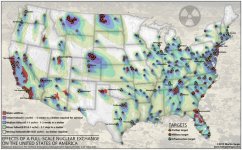
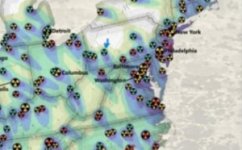
The U.S. Federal Emergency Management Agency probably didn't have canoeing in mind when they produced this map that shows which places in the USA would be blown to bits, burned to ashes, or contaminated by radioactive fallout after a full-scale nuclear exchange. But it looks like the canoeing waters of Maine, Minnesota, and northern Wisconsin and Michigan will be pretty safe.

That is, if you prefer black flies to nuclear bombs. Could be a close call.


Nuclear war danger zone map.jpg
 
Or Canada?

Southwest Texas should one need to stay warm. I’m actually in a minor fallout area. If all my mango trees hadn’t succumbed to the recent spate of 26 degrees, I might even have something to eat stored up.
 
When I was in the Air Force, flying with the Strategic Air Command (specializing in nuclear delivery systems), we were definitely a target at our base not far from the southwestern corner of the Adirondacks. We knew that not only was the base itself a target, but so was the area several miles off the north end of the runway, to catch departing already airborne bombers. That direction happened to be on the way to both my and my wife's home town families about 50 miles away. i told her that if the big one blew, definitely do not go that way, but to head directly east into the Adirondacks or west toward Lake Ontario instead. Not that it would have mattered much or made any difference in the long run.
 
Missile silos.
We certainly have a lot of military targets in Montana, North Dakota and southeastern Wyoming. What are they?

As with Offutt (SAC home base), Ellsworth, Whiteman (home of the B2 bomber), FE Warren, Malmstrom, and Minot Air Force bases ("why not Minot? Freezin's the reason"). These are Bomber, Tanker air refueler, and ICBM missile launch bases. They are situated far from the coastline to provide maximum warning and response time before being struck from sub launched missile attacks. Post WWII and Cold war thinking.

On SAC bases there and also closer to the coast, air flight crews lived in the Alert Facility immediately adjacent to their parked aircraft for a week at a time on a rotating basis. "Milssile Moles" lived underground for the duration. I remember a few times when tensions were so extra high that we literally lived on board the aircraft to save the 30 seconds that it takes "when the Klaxon horn goes off" to run through the facility exit tunnels to the aircraft, so that we could get off the ground that much faster. Each week featured at least one practice unannounced deafening klaxon blast to run out to your aircraft. On board, the navigator receives and decodes an encrypted radio message instruction, co-pilot verifies the decode, Pilot starts engines, hold brakes, receive another message and (hopefully) shut down. The message rarely included instruction to taxi to the runway hold line within xx minutes and another to stand down, turn around, reset to our original parking slot. Until the first received message is decoded, we never knew for sure if it was practice or real to take off and fly our planned mission heading north.

Watch the 1955 movie "Strategic Air Command" with Jimmy Stewart for a Hollywood rendition of what it was like.

 
Last edited:
As with Offutt (SAC home base), Ellsworth, Whiteman (home of the B2 bomber), FE Warren, Malmstrom, and Minot Air Force bases ("why not Minot? Freezin's the reason"). These are Bomber, Tanker air refueler, and ICBM missile launch bases. They are situated far from the coastline to provide maximum warning and response time before being struck from sub launched missile attacks. Post WWII and Cold war thinking.

On SAC bases there and also closer to the coast, air flight crews lived in the Alert Facility immediately adjacent to their parked aircraft for a week at a time on a rotating basis. "Milssile Moles" lived underground for the duration. I remember a few times when tensions were so extra high that we literally lived on board the aircraft to save the 30 seconds that it takes "when the Klaxon horn goes off" to run through the facility exit tunnels to the aircraft, so that we could get off the ground that much faster. Each week featured at least one practice unannounced deafening klaxon blast to run out to your aircraft. On board, the navigator receives and decodes an encrypted radio message instruction, co-pilot verifies the decode, Pilot starts engines, hold brakes, receive another message and (hopefully) shut down. The message rarely included instruction to taxi to the runway hold line within xx minutes and another to stand down, turn around, reset to our original parking slot. Until the first received message is decoded, we never knew for sure if it was practice or real to take off and fly our planned mission heading north.

Watch the 1955 movie "Strategic Air Command" with Jimmy Stewart for a Hollywood rendition of what it was like.
I've been in a Minuteman control room. You take an elevator down about 60 feet. Then, there are 2 spherical rooms on either side of the elevator room. One room is all machinery, the other is the control room. I remember the doors as being like vault doors. The floor of the both rooms are suspended on 3 big shock absorbers so that they don't contact the spherical walls. The two operators have military style airplane seats with seat belts and shoulder straps that are mounted on a floor track so the operators can slide side to side to monitor the instruments. They are far enough apart so that no single person can turn the 2 launch keys (they both have to turn the keys in near unison to launch). There is an emergency exit - a round hatch that can be opened. On the other side is a tunnel slanting up to the surface. The tunnel is filled with sand, so you have to dig out, should you survive a near miss. The real question is, "dig out to what?" The escape tunnel is kind of a bad joke.
 
Back
Top Bottom