Since getting into canoe tripping, I’ve coveted a fast, efficient, hard tracking tripping canoe. I’m a big fan of Swift’s construction, and I really like David Yost’s design philosophy, so when the Wabakimi 18 was introduced this spring, I started trying to rationalize buying a new canoe. Rutabaga in Madison, WI had one available, so I took it for a test paddle. My main concern was if I would feel comfortable with the 32” waterline width. On the test paddle I felt marginally comfortable, but I know that if a canoe feels marginally comfortable on a short test paddle, it will probably feel pretty good after a couple of hours of boat time, and after a few paddles, it will feel like home; which it did. So I choose my layup and options, and picked up my new boat from Rutabaga at the end of June. The fit, finish, and workmanship is as usual for Swift, outstanding. I’ve owned boats built by Wenonah, Northstar and Swift; they all make light and strong boats, but Swift’s construction is on another level.
Build/Options
I chose the carbon fusion layup with the epoxy resin upgrade. I also went with the carbon tech package and added the sliding bow seat, and both bow and stern foot bars. I know a bow foot bar is unusual, but not having one is something I really dislike about paddling bow in other canoes. I’m 6’3” and leggy, so when sitting in the demo boat at Rutabaga, I noticed that the foot bars were still a bit snug for me, even when adjusted full forward. So I asked that they be mounted 3” forward on my boat. With the carbon tech package, you have the option of bucket seats, or webbed seats. I love Swift webbed seats, so went with them.
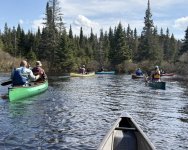
My son and I have been out for several fitness paddles, and along with my sister and nephew, we just finished our first seven day trip in the new boat. For the trip, we also rented a Wenonah Minnesota II, witch gave us a great opportunity to compare the two hulls. Other than mixing it up for a few short day paddles we mostly had me in the back of the Wabakimi, with my sister in front, and my son in the back of the MN II with my nephew in front. Both boats were very similarly loaded with paddler and gear weight at about 550 pounds in each boat.
Here are my impressions:
Stability:
The Wabakimi feels playful; it gives you a lot of feedback initially, but stiffens up with a progressive secondary stability, right up to the top of the tumblehome, where it starts to fall off, but can still be recovered with a brace. Comparatively, the MN II felt a little dead, with more initial stability, but not as progressive in secondary stability, and when it did fall off, it seemed more sudden and less predictable. Not that the MN II is bad, but to me, the Wabakimi is the ideal for a tripping canoe; it talks to you, but is progressive and predictable.
Seaworthiness:
We had a great opportunity to compare and contrast the seaworthiness between the Wabakimi and the MN II. We were out for a day paddle, and had one mile of unprotected headwind and whitecaps. Both boats had similar weight paddlers, light day packs, and a bag of water for ballast in the nose to provide good trim. We were both crossing the waves at about 30º. I was in the back of the Wabakimi, and it would pitch up and over the waves with very little rolling motion. My son was in the back of the MN II, and said it would cut straight through the waves with very little pitching, but a fair amount of rolling motion. The MN II took a few splashes over the side, but nothing that would amount to needing to bail water unless those conditions persisted for a very long time. The Wabakimi stayed absolutely dry.
Just to feel the boat out, I turned directly into the waves for a bit, and again: completely dry. I then turned almost, but not quite, parallel to the waves, and there was still surprisingly little rolling, no water over the side, and the boat remained controllable and easy to turn back up into the waves with a couple of sweep strokes from the stern. We didn’t encounter any significant following waves on our trip, but the Wabakimi’s bit of rocker and flared shape at the ends, vs the MN II’s zero rocker and slab sides lead me to believe that the Wabakimi would be more controllable and resistant to broaching in following seas. I love how the Wabakimi feels in waves, it just seems to ride up and over waves without any bother at all. It’s a dryer ride than the MN II, and yet has less freeboard and is therefore easier to handle in the wind.
Self rescues:
This was my nephew’s first trip and first time in a canoe, so we spent some time practicing self-rescues. I like to use the Capistrano flip to right a capsized canoe in deep water, and we were able to get the Wabakimi upright and virtually dry without much trouble. But the MN II sat so low in the water when capsized that we couldn’t get it upright without a significant amount of water left in the boat. It could be bailed out if you spent some time at it, but if I was tripping in cold water in an MN II, I think I’d want to bring along one of those bilge pumps used by kayakers.
Speed/efficiency:
The MN II is considered by many to be the quintessential fast-tripping canoe, so I was eager to A/B test it against the Wabakimi. I know for some, it’s almost considered impolite to talk about how fast a canoe is, and mentioning actual values is downright tacky. But the type of person considering a boat like this probably is concerned with speed, so I’m going to go ahead and be tacky and tell you how fast (or slow) my son and I paddled both boats back to back. We did this on a day with a light breeze and ripples on the water; no real waves. We paddled each boat along the same course, upwind and downwind, and would then swap seats and do it again. We didn’t use heart rate monitors, but did our best to keep perceived effort consistent. Going upwind we got identical speeds out of both boats 4.7-4.9 MPH. Going downwind, the MN II was maybe a tick faster at 5.2-5.4 MPH while the Wabakimi was 5.1-5.3 MPH. This was at a fairly brisk effort for us; the kind of pace we keep if going out for a one-hour workout. At our all-day tripping pace, I’m guessing there would be no speed difference at all between the two boats, or maybe even an advantage to the Wabakimi, as its shorter and narrower waterline would become relatively more efficient at the more sedate tripping speed. Stronger paddlers than us may find more advantage in the MN II. At any rate, these two boats are very very close in speed.
Overall, I think I’d be pretty happy paddling an MN II (as long as it was from the stern), but I absolutely love the Wabakimi 18. I find it very comfortable to paddle all day from the front or back, and it’s combination of speed, tracking, and seaworthiness is exactly what I’m looking for in a tripping canoe.
Build/Options
I chose the carbon fusion layup with the epoxy resin upgrade. I also went with the carbon tech package and added the sliding bow seat, and both bow and stern foot bars. I know a bow foot bar is unusual, but not having one is something I really dislike about paddling bow in other canoes. I’m 6’3” and leggy, so when sitting in the demo boat at Rutabaga, I noticed that the foot bars were still a bit snug for me, even when adjusted full forward. So I asked that they be mounted 3” forward on my boat. With the carbon tech package, you have the option of bucket seats, or webbed seats. I love Swift webbed seats, so went with them.
My son and I have been out for several fitness paddles, and along with my sister and nephew, we just finished our first seven day trip in the new boat. For the trip, we also rented a Wenonah Minnesota II, witch gave us a great opportunity to compare the two hulls. Other than mixing it up for a few short day paddles we mostly had me in the back of the Wabakimi, with my sister in front, and my son in the back of the MN II with my nephew in front. Both boats were very similarly loaded with paddler and gear weight at about 550 pounds in each boat.
Here are my impressions:
Stability:
The Wabakimi feels playful; it gives you a lot of feedback initially, but stiffens up with a progressive secondary stability, right up to the top of the tumblehome, where it starts to fall off, but can still be recovered with a brace. Comparatively, the MN II felt a little dead, with more initial stability, but not as progressive in secondary stability, and when it did fall off, it seemed more sudden and less predictable. Not that the MN II is bad, but to me, the Wabakimi is the ideal for a tripping canoe; it talks to you, but is progressive and predictable.
Seaworthiness:
We had a great opportunity to compare and contrast the seaworthiness between the Wabakimi and the MN II. We were out for a day paddle, and had one mile of unprotected headwind and whitecaps. Both boats had similar weight paddlers, light day packs, and a bag of water for ballast in the nose to provide good trim. We were both crossing the waves at about 30º. I was in the back of the Wabakimi, and it would pitch up and over the waves with very little rolling motion. My son was in the back of the MN II, and said it would cut straight through the waves with very little pitching, but a fair amount of rolling motion. The MN II took a few splashes over the side, but nothing that would amount to needing to bail water unless those conditions persisted for a very long time. The Wabakimi stayed absolutely dry.
Just to feel the boat out, I turned directly into the waves for a bit, and again: completely dry. I then turned almost, but not quite, parallel to the waves, and there was still surprisingly little rolling, no water over the side, and the boat remained controllable and easy to turn back up into the waves with a couple of sweep strokes from the stern. We didn’t encounter any significant following waves on our trip, but the Wabakimi’s bit of rocker and flared shape at the ends, vs the MN II’s zero rocker and slab sides lead me to believe that the Wabakimi would be more controllable and resistant to broaching in following seas. I love how the Wabakimi feels in waves, it just seems to ride up and over waves without any bother at all. It’s a dryer ride than the MN II, and yet has less freeboard and is therefore easier to handle in the wind.
Self rescues:
This was my nephew’s first trip and first time in a canoe, so we spent some time practicing self-rescues. I like to use the Capistrano flip to right a capsized canoe in deep water, and we were able to get the Wabakimi upright and virtually dry without much trouble. But the MN II sat so low in the water when capsized that we couldn’t get it upright without a significant amount of water left in the boat. It could be bailed out if you spent some time at it, but if I was tripping in cold water in an MN II, I think I’d want to bring along one of those bilge pumps used by kayakers.
Speed/efficiency:
The MN II is considered by many to be the quintessential fast-tripping canoe, so I was eager to A/B test it against the Wabakimi. I know for some, it’s almost considered impolite to talk about how fast a canoe is, and mentioning actual values is downright tacky. But the type of person considering a boat like this probably is concerned with speed, so I’m going to go ahead and be tacky and tell you how fast (or slow) my son and I paddled both boats back to back. We did this on a day with a light breeze and ripples on the water; no real waves. We paddled each boat along the same course, upwind and downwind, and would then swap seats and do it again. We didn’t use heart rate monitors, but did our best to keep perceived effort consistent. Going upwind we got identical speeds out of both boats 4.7-4.9 MPH. Going downwind, the MN II was maybe a tick faster at 5.2-5.4 MPH while the Wabakimi was 5.1-5.3 MPH. This was at a fairly brisk effort for us; the kind of pace we keep if going out for a one-hour workout. At our all-day tripping pace, I’m guessing there would be no speed difference at all between the two boats, or maybe even an advantage to the Wabakimi, as its shorter and narrower waterline would become relatively more efficient at the more sedate tripping speed. Stronger paddlers than us may find more advantage in the MN II. At any rate, these two boats are very very close in speed.
Overall, I think I’d be pretty happy paddling an MN II (as long as it was from the stern), but I absolutely love the Wabakimi 18. I find it very comfortable to paddle all day from the front or back, and it’s combination of speed, tracking, and seaworthiness is exactly what I’m looking for in a tripping canoe.