

@Gamma1214, in his Bloodvein II build thread, recently sawed off a protuberant strip along the edge or corner where the top of the hull sharply bends in so as to narrow the gunwale beam. Thereupon, his build thread began to diverge into a discussion as to what this feature is called. Candidates included "shoulder", "knuckle" and "chine". I've moved that terminological discussion to this new thread.
"Chine" is clearly incorrect terminology for the upper hull feature at issue. The chine is the transition area between the bottom of the canoe and the sides. The chine's radius can be a very gradual curve, called a soft chine, or it can be a "sharp" or "hard" chine radius. But that's not the hull transition zone at issue. What's at issue is the sharp edge or corner that transitions (usually) flared sides into a tumbled gunwale beam at the top of the hull.
The feature we're talking about is not new. It's been a standard feature, designed into canoes, particularly solo canoes, in modern era USA for 45 years.
Harold Deal, Dave Yost and Dave Curtis collaborated in 1981-82 to design for Harold a combined whitewater racing canoe called the Dragonfly, which was manufactured by Curtis. One feature of this canoe was that it had flare above the chines, then a sharp edge or corner, which then slanted the top of the hull inward to narrow the gunwale beam. Harold wanted this feature so he could heel the canoe in whitewater to the wide corner, yet not have waves slop over the gunwales themselves as they would do in a flared or straight-sided hull with no tumble at the gunwale sheer.
Deal, Yost and Curtis forevermore called this feature "shouldered tumblehome" because the top of the hull "tumbles" home above the sharp "shoulder" edge at the widest part of the flare, which is the feature we're discussing. This terminology has been uniform in USA for all Yost, Deal and Curtis/Hemlock canoes, and the host of manufacturers who copied the feature (like Bell and its progeny), for 45 years now.
I don't know about terminology in Canada, where paddlers still like to solo big tandem canoes that have no shouldered tumblehome.
Northstar Canoes now calls this hull architecture "shouldered flare" instead of "shouldered tumblehome". I assume they do so because they want to emphasize the flared hull architecture below the shoulder. They have an informative shouldered flare page, which has diagrams of different hull architectures, and here is their diagram of shouldered flare:
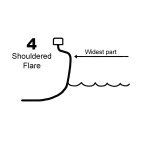
Northstar's neo-terminology may focus on the hull flare below the shoulder rather than the more common terminological focus on the tumblehome above the shoulder, but the shoulder is still called the "shoulder".
In summary, the sharp crease above flared sides and below tumblehomed gunwales has long been established in the U.S. paddling lexicon as a "shoulder", as far as I'm concerned.
On a decked kayak or canoe, that sharp corner/edge would demarcate the physical transition from the deck to the hull, and would typically be called the "seam line".
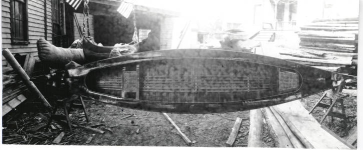
Related to seam lines, Harold Deal told me in person many times that he first got the idea for shouldered tumblehome from looking at partially decked Rushton canoes in photographs and museums, such as the two below. This first Rushton canoe (~1908) has a flared hull that, at the seam between hull and deck, "tumbles" the cockpit gunwales inward at an up-sloped angle.
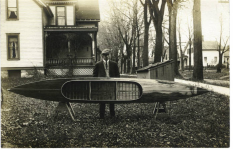
Here's another ~1908 Rushton with a much fuller deck, but the feature of tumbling of the cockpit/gunwales upward and inward alongside the paddling station is conceptually the same.
While limited by the bending methods of bark and ribs, you can see that the Eastern Cree pulled in ("tumbled") the gunwale tops of their so-called "crooked canoe" hulls. (Adney & Chapelle, p. 101)
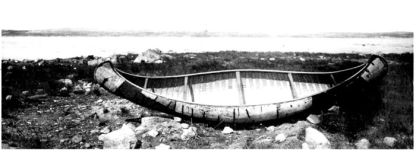
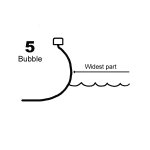
In today's Yost-influenced terminology, we'd probably say the Cree crooked canoe has bubble-sided tumblehome.
"Chine" is clearly incorrect terminology for the upper hull feature at issue. The chine is the transition area between the bottom of the canoe and the sides. The chine's radius can be a very gradual curve, called a soft chine, or it can be a "sharp" or "hard" chine radius. But that's not the hull transition zone at issue. What's at issue is the sharp edge or corner that transitions (usually) flared sides into a tumbled gunwale beam at the top of the hull.
The feature we're talking about is not new. It's been a standard feature, designed into canoes, particularly solo canoes, in modern era USA for 45 years.
Harold Deal, Dave Yost and Dave Curtis collaborated in 1981-82 to design for Harold a combined whitewater racing canoe called the Dragonfly, which was manufactured by Curtis. One feature of this canoe was that it had flare above the chines, then a sharp edge or corner, which then slanted the top of the hull inward to narrow the gunwale beam. Harold wanted this feature so he could heel the canoe in whitewater to the wide corner, yet not have waves slop over the gunwales themselves as they would do in a flared or straight-sided hull with no tumble at the gunwale sheer.
Deal, Yost and Curtis forevermore called this feature "shouldered tumblehome" because the top of the hull "tumbles" home above the sharp "shoulder" edge at the widest part of the flare, which is the feature we're discussing. This terminology has been uniform in USA for all Yost, Deal and Curtis/Hemlock canoes, and the host of manufacturers who copied the feature (like Bell and its progeny), for 45 years now.
I don't know about terminology in Canada, where paddlers still like to solo big tandem canoes that have no shouldered tumblehome.
Northstar Canoes now calls this hull architecture "shouldered flare" instead of "shouldered tumblehome". I assume they do so because they want to emphasize the flared hull architecture below the shoulder. They have an informative shouldered flare page, which has diagrams of different hull architectures, and here is their diagram of shouldered flare:
Northstar's neo-terminology may focus on the hull flare below the shoulder rather than the more common terminological focus on the tumblehome above the shoulder, but the shoulder is still called the "shoulder".
In summary, the sharp crease above flared sides and below tumblehomed gunwales has long been established in the U.S. paddling lexicon as a "shoulder", as far as I'm concerned.
On a decked kayak or canoe, that sharp corner/edge would demarcate the physical transition from the deck to the hull, and would typically be called the "seam line".
Related to seam lines, Harold Deal told me in person many times that he first got the idea for shouldered tumblehome from looking at partially decked Rushton canoes in photographs and museums, such as the two below. This first Rushton canoe (~1908) has a flared hull that, at the seam between hull and deck, "tumbles" the cockpit gunwales inward at an up-sloped angle.
Here's another ~1908 Rushton with a much fuller deck, but the feature of tumbling of the cockpit/gunwales upward and inward alongside the paddling station is conceptually the same.
While limited by the bending methods of bark and ribs, you can see that the Eastern Cree pulled in ("tumbled") the gunwale tops of their so-called "crooked canoe" hulls. (Adney & Chapelle, p. 101)
In today's Yost-influenced terminology, we'd probably say the Cree crooked canoe has bubble-sided tumblehome.
Last edited:


