• Happy Look Up At The Sky Day! 😎⛅🌅

Paddler Magazine: Functional vs. Interpretive Freestyle Canoeing

Glenn MacGrady

Administrator
Staff member
Joined
Oct 24, 2012
Messages
6,766
Reaction score
13,263
Location
NW Connecticut
"So, what is FreeStyle, and what is the difference between Functional FreeStyle and Interpretive FreeStyle? One of the best definitions of FreeStyle is ‘The art and science of precision canoeing.’ That definition is a catchy phrase and quite accurate, but it requires more discussion."


Functional axle solo:

1775707702256.png

Interpretive axle solo:

1775707761973.png
 
Good article with good photos for reference, although I think more photos showing the artistic flair of interpretive freestyle would help get the distinction across. As the photo of Bob and Elaine hint at, there's more to it than the advanced skill of heeling to the rail.

It is unfortunate, though, that there isn't a simple term for functional freestyle, similar to how in the Nordic skiing world "skating" is used to describe "freestyle skiing". I haven't come up with a good term for functional freestyle canoeing but "functioning", "canoodling", and "quadranting" just don't work. :)
 
Last edited:

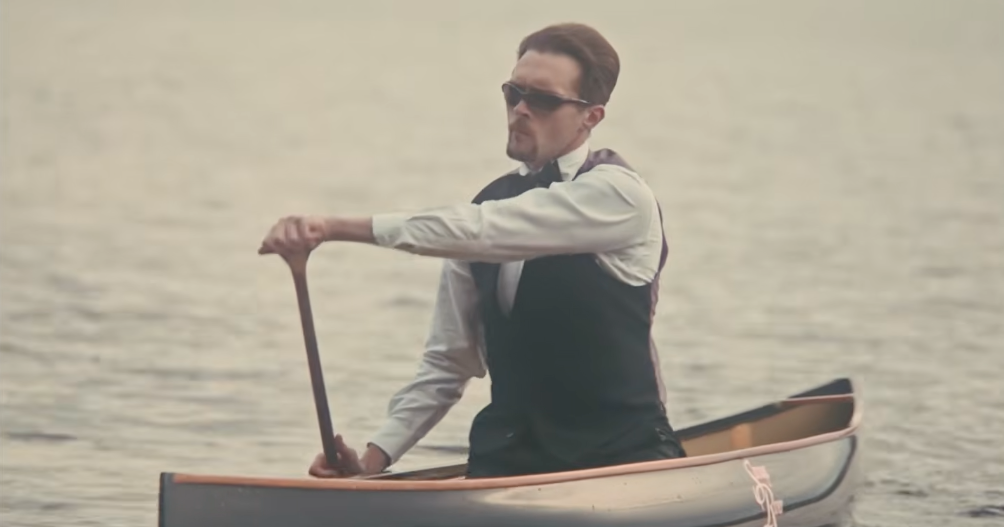
I haven't seen this so-called mockumentary, but it seems to be built on this false premise from the linked article:

"The sport, which has a small but passionate fanbase, involves performing complex choreographed canoe maneuvers set to music like a figure skating routine. Competitors demonstrate extraordinary control of their boats, but often also perform with emotion, narrative flair and even costumes, making it as much art as sport."

No, that's not "the sport". That's a description of interpretive freestyle demonstrations, not of functional freestyle sport canoeing. As far as I know—and I'll accept corrections if I'm wrong—there have not been any formal interpretive freestyle competitions with costumes and music for more than a decade. Interpretive freestyle exists now mainly as short, voluntary demonstrations at the end of freestyle clinics.

All the freestyle clinics, or symposiums, or rendezvous, or workshops, or whatever the events may be called these days, simply teach basic-to-advanced canoe control moves—the same thing you would have learned from Bill Mason 50 years ago, or Reg Blomfield and Omer Stringer 100 years ago, or Henry Rushton 150 years ago, or any native North American in a birchbark canoe 5,000 years ago.

I have never really liked the word "freestyle" because it implies that the activity is something other than basic-to-advanced flatwater canoeing technique. I much prefer the historically earlier term "sport canoeing", initially advocated by Patrick Moore, Mike Galt, Harold Deal and others in the late 1970s and early 1980s. What they were trying to convey by that term was learning how to enjoy the motion pleasure achievable in a recreational canoe, solely for the sport of that canoeing motion pleasure itself, as opposed to using a canoe as a vehicle or platform for some other flatwater activity such as fishing, hunting, carrying cargo, tripping, photography, racing, or canoodling.

In addition, all intermediate to advanced whitewater canoeing employs boat control principles analogous to those taught in flatwater canoe clinics.
 
I agree that the article doesn't distinguish between "functional freestyle" and "interpretive freestyle". I can tell you, from 1st hand knowledge, that the film only deals with the interpretive end and that the film uses the "sport" as a means to develop the script's characters rather than to showcase freestyle. I too, wish that the generalized term of "freestyle" lacks clarity, and prefer the term "sport canoeing" although that term too, could be interpreted in unintended ways.

Having been involved with freestyle as well as other canoeing disciplines, for many years, I am convinced that we teach certain methods or perhaps refinements of boat control that are not taught or certainly not emphasized in other canoeing disciplines.

As Glenn noted, there have not been any formal freestyle competitions for a decade or so. It's not that we've given up on the concept but that we simply haven't had the critical mass necessary to hold meaningful competitions. Attendance at freestyle symposia has waned in recent years as has attendance at other canoeing venues. Those K craft as ell as other interests have siphoned off many potential participants. In the meantime, we still offer classes geared to the interpretive side of freestyle and they are attended by a few who are hopeful (as am I) for a resurgence.
 
Good article with good photos for reference, although I think more photos showing the artistic flair of interpretive freestyle would help get the distinction across. As the photo of Bob and Elaine hint at, there's more to it than the advanced skill of heeling to the rail.

It is unfortunate, though, that there isn't a simple term for functional freestyle, similar to how in the Nordic skiing world "skating" is used to describe "freestyle skiing". I haven't come up with a good term for functional freestyle canoeing but "functioning", "canoodling", and "quadranting" just don't work. :)
I feel qualified to speak to the term "functional freestyle" as I believe, I coined that phrase. When I began learning the various maneuvers that are taught in the freestyle curriculum, I recognized how they applied to and improved my performance in both touring and whitewater. Other freestyle paddlers with whom I paddled often, noticed the same. The intent was to adapt the established freestyle curriculum (some might say the interpretive freestyle curriculum) to functional, everyday paddling. Perhaps, in a way it was to return freestyle to it's own routes. Having been exposed to the, then established, touring and whitewater curricula, none of which focused on the nuances of freestyle, I felt it necessary to incorporate the term freestyle in this adaptation. Perhaps not the perfect description, but the best I could come up with.
 
I feel qualified to speak to the term "functional freestyle" as I believe, I coined that phrase. When I began learning the various maneuvers that are taught in the freestyle curriculum, I recognized how they applied to and improved my performance in both touring and whitewater. Other freestyle paddlers with whom I paddled often, noticed the same. The intent was to adapt the established freestyle curriculum (some might say the interpretive freestyle curriculum) to functional, everyday paddling.
The idea of functional freestyle does make sense if you think about canoeing narrow streams or along a shoreline and purposefully maneuvering through all the inherent obstacles while adding a bit of flare and elegance. Otherwise, I guess it would be sport canoeing? ;)

I have never really liked the word "freestyle" because it implies that the activity is something other than basic-to-advanced flatwater canoeing technique. I much prefer the historically earlier term "sport canoeing", initially advocated by Patrick Moore, Mike Galt, Harold Deal and others in the late 1970s and early 1980s.
I agree, "freestyle" implies something other than common technique or usage, thus my comment about coming up with another term for "functional freestyle". (Thanks, Marc, for the back story.) To me, it's the artistry of freestyle that makes it freestyle, e.g., freestyle skiing, freestyle skating, and freestyle BMX. I'm not sure what to make of freestyle wrestling or freestyle football.

The term "sport canoeing", as you and Marc suggest, may be a more applicable description of functional freestyle and follows the logic behind sport bikes, sports cars, and sport carvers (alpine skis). You don't need a sport canoe, sport bike, sports car, or sport carvers to have fun but they do add a little something to the activity.
 
Last edited:
...coming up with another term for "functional freestyle"
I think @Sweetfancymoses did that in this thread. I'd get behind the idea of "obedience training for your canoe" more quickly than I would anything labelled as "freestyle".

To be sure, "functional freestyle" is probably best described as "obedience training for your canoe" but label anything as "freestyle" and I can't get past the image of paddlers taking strokes to such extremes that they're no longer practical in everyday navigation. "Interpretive" is certainly cool to see once in awhile but there's no way that I'd ever invest that kind of time and energy practicing it.

Maybe I'm "old school", maybe I'm just "old" but all I want is for the canoe to go where I want it to go, when I want it to go there so that I can miss most of the rocks in a set of rapids and land somewhat cleanly at campsites and portages.

For that, all I need is a well-trained canoe (and paddler); no sense conjuring up images of parasols, easy listening music and bow paddlers hanging over the gunwale past her waist. (again, admittedly cool to watch but super impractical on a trip and who would you be showing off for any way?)

Then again, maybe it's like "poutine" and we need a new word. After all, poutine is just fries with cheese curds and brown gravy but it's faster to write "poutine"... maybe a new word that means "training your canoe to behave and teaching yourself to master it"
 
I'd get behind the idea of "obedience training for your canoe" more quickly than I would anything labelled as "freestyle".

As far as I recall, "obedience training for your canoe" is a slogan that was created and popularized by the flatwater freestyle community.

Maybe I'm "old school", maybe I'm just "old" but all I want is for the canoe to go where I want it to go, when I want it to go there
"Interpretive" is certainly cool to see once in awhile but there's no way that I'd ever invest that kind of time and energy practicing it.

Those are legitimate opinions and points of view, but why are you airing them in a thread about functional vs. interpretive freestyle flatwater moves in a forum devoted to paddling techniques, specifically including freestyle technique?

There's no rule against it, but it would seem to me to be a bit rude to go into a thread in the Books forum just to say you are not interested in reading books. Or to go into a thread in the Canadian Trip Reports forum to point out that you and 99% of American canoe owners have no interest in going on a Canadian wilderness trip. Or to go into the Whitewater or Racing or Fishing/Hunting forums to declare that you have no interest in those aspects of the sport.

This site caters to all aspects and geographical venues of canoe sport, and it has evolved many subforums cater to and cabin those different aspects and venues.

I agree, "freestyle" implies something other than common technique or usage

I think this is a legitimate semantic issue to discuss, since the article linked in the OP is attempting to explain the semantic difference between "functional" and "interpretive" freestyle. Words are important, including the word "freestyle" itself. A word should conjure up a clear meaning and not be confusing.

I am a huge supporter of what is taught in freestyle clinics and of interpretive freestyle exhibitions/competitions. Honestly, however, the word "freestyle" didn't conjure up anything related to flatwater canoeing when I first heard it. I was already familiar with "freestyle" whitewater play and competitions, sometimes also called whitewater "playboating" or "rodeo". Unlike traditional river running, where the primary goal is to travel from Point A to Point B, freestyle paddlers typically stay in one spot—usually a wave (a standing wave) or a hole (a recirculating hydraulic)—to interact and play with the dynamic forces of the water.

Whitewater freestylers can stay at one playboating spot for hours, and if they are in decked boats they can do three-dimensional moves such as spins, cartwheels, loops and blunts. This kind of whitewater freestyle practice, in addition to being sporty fun, greatly enhances one's boat control and confidence when running hard rapids. Like flatwater freestyle, it is "obedience training for your canoe."

When the freestyle curriculum was being systematized in the early 1990s, lots of new words were invented to apply to age-old moves that had been known by different names. The Cree, Omer Stringer, Bill Mason, and the Red Cross Canoe Manual did not use terms such as axle, post, wedge, christie, or tangent. Neither did the whitewater community.

I think an argument can be made that this barrage of new terminology to describe old corn has had, on balance, a repulsive rather than an attractive effect. Many people get the impression that some obscure and impractical rigamarole is being taught at freestyle clinics, instead of a logically systematized curriculum of time-tested control strokes and control maneuvers for a canoe.

Whatever the origins and etymology of the terms, "functional freestyle" just means, to me, elegant and practical canoe control, and "interpretive freestyle" means a fun way to play with a canoe in flatwater using exaggerations of the basic moves and rare combinations of them. I further am convinced functional freestyle is very valuable for boat control on Canadian wilderness trips—as is whitewater freestyle—and interpretive freestyle can be great day paddling fun for the 99% of American canoe owners who don't, in fact, ever go on Canadian wilderness trips.

I don't expect the word "freesyle" to go away or be replaced. But anyone who has to "wrangle" a canoe to do anything should humbly consider the possibility of improving his or her control techniques and/or getting a different hull.
 
Back
Top Bottom