• Happy 1st Showing of a Color Photograph (1861)! 📷🎥🏳️‍🌈

Paddlemap.net: Canoe Navigation and Trip Planning

Joined
Aug 23, 2014
Messages
39
Reaction score
118
A while ago I made up my mind that what the world was missing was the ability to get turn by turn directions for canoeing like you can get for driving, walking, biking, public transport etc. So I ended up building a solution for that


I've tried to make a pretty good general tool for canoe trip planning. And I'm curious to get your feedback.

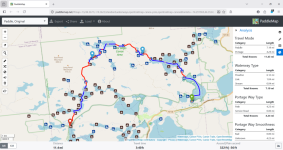
You can get plan routes on waterways and portages and get statistics (distance, elevation, portage vs paddle distance) about your route. The site supports downloading your route to put it on your mapping app or gps. You can also customize your route based on things like max grade of whitewater and number of carries per portage, whether you use a portage cart, etc.

The map also shows important paddling features like put ins, dams , rapids, waterfalls , etc.

Let me know what you think.

-carp
1778356650122.png
 
Quite an ambitious undertaking if you intend to map the entire planet.

I messed around with it a little on 2 routes I'd researched previously and it showed required portages accurately on the West Branch of the Susquehanna (the portage around Curwensville Dam is shown as requiring a vehicle and, as that's the official route, it should probably be left as is).

One critical addition (and I have no idea how you might identify other, similar areas) is on the Allegheny River in the city of Salamanca.

The Seneca Nation of Indians has a restricted/sensitive area which begins at Masonic Park in Salamanca and extends about 10 miles downstream to end at the I-86 bridges in Cold Springs/Steamburg, NY. There is no entry (by any means) allowed in this area and public access resumes below the I-86 bridges.

Best of luck with the project.
 
@Gamma1214 thanks for the tip. All the underlying data comes from OpenStreetMap, the free map of the world that can be edited by anyone. So while, I have mapped a lot of rivers and canoe routes, it relies on the collective contributions of all the volunteers.

I'll put that on my (long) list of things to map one day, but if you feel the gumption, you can do it yourself. Send me a DM if you wants some tips. :)

-carp
 
I thought it was impressive. I put in two of my most recent trips (Horton in NWT, and Dubawnt in Nunavut) and it showed the routes we took complete with mileage. I just have my phone now, but will further investigate in a week or so when I'm home with my desktop. It looks like a really neat tool for planning.
 
Awesome, please keep this going! Even though there won't be portage data for a lot of routes, it's still useful as a high-level planning tool to calculate distances...similar to Paddle Planner but not limited in geographic scope like their maps.

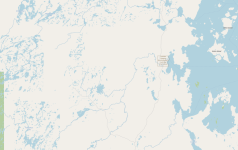
Looking around here in NW Ontario, unfortunately the OSM basemap is missing huge swathes of lakes, with large blank areas like these (west of Lake Nipigon pictured but these are all over the place). This is a bizarre issue for other basemaps as well like Bing Maps. I used to work in GIS and understand the principles of generalization and scale but these are just problems with the dataset.

1778498065486.png
 
Looking around here in NW Ontario, unfortunately the OSM basemap is missing huge swathes of lakes, with large blank areas like these (west of Lake Nipigon pictured but these are all over the place). This is a bizarre issue for other basemaps as well like Bing Maps. I used to work in GIS and understand the principles of generalization and scale but these are just problems with the dataset.
It has improved over the years, but, you are right @Jontario openstreetmap is unfortunately still missing some big chunks of canada. Consequently so are any of the map providers that rely on wholly or partially openstreetmap (Apple outside certain markets, Bing, OnX, gaiagps, caltopo, PaddleMap and many others)

To get deep into the inside baseball of OpenStreetMap in Canada, most of the baseline data has been important from CanVec in rectangular chunks. So what you see in the picture above is where some chunks have been important, some have not, but in those relatively blank spaces someone has (probably) hand created some of the big features like rivers.

As OpenStreetMap is open for all to edit, you can always get involved and help update it.

On the positive side, we do have a remarkable amount of data around the globe for canoeing (and other activities) in OSM. As of last week there were over 73,000 miles of waterways marked as canoeable and over 900 named canoe routes mapped. So as you mention, a much broader dataset than Paddler Planner and in many cases I think as good (BWCA/Quetico) or better (Everglades) data.
 
i haven't fully dug into this yet, but it's really neat. i think i might find more use for this searching for new day paddle locations and as a companion resource for trip planning than actual trip planning, but that's mostly due to my comfort and familiarity with using caltopo for planning and mapmaking.

the good :
  • my favorite day paddle location (link), where i have not seen another canoeist in 5 years of going there, is not only shown, but shown fairly accurately. i've followed the route south all the way to the pond where it terminates - there are beaver dams to contend with, and a swift/shallow just south of the put-in that requires wading after early spring, but it's a viable route. i don't know that the route shown north of the dam is viable, but i don't know that it's not either.
  • other routes that i'm familiar enough with to assess solely by memory also seem largely accurate, as do marked put-ins and such.

the less good:
  • not all rapids are marked. granted, i'm looking at many spots that don't see a lot of canoe traffic, but i feel that the lack of this information (in spots - other spots are very well marked) would require great care and/or a big ol' grain of salt to rely on what's presented for trip planning. a good example here, where there is a rapid that begins just west of the bridge, and continues a couple hundred meters east of it. i've seen kayakers run it, and am pretty confident that a better canoeist than myself might deem it runnable, but it's definitely there. if you continue northeast to where the river travels under US 2, there is a longer and more serious rapid there that i suspect isn't runnable, and again isn't marked. as you've mentioned above, all the data relies on OSM, so it might be something that time and more contributed data will solve, but it would definitely be something to keep in mind while planning.

the minor quibbles:
  • even in some spots where portages are shown, it shows the canoe route continuing through what i believe to be mandatory portages. the best example i've seen of this is here, where it accurately labels the rapid as a class 5 (from what i've seen at the top and bottom of it, it's basically a boulder field that the river drops through) and accurately shows the portage trail, but also shows the route continuing through the river. in less obvious instances, it might engender an unwarranted confidence, but a) i have no idea if addressing this is even possible without a stupefying amount of work and local knowledge and b) i feel like the the kind of person who would use a tool like this likely has the sense to not blindly trust it, and has the ability to assess things once they're actually there.
overall: this is pretty awesome, and it's definitely a welcome resource - thanks for putting in the work to get it up, and for sharing it with us.
 
Looking around here in NW Ontario, unfortunately the OSM basemap is missing huge swathes of lakes
I was surprised to see the Steel River loop on it & it seems pretty accurate except that it is missing the access from Eaglecrest lake. Personally, I'd much rather do the loop from Eaglecrest than paddle the length of Santoy.

I played with it a bit to see if I could add the Eaglecrest access and the restricted area in the Seneca Nation but I couldn't get it. Might try it again once I get some other irons out of the fire.
 
Back
Top Bottom