Day 3
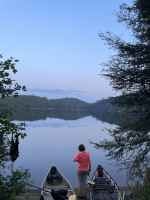
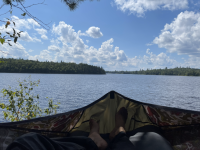
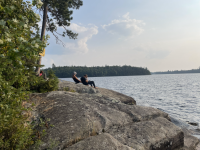
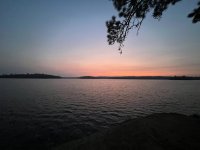
My wife and I are up by seven. We quietly sip our coffee and watch the peaceful lake, enjoying the mild temperature that we know won’t last long. The kids appear one by one, and by eight we are all eating our usual oatmeal breakfast. Our version of oatmeal is not cooked, but rather is simply oats, steeped in hot water for a few minutes, accompanied by nuts, fruit, milk powder and a dash of that prolific supply of maple syrup we are carrying around. Tasty and filling.
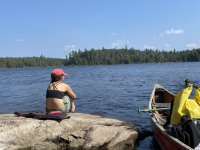
It is tempting to linger and enjoy the blissful peace of Lac Paget, although we have a long day ahead of us. It is again past nine before we get underway.
The first stretch is a short hop a few hundred meters down the lake. Our first portage of the day awaits. At over a kilometer, it is also the longest of the trip.
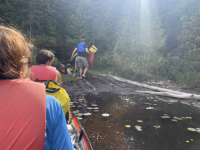
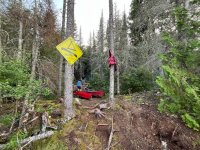
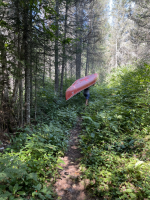
The portage trail is not overly challenging, but it’s muddy and there are a couple of fallen trees to clamber over. Underneath the tree canopy, with no breeze, it's already muggy and hot.
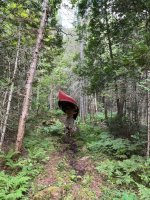
Midway through we spot a large family of ground-walking birds of a species unknown to us. They certainly aren’t Eastern Wild Turkeys, which we’ve seen. (Looking online, after the trip, I think they were Ruffled Grouse.)
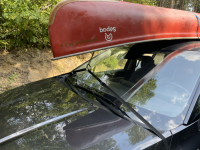
We do what I call a team leapfrog of the bags again: i.e. a couple of us carry our load to the very end, then come back and pick up bags that two of us have deposited at the halfway point. This works well. We have trouble with the Pakboat, which is proving awkward to carry overhead on rough terrain without a portage yoke. We have never had it on a wilderness trip. At times, we give up on the overhead carry and it takes two of us to portage it.
By the end of the trail, we are sweaty and hot, and the early mildness of the morning is long forgotten.
The portage trail—decent enough most of the way—has a soggy ending.
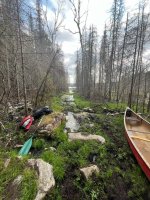
Parts of Lac du Noyer look like a flooded world. The decaying trunks of dead trees sprout from the water all along the edges, some of them 20 meters or more from the present shoreline. At some point, years back, water levels have risen here substantially. Beavers at work, I suppose.
The portage to Lac du Sceptre certainly starts with a beaver dam. There is the remnant of an old logging road in this section. A section of the road (or bridge) has at some point been removed, leaving a gap which the beavers have filled quite well.
After portaging our stuff around the dam, we are soon underway again, following a narrow and shallow channel. But not for long, less than a kilometer later comes the next portage. That portage drops us into Lac du Sceptre, a small but pretty lake.
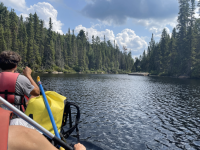
We fill up the dirty bag with water for filtering at the next portage. Our water bottles are already empty. In this heat, we are chugging water laced with electrolytes. The remaining portage and the two additional beaver dams leave images that swim together in my memory—we are too busy to pause and make many pictures.
I remember it being hot, muggy and quite muddy in places. The last beaver dam shows no signs of anyone landing in recent times and requires a fair bit of bushwhacking to get around it. My original hope of simply lifting the boats over the dams proves misplaced. There is too much deadfall and debris around them. And finding a good landing is not always easy.
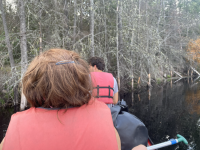
After the last dam, we put the boats back in on a small, winding channel. This is too shallow for paddling at the outset, so we line the boats for 50m or so. Given all the muck wading we are doing, I’m beginning to wish we’d packed a pair of wading boots. Afterwards we paddle and pole our way along.
In retrospect, this is a pretty strenuous section for us. Not for my sons, they almost seem to relish these tough portages and their good spirits never fail. They are truly the bedrock of these expeditions. But the women are flagging.
“You picked this route?” my wife asks at one point. There is a slight edge to her voice that one picks up on after 25 years of marriage. Uh oh.
A beaver dam later, I see my daughter looking tired and dejected. “Don’t worry, this is the hardest day,” I assure her.
“You said that yesterday.”
Oops, I did.
My women are hard-working paddlers and wonderful to have in camp. They usually portage without complaint. A trip wouldn’t be the same without them. I am grateful every day for their presence. But they are different than us men in the family. Much less interested in the whole "pain and suffering" aspect of canoe camping. Amazingly, they have the notion that pain and suffering shouldn’t be required at all!
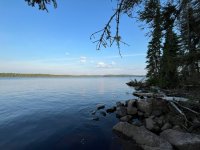
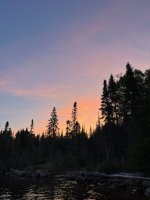
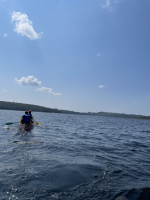
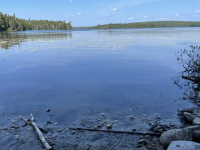
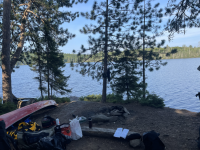
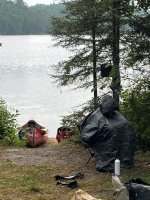
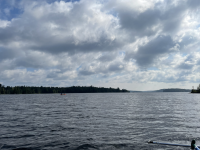
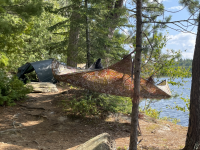
We finish the day’s padding with a roughly 8km journey down the northern half of Baie Mclaurin, ending at site 33-71. We are all hoping for a splendid campsite as a reward for our day’s labor, but it is not to be. It is more open, slightly prettier, and has marginally better views than the site of our first night, but it also suffers from poor seating opportunities and has a swampy area nearby that breeds a large number of mosquitoes.
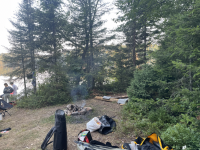
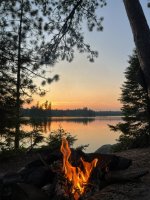
Everyone is in amazingly good spirits at dinner—a testament to our resilience, I think to myself. We cook, as every night, over an open campfire. Eggs, paprika and chorizo topped with an improvised salsa and wrapped in tortillas. Though the view is limited, our section of the lake is pretty enough. In the evening, a motorboat crosses down the lake to the south of us. It’s the closest we have come to seeing anyone else all day long.