• Happy National Umbrella Day! ⛈️☔⛱️☀️

A canoe with external thrusters

Joined
Jul 16, 2024
Messages
27
Reaction score
80
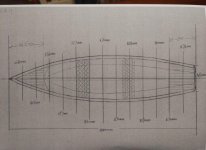
Hello everyone, this year I suddenly wanted to build a flat tailed canoe. It's not just pointed on both sides, but with a 90 centimeter V-shaped bottom on one side, rounded in the middle, and flat at the tail to facilitate the installation of thrusters. However, I haven't found any similar canoe construction messages on the forum. I don't know if you have any similar links or pictures for me to refer to. You know that few people in China play canoes, and sometimes they have some ideas but dare not boldly implement them. Thank you very much
 

Attachments

  • e61190ef76c6a7ef7ce5062f1851f55ef2de6637.jpeg
    e61190ef76c6a7ef7ce5062f1851f55ef2de6637.jpeg
    119.1 KB · Views: 17
By searching, I found out that it should be called a cargo ship canoe or a square tailed canoe. What I want to know is whether it will overturn or capsize at high speeds, and whether its narrowest point should be several centimeters, because I don't have any drawings. However, I have a template for a previous canoe that can be from 4.5 meters to 5 meters in length, but the widest point of the template is only 90 centimeters. If I want to build a cargo ship canoe that is 4 meters long and 1 meter wide, is this idea practical because I am afraid it will overturn at high speeds
 
They're termed "square stern" around here and @memaquay has built at least one that he powers with an outboard motor.

As for flipping it: Higher speeds increase the risk of overturning on any type of boat but I have no idea how to minimize the risk except to keep speed within your risk tolerance. Just because you have a 5 horsepower engine (for example) doesn't mean you have to twist the throttle all the way to the stop.
 
Here are some links to freighter canoe plans that might help:


Here's a link to a build thread on this site:


Alan
 
Here are some links to freighter canoe plans that might help:


Here's a link to a build thread on this site:


Alan
Thank you.
 
They're termed "square stern" around here and @memaquay has built at least one that he powers with an outboard motor.

As for flipping it: Higher speeds increase the risk of overturning on any type of boat but I have no idea how to minimize the risk except to keep speed within your risk tolerance. Just because you have a 5 horsepower engine (for example) doesn't mean you have to twist the throttle all the way to the stop.
Since I have never seen a similar ship before, I would like to refer to it. Considering the possibility of rollover, I plan to add two exhaust angles at the rear at around 35 degrees, so that the route will not overturn due to poor handling
 
Perhaps do some more reading about the general shape and design of freighter canoes. "Rollovers" would be extremely unusual. If you compare a legitimate freighter canoe to a regular canoe, you will see that the size is generally bigger in most areas. My 20 foot freighter is extremely seaworthy, as is my 17 footer. They have been in waters that many boaters would be afraid to navigate.

The only thing that could compromise safety is adding a motor that is too big for the canoe, This is the case with most boats.
 
When I read the title I couldn’t help but remember this build where he puts two jet engines on his canoe, now those are thrusters.IMG_8044.jpeg
IMG_8044.jpeg

Jim
 
Last edited by a moderator:
Perhaps do some more reading about the general shape and design of freighter canoes. "Rollovers" would be extremely unusual. If you compare a legitimate freighter canoe to a regular canoe, you will see that the size is generally bigger in most areas. My 20 foot freighter is extremely seaworthy, as is my 17 footer. They have been in waters that many boaters would be afraid to navigate.

The only thing that could compromise safety is adding a motor that is too big for the canoe, This is the case with most boats.
Through researching, I know that a keel usually needs to be created at the bottom of cargo ship canoes, and this keel seems to be from the bow to the stern of the ship. However, I noticed that the actual picture of the keel is not very prominent, about 3-5 centimeters. Please forgive me for not being able to use imperial units. I am better at using meters and centimeters (in China, it seems that only specific jobs require the use of imperial units). Our education since childhood tends to be more inclined towards meters, centimeters, and millimeters. I am worried about the weight and carrying capacity of the cargo ship, so I want to make a keel that is about 15-16 feet long, which is about 4.5 meters or shorter. But I want to increase the width a little, which can be about 1 meter or 1.2 meters. I don't know if this will be more stable
 
Lol, I'm Canadian. The metric system is official in Canada, although I operate in Imperial as well. The usefulness of a keel is often debated by canoeists. Most feel that a keel does not provide increased tracking ability (making it easier to go straight), and I don't think anyone would consider it increases stability. Instead, keels are often found on cheaply made canoes, as it is a method for making the hull more rigid. On wooden canoes, the keel was often included to reduce damage to the bottom of the hull when used in shallow water. However, this is often not the case either, as strong impacts on the keel would often cause the screws holding it on to pull and deform, causing leaks.

Instead, the main defining characteristics of how a canoe will behave in the water is due mostly to the shape of the hull. Your thoughts on expanding the width of the hull to 1.2 meters is more important than the inclusion of a keel. There are two types of stability in canoe language, primary and secondary. Primary stability means that the canoe will feel stable when you enter it, but does not mean that the overall stability is high. Primary stability can be tricky, as it might make you overconfident. Secondary stability is a measurement of how hard it will be to actually make a canoe tip over. Some canoes with primary stability will have very poor secondary stability, and some canoes with excellent secondary stability will have poor primary stability. These things are determined by the shape of the hull. For instance, a hull with a flat bottom might feel very stable when you first get into it, but when it is put into challenging conditions, it might be prone to tipping.

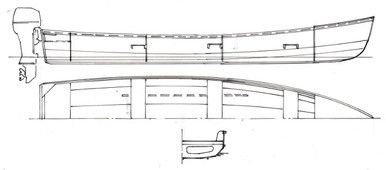
I'm including a link to what I think is a good design for a cargo canoe. Measurements are included in metric. If the link doesn't work in China, please let me know and I will screen shot it for you. You will notice that it is 5.18 m long, 111.76 cm wide and 40.6 cm deep. Also, it has no keel. This is a very good, stable sea worthy cargo canoe.
 
There is a lot of debate over keels, I find they are next to useless in a paddling craft and, in fact, can snag underwater obstructions and actually lead to the possibility of flipping by limiting the amount of sideslip off the offending object, but in powered craft it's a different situation- the keel helps counteract the centrifugal force of the prop wanting to turn the canoe. Every keeless canoe I've tried with a motor has had various degrees of slide-slip caused my the motor, with a sidemount being the absolute worst, almost to the point of being uncontrollable- for instance my keelless Swift Kippawa wants to do nothing but spin in circles or shoot sideways across the water at more than an idle, but My old, keeled Scott Echo, only has a mild amount of sideslip and no problem with turning, even at 3/4 throttle.
Every freighter I've tried has had a keel and it can counteract those forces- even a 20' boat with a 7hp tends to track well even with a shallow shoe keel, at the wider widths it also add substantial stiffening to the hull by breaking the large inevitably flatter bottom that width causes.
You could always try an internal keel and see if that works for you, and if necessary, add an external keel later.
 
Having built two freighters without keels, I can safely say that they track well under power. The 20 footer runs off a 6 horse. You will notice Esquif's offerings are also keelless. In order for a keel to have any noticeable affect on tracking, it would have to be substantially deeper than the usual shoe keels found on canoes. The freighters up north that I had experience in had keels that we're about 3/4 inch deep, but again, I would say it was hull design that provided the tracking, not the little keel.
 
Back
Top Bottom