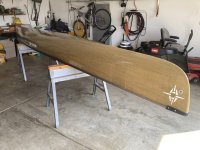
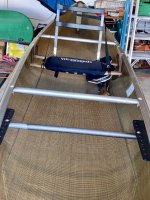
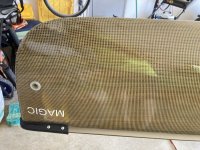
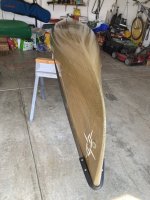
Can l ask why you put the holes in the bow and stern? I’ve not seen this before?
Installing a Lining Hole in your Canoe
by
Cliff Jacobson
The ends of your canoe should have a fitting for the attachment of tie-downs and lining ropes. Deck-mounted ropes are fine for tie-downs, but they can cause a capsize when lining because they exert their pull above the mass of the canoe.
The safest plan is a Bill Mason style harness (see Mason's book,
Path of the Paddle) that pulls right from the keel-line.
But rigging a harness at every rapid is a hassle.
Better to install a waterproof lining hole a few inches
above the cutwater point (see bottom photo).
"Cutwater" is the place on a boat where, when the boat is loaded, the surface of the water intersects the hull at the bow.
Since a typical loaded, tandem canoe draws about three inches of water at the bows, this would be the cutwater point. Thus, if the bow is say, 21 inches high, then 21-3= 18 inches, which would be the "cutwater" point. However, it's not a good plan to install lining holes this far down even though this is physically the best place for the lining ropes. Installing them at actual cutwater would result in the knot and portion of the rope being underwater much of the time. This would slow the canoe and the rope might catch on something. That's why I recommend a place about half way down the bow of the canoe. For 21 inch bows, this would be about 10 inches down. This will get the center-of-gravity low enough for safe lining, and the lines won't be submerged in water.