• Happy National Dog Day! 🐶🐩🐕‍🦺

Royalex / T-Formex vs. Tough Composites

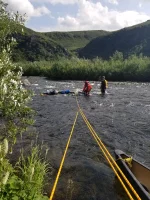
I would have tried tying the ropes to the upstream ends of the thwarts, perhaps wrapping the ropes completely around the hull, in an attempt to roll the canoe over the pinning rocks. Or at least rolling the canoe enough to get the upstream gunwale above the water line.
This was my thought watching the video - had they pulled the upstream gunwale up and over the rock, they may have been able to flip the canoe over top the pinning rock. They sort of did that anyway, but with a different mechanism and after a ton of time.

I will say that I have been paddling with a pin kit for three summers now - and boy did that save things last year on the Big Salmon. I got caught up on a log pile (I am SO embarrassed about that) and my fellow paddler Barnard climbed onto the log pile to save boat and paddler. He also had a pin kit, but given the dynamics of the log pile we ended up making a 5-way Z-drag combining components of both our kits. Amazingly the Redfeather RocksSTAR didn't wrap and was able to be paddled for the rest of the trip - but I am not sure it would ever have been recovered without those pin kits. I can say quite confidently that I will not do an extended river trip without one; I pack the kit in a waist pack so that it's within quick reach, even when I dump...
 
Jon posted another video after the trip showing how his wife refurbished his pinned canoe, and talking about things he should have done differently to prevent the pin.

He at least admits he should not have run the rapid, and only did so because he has a tendency to be subject to a "weird social phenomenon" when paddling with a better whitewater canoeist to "match them" and prove that he's "not a liability." Self-awareness of paddling ability is a good thing, but his conclusion should be that he is more of a liability to his paddling companions, not less, if he runs rapids above his ability and equipment level.

 
...and only did so because he has a tendency to be subject to a "weird social phenomenon" when paddling with a better whitewater canoeist to "match them" and prove that he's "not a liability."
There are a number of social factors that effect people's perception of risk. Peer pressure is definitely at the top of the list, but there are others that can influence people's decision making. Things like:

Peer Pressure - The group is all here - I can't let them down (the one that effected Jon)
Familiarity - This is my home turf, I know it well
Enthusiasm (“get-moreitis”) - This is great - lets keep going.
Overconfidence - I’m experienced – I can do this
Dedication to a Plan - This is what we planned to do – we can’t change it now
Risk Shifting (“expert halo”) - I'm with an expert - if he/she thinks its safe, it must be safe
Scarcity - This is the one day that I can do this - its now or never
Fearless vs Foolish - If I’m not always at the edge of my competence, I’m not trying hard enough.

We all do it. Experienced paddlers might be better at taking these things into consideration, but even the best sometimes get it wrong. I give Jon credit for putting this out there - no one does thing perfectly in the heat of the moment. Live and learn.
 
Back
Top Bottom