• Happy Birthday, Gene Kelly (1912-1996)! 📽️⭐🕺🏻☔

Royalex / T-Formex vs. Tough Composites

Joined
Nov 9, 2022
Messages
288
Reaction score
625
Location
Columbia, MD
Just finished watching the latest Northern Scavenger video on YouTube. This trip was done along with Jon from Lost Lakes - who had a pin during the trip. He was paddling a Nova Craft Pal in Tuff Stuff layup, which from what I can tell uses basalt innegra (much like Northstar's IXP and Swift's Expedition Kevlar). The boat was retrieved and was able to be paddled away but with significant damage. Interestingly Noah (from Northern Scavenger) was paddling an Esquif T-Formex boat. Jon mentions at one point that he felt the T-Formex has an advantage in that it slips more easily over rocks, suggesting that the gel coat actually grips rocks a bit. He left the trip feeling he should have been paddling a T-Formex boat, but I left the video thinking that his boat did amazingly well for suffering such a pin, and it has me wondering whether composites, particularly basalt innegra composites, are THE way to go in whitewater and on such rugged backcountry trips.

This also made me wonder what experiences everyone has had with Royalex vs. composites on backcountry trips? How many of you have been (or have been with someone who has) pinned and was able to get away with your boat? Royalex is famous of course for popping back into shape, but Jon's Tuff Stuff boat basically did so as well. Would love to hear thoughts / ideas / experiences...

P.S. I am sure this must have been a discussion on the board at some point - but I couldn't find one! Hence the new discussion.
 
Last edited:
I only have two canoes with gelcoat, and I haven't done much scraping with them. So I can't say whether they will slide off a rock as easy as royalex. But what I do know is an outer layer of glass slides off just as well as rx or better, and with much less damage. My Millbrook Coho has a million surface scratches on the bottom, but nothing as significant as what I've seen from one trip down a bony river with rx. Don't know how T-formex or Tuff Stuff compare. I have only pinned a swamped boat once, and not seriously enough to wrap it. Guess I'm not much help.
 
I have no personal experience with tuff stuff but was impressed and entertained by this video when it came out

 
We will never know. It could be that a t formex boat on the same spot would completely wrapped around. and could not be recovered with just to man with 2 ropes.
I guees they brought some pullies and more ropes with them (i would). the stickiness of materials on rocks is also not researches in any scientifieic way ad far as I know. If there is I would love to read it.
 
I just got through that part of the trip yesterday. I very impressed with how they got the Nova out, and even more impressed that they were able to get it back into paddle shape (even with a little leak).

Dutch all they had was two ropes and stubbornness/desperation. He kept saying they should have had a pin kit, which I assume is something similar to what you're referring to.
 
I missed that I had the sound of and just quickly looked at the pin and the damaged boat, and looks about 5 to 10 min of the 2 hrs.
Yes the pullies and more rope and some carabiners and a couple of slings make a pinkit. and are helpfull with othtesuf you can do when tripping.
they could have used a pole /tree to creat more monentom to lift the boat. and at some point it looked like the gunnels where above the waterline then bailing is very usefull.
before settign of it helps to put airbags in. I know that is more of a uk thing.
I guess some tricks i edon some uk courses on safety and rescue are less known then i think.
 
my pin kit has only 3 carabiners, some mule tape, and a couple of prussiks, (I use my throw bag and bowlines for rope) and has been more than enough to handle any pin but one- in that case we used a Z-pull and literally tore the boat in half... :rolleyes:
 
I think the first thing he needed was floatation. I know it is a pain, but airbags make this better all around. There is less chance of swamp and swim, less chance of pin, less damage, and easier recovery.

As for hull material, I think any hull is trash after damage like that. Sure, you can patch it, but it will be ugly and heavy.

I like composite because, in my opinion, smaller damage is easier to fix. Also, stiff composite canoes paddle much much better. Especially for day trips or where you are near roads.

But, I think they had good boats for a wilderness trip. Both could be beaten out and floated. So take your pick.

Bonus there was two of them in tandems. They could have floated out in one boat.

I would take either of those canoes, but I'd take floatation and a pin kit.
 
Last edited:
any hull is trash after damage like that. Sure, you can patch it, but it will be ugly and heavy.
I fully agree, I think the concern would be the ability to paddle out after the pin, but no question the boat would be compromised for future trips. I think I'd be trying to replace a Royalex boat after a significant pin with a creased hull, but the real question in my mind is whether there's a greater likelihood that Royalex will crease without tearing in comparison to something with basalt innegra.
 
Last edited:
This is a timely post for me because I made a run yesterday that should have been a 3 hr easy trip and turned into a 7+ hr ordeal with some serious boat abuse. Dad paddled his royalex Mad River Guide, and I paddled my previously new Clipper 14 Prospector. The stream we paddled is remote, gets little use, recently experienced significant flooding, and we knew there were a couple of “shut ins” sections with class II rock gardens. We did not expect the water to be so low given the gauge readings, and the shuts ins turned into extremely technical class II alternating between high pin potential and absolute scrape fests. There were also tons of downed trees and strainers to scrape over and through. In the non WW sections of riffles, I lost count of how many times I got out of the boat to minimize scraping/dragging (still ended up scraping a LOT). I beat the snot out of my Clipper and can now confidently compare Kevlar Duraflex to IXP, and to Swift’s epoxy “beefy” expedition Kevlar (extra layer of innegra), as well as t formex and royalex.

Firstly, t-formex to me seems significantly softer than royalex and less stiff. It dents easier and scratches deeper in my experience. Dad dragged his Guide over stuff yesterday that would have made ugly scratches/gouges/dents in my old Wenonah P15 (t formex). T-formex does slide over rocks pretty easily and can take quite an impact, but I do think it being softer makes it easier to wrap in addition to showing more damage. Just my opinion.

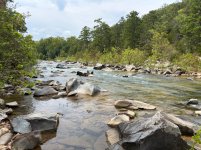
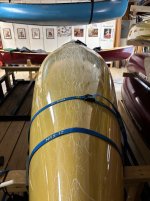
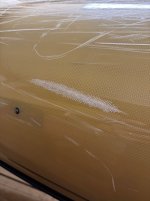
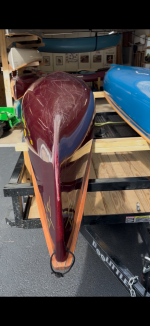
Similarly, I now think Duraflex is stiffer and harder than IXP or Expedition Kevlar. I think the resin specifically is harder in the Duraflex, and they somehow have the outermost fiberglass layer closer to the surface for better abrasion resistance, but it will still flex enough when you slide over a big rock. The softer IXP and Swift resins scratch deeper, taking more resin with each scratch. I have scratched into the innegra fabric on my IXP Phoenix with much less severe conditions than the Clipper took yesterday and all of the Clipper scratches are way, way shallower because they immediately run into 6oz S-glass which helps you skate over the rocks easier. I also missed a quick technical turn where I should have transitioned into a ferry, but my hesitation caused the current to grab me and slam me bow first into a large downstream rock very hard (picture of the rock garden and the type of rocks below, from the bottom looking upstream). The Clipper barely shows a mark (pictured). I had a similar experience on the Buffalo last spring in my Phoenix and while the impact was similar, the softer Phoenix layup shows more damage.
IMG_3786.jpeg
I think the Swift is very similar to the IXP, but the epoxy may be slightly harder than the IXP vinylester resin for slightly more scratch resistance. I haven’t scratched fully into the fabric of the Swift yet, but it also hasn’t seen the same level of abuse. All three are plenty stiff, but I do feel like the clipper being a little harder/stiffer, and having more layers of cloth in general, would take more force to wrap, and would fair better afterwards. The thwarts are also thicker and stiffer aluminum as well vs Northstar.

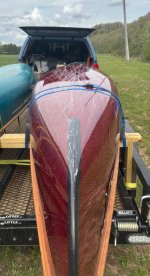
Clipper after yesterday:
IMG_4142.jpegIMG_4140.jpeg

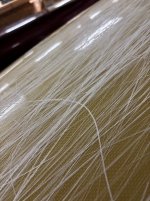
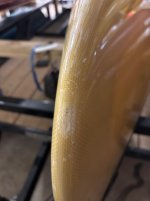
Clipper showing S-glass pattern near surface abrasion:
IMG_4139.jpeg

Phoenix showing bow impact location, hard to see but went through fabric in places. This is right after 303 application.
IMG_3872.png

Clipper showing similar bow impact location:
IMG_4141.jpeg

Swift epoxy Exp. Kevlar scratches:
IMG_3633.jpeg

Clipper mentioned they looked into innegra at one time and still have some on hand, but their testing didn’t show any improvement over their Duraflex so it wasn’t worth the added cost to them.

The tradeoff of course is weight. I now firmly believe Clipper makes the toughest composite boats out there. They are definitely not the lightest. I carried it about 100 yds in one place yesterday and it is not a light boat fully outfitted.

All things considered, all three layups are very tough and very capable. For my uses with its added stiffness and abrasion resistance, the Duraflex is proving the best, but for wraps/pins I think all three are likely capable of being paddled out of a bad spot as well as a t formex boat in most cases. I think the swift “could” be the worst there because the mat or ribs could break or delaminate, whereas that isn’t an issue with the IXP or Duraflex. Every pin and river/situation is different though and there are of course situations where a royalex boat or any other layup won’t survive. But a good “tough” composite layup is pretty great these days.

 
I now firmly believe Clipper makes the toughest composite boats out there.
That is impressive to hear, especially considering that the Clipper P14 in Duraflex at $2500USD is well cheaper than any other the equivalent composite P14s (Swift P14, Nova Craft P14, and Northstar Phoenix). It is almost competitive with the Esquif Echo 2.0. Difficult to find out east however. But at 44ish pounds, the Clipper P14 will be similar in weight to the Royalex Bell Yellowstone Solo I just nabbed. If the Clipper is really that tough in a rock garden, it should be getting much more love that I feel it currently gets (not sure I have ever seen a Clipper outside of the Yukon - other than in shops up in Ottawa)...
 
Back
Top Bottom