

By Daniel Pike (Facebook post)
We were trapped in the wildfires in the Wabakimi area. This is what happened.
Our party of 6 experienced paddlers, all in their 60’s and 70’s, departed in 3 canoes from Little Caribou Lake near Armstrong on July 7, 2026. We were planning a 3-week loop beginning and ending at the same place. Mattice Lake Outfitters provided the car shuttle and our vehicles were left at their base. The weather at the time was sunny and warm. There were no fires burning in the area and no fire restrictions, although the fire risk was classified as “high”. The forecast for the next few days was for continued warm, dry weather.
Over the next few days, we worked our way NE through Caribou, Smoothrock and Wabakimi Lakes, then N down the Ogoki to Kenoji Lake, and finally crossing over to the Grayson River system further N and E. Over the course of the week, the weather became increasingly hot, with the temperature reportedly reaching 39 C by the sixth day of our trip. This was exhausting and difficult, but we coped by starting early in the morning and finishing early in the afternoon, when temperatures became unbearably hot, and by swimming frequently. Also, winds increased in the afternoon on these days, making travel challenging. Obviously, this is also ideal weather for forest fires to start and spread.
On our fifth night, there were some intense thunderstorms in the area, with several nearby lightning strikes. Unfortunately, these storms did not produce any significant precipitation. The next day we saw one smoke plume to the SE, although it did not appear to be moving our way.
We arrived at Grayson Lake on day 7 in the afternoon, in very hot conditions with very strong SW winds. We had planned to camp on the main basin of Grayson, but the winds were simply too strong to proceed safely so we camped on the smaller basin to the SW of the main lake. After making camp and eating dinner, we noticed smoke levels increasing and some ash and debris landing on our gear. We saw saw several smoke plumes in the distance. One of these was moving towards us, and we started to hear a loud rumbling sound, rather like a moving train. Finally, we saw flame in the distance and decided to pack up and move immediately, hoping to make it to the main lake despite the winds. However, after starting out, we realized that we could not proceed safely, as the fire was now reaching the narrows between the lake basins, and effectively blocking our paths in both directions out of the lake we were on. We could not proceed or retreat: we were trapped.
We retreated to a small, rocky peninsula, almost an island really, on the SE side of the lake, a place we came to call “Salvation Point”. We pulled our loaded canoes out of the pounding waves onto the rocks, resigning ourselves to an uncomfortable night in the open, remaining ready to paddle or even swim at a moment’s notice.
We had earlier contacted our outfitter, Don Elliot of Mattice Lake Outfitters, who told us that there were many fires in our area and suggested that we evacuate to Whitewater Lake, a full day’s paddle away. But our way there was blocked by fire. He also told us that the Park was now closed and that Armstrong was being evacuated. Given the dangerous situation we were in, we reached a group consensus to trigger the SOS function on an InReach Device. We were under no illusions that an immediate rescue was possible, given the fires and thick smoke in the area, but we at least wanted to get the wheels in motion.
By this time the smoke was very thick, and there were visible fires burning to the NW and NE, close to the lakeshore. There was a large island about 300 m to the NW of our point, and we hoped that the fire would not reach there, as that would endanger our position. As it was, it looked like the fires would pass us by, as long as the wind didn’t change.
But it did.
Just before dusk, the wind shifted abruptly from the SW to the NNE, and reached astonishing force, probably exceeding 60 km/hr. And when I say suddenly, I mean within a couple of minutes. I have never seen such an abrupt and strong wind shift. Almost immediately, the island in front of our point burst into flame, and the fire began to consume the entire island. The visibility in the smoke dropped to a few 10’s of meters, with ash and burning cinders flying through the air around us. And the noise returned, that fierce rumbling that I will never forget. We immediately wet down our gear and ourselves, and partially immersed ourselves in the shallow water for protection from the burning debris.
This was certainly the low point of our eventful evening. With burning cinders flying over our heads, we feared that our refuge would ignite behind us and push us into the water. Also, we could feel the heat from the intense fire on the island in front of us, and lacking experience with forest fires, we didn’t know how hot it would get. Fortunately, this firestorm lasted only about 10-15 minutes, by which time the fire had consumed most of the island and subsided somewhat. We were able to come out of the water and try to prepare ourselves for the long night ahead.
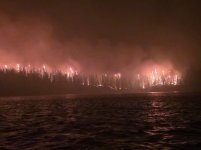
By now the fire was advancing southward down both sides of the lake, and we were completely surrounded by burnt or burning forest. The light show was fantastic, with individual trees bursting into flame with a gigantic “whoosh”. I wish now we had taken more photos, but that didn’t seem important at the time. However, we thought that the worst was over, and that our little Salvation Point should remain a refuge for us for the night.
It did, but it was a very long and uncomfortable night. We had to remain vigilant, with all our gear packed in the canoes and PFD’s on in case the wind changed again and drove us into the water. The peninsula was rough with no level ground, which made finding a comfortable place to rest impossible. To add to our misery, we were now wet and cold, despite the temperature being in the low 20’s. But we were able to warm up by donning some extra clothing and rain gear. At least we had the raging fire to entertain us. We also had contact with the coordinator at Garmin, who messaged us throughout the night to get status updates and offer encouragement. At least they knew our situation, and that made us feel a bit safer.
At last the grey and smoky dawn came, revealing a devastated landscape, with the fire periodically breaking out as it found a few surviving trees to consume. After a quick bite to eat, we decided to try to reach an outpost fishing camp on the main body of Grayson Lake, about 4 km away. We felt we would be safer on a larger body of water, and rescue would be difficult from our location as the lake was shallow and rocky and there was not room enough to land a helicopter. The wind had subsided somewhat, which made canoe travel feasible.
We paddled through the smoke past our previous campsite, now burnt over. Good thing we left. Here and there, small pockets of trees survived, seemingly at random. Small ground fires continued to burn in the devastated forests. We went through the two narrows to the main lake, and were happy to see that the large island on which the lodge was located seemed untouched by the fire. Rounding the corner, we were ecstatic to find the lodge intact, unoccupied but unlocked.
However, we were not out of the fire yet. Shortly after arriving, we noticed a fire flaring up on the E shore of the lake, to the NE of our island, and began to hear that familiar and scary freight train sound. As the island was separated from the mainland by a narrow channel, we feared that the fire might jump to us and consume our island (and the lodge). Again we jumped into our canoes and paddled to a smaller island just to the S of the island on which the lodge was situated, which offered a good view of the main island and the approaching fire. It seemed like a relatively safe spot.
But we weren’t there for long. Shortly after arriving, we heard the unmistakeable drone of a plane! Low and Behold, rescue at hand! The plane landed in front of us, then cruised towards the lodge we had just left. We paddled back there, to find a crew of 3 had arrived in a Beaver to install a sprinkler system at the lodge. They were not there to pick us up, and in fact knew nothing about us. Deciding to make the best of the situation, we spent most of the rest of the day helping them install the system and trimming back trees and brush around the building. We also cut a crude helicopter pad, as we were informed we were in line to be picked up by helicopter at some point. The kind folks from Rusty Myer’s Flying Services told us we were welcome to stay in the lodge, and showed us how to keep the sprinkler system fuelled and running. Then they left, leaving 6 weary canoeists behind.
But at least we were in a better situation now. The fire had not ignited the island and seemed to be moving off a bit. And we had some degree of protection from the sprinkler system. We hunkered down for another night, taking turns fuelling the water pump and checking on the fire situation. We felt some degree of security in the cabin, as the sprinkler system created the illusion that it was raining and cooled the air to some degree.
Early in the morning we received a message from John Bayley of Rusty Myers Air, who had flown the plane in the previous day, offering to fly us and our gear (but not our canoes) out to Savant Lake for a more than reasonable price. We still had no word as to when our rescue might come, but knew we would have to leave all our gear if we flew out by helicopter. Our vehicles were still in Armstrong, but we knew we could not go there as the town was evacuated and the road was closed. We immediately accepted the offer, and cancelled the SOS and rescue.
A few hours later, we heard the sounds of both a helicopter and a plane approaching. Somehow, the rescue people had not been passed the message that we no longer needed to be rescued! It was almost comical, after so long, to have two aircraft vying for the chance to pick us up. We later learned that the helicopter pilot was reluctant to land as he feared his downwash would fan more fires into life. After being radioed that we already had a pickup, the helicopter moved off to pick up a group of paddlers from a summer camp. Our plane landed, and we quickly loaded up our gear and ourselves and took off from Grayson Lake.
The flight to Savant Lake revealed the true extent and incredible intensity of the fire. We flew along the northern edge of the fires, and as far as the eye could see, the land was scorched to the south. Even in unburnt areas, small pocket fires had started up, far from the main burn, presumably caused by cinders flying far in advance of the fire. Small pockets of green remained near lakeshores and often for no apparent reason at all. Fire is weird that way... I realized that it would be completely hopeless to try to “fight” a fire like this. There are not enough water bombers in the world to make the slightest difference. The best that can be hoped for is to save people and property, and even that is a challenge, given how fast the fire moves.
As we flew west and finally arrived at the Rusty Myers base near Savant Lake, the fires became less frequent, although the entire area remained enveloped in smoke. The crew at Rusty Myers took good care of us, feeding us and making us comfortable. I felt a strong sense of relief from the tension of the last couple of days. They contacted the OPP in Sioux Lookout, where “Park Refugees” were being taken, and arranged to have the the OPP pick us up and take us there. I was impressed and grateful that they would do this. A few hours later, two vehicles arrived, and we loaded up for the 1.5 hour drive to Sioux Lookout.
And here our adventure ends, more or less. One of our party arranged to have a family member make the long drive to Sioux Lookout to pick us up, and we waited in a nearby camp ground for a couple of nights. Our vehicles remain at the Mattice Lake Outfitters base near Armstrong, which unfortunately was largely destroyed in the fire. Our cars may or may not be destroyed also: we just don’t know yet. Some of our party left wallets, phones and other valuables in those vehicles. Our canoes were left at the outpost camp on Grayson Lake, but the good people at Rusty Myers have agreed to back-haul them out in the next few weeks. I foresee some long drives and train trips in our futures.
Looking back on this experience, I am not sure what lessons, if any, I have learned. I think, in hindsight, we made the best decisions we could under rapidly changing circumstances. Our group was cohesive, didn’t panic, discussed all decisions, reached a consensus, and then acted. While our situation was very serious at times, at no point did I feel that my life or those of my companions were in imminent danger. What really saved us, and what makes canoeing a relatively safe way to travel in the fire-prone boreal forest, was being close to water, preferably a good-size lake. This provides a natural fire break, and one has the ability to move if conditions change. I wouldn’t want to be on a hiking trail in such a situation.
In closing, I want to say that everyone we met during the course of this incident was kind, supportive and helpful. In particular, I want to thank Don Elliot of Mattice Lake Outfitters, who unfortunately lost his base and livelihood in the fire; the folks who answered our SOS call and encouraged us during that long night; John Bayley and the rest of the crew at Rusty Myers Flying Services; OPP Officers Alex and Graham who picked us up at Savant Lake; the Rescue Coordination Services at Sioux Lookout who helped us with transport and accommodation, and everyone else who helped and encouraged us. It is heartening to see how people come together to help others in a disaster like this.
Finally, my heart goes out to all the people of northern communities that have been evacuated and in some cases destroyed by this fire. We lost some material goods and had our vacation interrupted, but this is nothing compared to what others have lost. Unfortunately, in our rapidly warming climate, these events are becoming more frequent, intense and destructive. We can come together to help each other in a disaster: why can we not come together to solve a problem that threatens people worldwide, and jeopardizes the future of our children and their children? Why can’t we start caring again?
Photo taken from Salvation Point at about 0100 hrs.
We were trapped in the wildfires in the Wabakimi area. This is what happened.
Our party of 6 experienced paddlers, all in their 60’s and 70’s, departed in 3 canoes from Little Caribou Lake near Armstrong on July 7, 2026. We were planning a 3-week loop beginning and ending at the same place. Mattice Lake Outfitters provided the car shuttle and our vehicles were left at their base. The weather at the time was sunny and warm. There were no fires burning in the area and no fire restrictions, although the fire risk was classified as “high”. The forecast for the next few days was for continued warm, dry weather.
Over the next few days, we worked our way NE through Caribou, Smoothrock and Wabakimi Lakes, then N down the Ogoki to Kenoji Lake, and finally crossing over to the Grayson River system further N and E. Over the course of the week, the weather became increasingly hot, with the temperature reportedly reaching 39 C by the sixth day of our trip. This was exhausting and difficult, but we coped by starting early in the morning and finishing early in the afternoon, when temperatures became unbearably hot, and by swimming frequently. Also, winds increased in the afternoon on these days, making travel challenging. Obviously, this is also ideal weather for forest fires to start and spread.
On our fifth night, there were some intense thunderstorms in the area, with several nearby lightning strikes. Unfortunately, these storms did not produce any significant precipitation. The next day we saw one smoke plume to the SE, although it did not appear to be moving our way.
We arrived at Grayson Lake on day 7 in the afternoon, in very hot conditions with very strong SW winds. We had planned to camp on the main basin of Grayson, but the winds were simply too strong to proceed safely so we camped on the smaller basin to the SW of the main lake. After making camp and eating dinner, we noticed smoke levels increasing and some ash and debris landing on our gear. We saw saw several smoke plumes in the distance. One of these was moving towards us, and we started to hear a loud rumbling sound, rather like a moving train. Finally, we saw flame in the distance and decided to pack up and move immediately, hoping to make it to the main lake despite the winds. However, after starting out, we realized that we could not proceed safely, as the fire was now reaching the narrows between the lake basins, and effectively blocking our paths in both directions out of the lake we were on. We could not proceed or retreat: we were trapped.
We retreated to a small, rocky peninsula, almost an island really, on the SE side of the lake, a place we came to call “Salvation Point”. We pulled our loaded canoes out of the pounding waves onto the rocks, resigning ourselves to an uncomfortable night in the open, remaining ready to paddle or even swim at a moment’s notice.
We had earlier contacted our outfitter, Don Elliot of Mattice Lake Outfitters, who told us that there were many fires in our area and suggested that we evacuate to Whitewater Lake, a full day’s paddle away. But our way there was blocked by fire. He also told us that the Park was now closed and that Armstrong was being evacuated. Given the dangerous situation we were in, we reached a group consensus to trigger the SOS function on an InReach Device. We were under no illusions that an immediate rescue was possible, given the fires and thick smoke in the area, but we at least wanted to get the wheels in motion.
By this time the smoke was very thick, and there were visible fires burning to the NW and NE, close to the lakeshore. There was a large island about 300 m to the NW of our point, and we hoped that the fire would not reach there, as that would endanger our position. As it was, it looked like the fires would pass us by, as long as the wind didn’t change.
But it did.
Just before dusk, the wind shifted abruptly from the SW to the NNE, and reached astonishing force, probably exceeding 60 km/hr. And when I say suddenly, I mean within a couple of minutes. I have never seen such an abrupt and strong wind shift. Almost immediately, the island in front of our point burst into flame, and the fire began to consume the entire island. The visibility in the smoke dropped to a few 10’s of meters, with ash and burning cinders flying through the air around us. And the noise returned, that fierce rumbling that I will never forget. We immediately wet down our gear and ourselves, and partially immersed ourselves in the shallow water for protection from the burning debris.
This was certainly the low point of our eventful evening. With burning cinders flying over our heads, we feared that our refuge would ignite behind us and push us into the water. Also, we could feel the heat from the intense fire on the island in front of us, and lacking experience with forest fires, we didn’t know how hot it would get. Fortunately, this firestorm lasted only about 10-15 minutes, by which time the fire had consumed most of the island and subsided somewhat. We were able to come out of the water and try to prepare ourselves for the long night ahead.
By now the fire was advancing southward down both sides of the lake, and we were completely surrounded by burnt or burning forest. The light show was fantastic, with individual trees bursting into flame with a gigantic “whoosh”. I wish now we had taken more photos, but that didn’t seem important at the time. However, we thought that the worst was over, and that our little Salvation Point should remain a refuge for us for the night.
It did, but it was a very long and uncomfortable night. We had to remain vigilant, with all our gear packed in the canoes and PFD’s on in case the wind changed again and drove us into the water. The peninsula was rough with no level ground, which made finding a comfortable place to rest impossible. To add to our misery, we were now wet and cold, despite the temperature being in the low 20’s. But we were able to warm up by donning some extra clothing and rain gear. At least we had the raging fire to entertain us. We also had contact with the coordinator at Garmin, who messaged us throughout the night to get status updates and offer encouragement. At least they knew our situation, and that made us feel a bit safer.
At last the grey and smoky dawn came, revealing a devastated landscape, with the fire periodically breaking out as it found a few surviving trees to consume. After a quick bite to eat, we decided to try to reach an outpost fishing camp on the main body of Grayson Lake, about 4 km away. We felt we would be safer on a larger body of water, and rescue would be difficult from our location as the lake was shallow and rocky and there was not room enough to land a helicopter. The wind had subsided somewhat, which made canoe travel feasible.
We paddled through the smoke past our previous campsite, now burnt over. Good thing we left. Here and there, small pockets of trees survived, seemingly at random. Small ground fires continued to burn in the devastated forests. We went through the two narrows to the main lake, and were happy to see that the large island on which the lodge was located seemed untouched by the fire. Rounding the corner, we were ecstatic to find the lodge intact, unoccupied but unlocked.
However, we were not out of the fire yet. Shortly after arriving, we noticed a fire flaring up on the E shore of the lake, to the NE of our island, and began to hear that familiar and scary freight train sound. As the island was separated from the mainland by a narrow channel, we feared that the fire might jump to us and consume our island (and the lodge). Again we jumped into our canoes and paddled to a smaller island just to the S of the island on which the lodge was situated, which offered a good view of the main island and the approaching fire. It seemed like a relatively safe spot.
But we weren’t there for long. Shortly after arriving, we heard the unmistakeable drone of a plane! Low and Behold, rescue at hand! The plane landed in front of us, then cruised towards the lodge we had just left. We paddled back there, to find a crew of 3 had arrived in a Beaver to install a sprinkler system at the lodge. They were not there to pick us up, and in fact knew nothing about us. Deciding to make the best of the situation, we spent most of the rest of the day helping them install the system and trimming back trees and brush around the building. We also cut a crude helicopter pad, as we were informed we were in line to be picked up by helicopter at some point. The kind folks from Rusty Myer’s Flying Services told us we were welcome to stay in the lodge, and showed us how to keep the sprinkler system fuelled and running. Then they left, leaving 6 weary canoeists behind.
But at least we were in a better situation now. The fire had not ignited the island and seemed to be moving off a bit. And we had some degree of protection from the sprinkler system. We hunkered down for another night, taking turns fuelling the water pump and checking on the fire situation. We felt some degree of security in the cabin, as the sprinkler system created the illusion that it was raining and cooled the air to some degree.
Early in the morning we received a message from John Bayley of Rusty Myers Air, who had flown the plane in the previous day, offering to fly us and our gear (but not our canoes) out to Savant Lake for a more than reasonable price. We still had no word as to when our rescue might come, but knew we would have to leave all our gear if we flew out by helicopter. Our vehicles were still in Armstrong, but we knew we could not go there as the town was evacuated and the road was closed. We immediately accepted the offer, and cancelled the SOS and rescue.
A few hours later, we heard the sounds of both a helicopter and a plane approaching. Somehow, the rescue people had not been passed the message that we no longer needed to be rescued! It was almost comical, after so long, to have two aircraft vying for the chance to pick us up. We later learned that the helicopter pilot was reluctant to land as he feared his downwash would fan more fires into life. After being radioed that we already had a pickup, the helicopter moved off to pick up a group of paddlers from a summer camp. Our plane landed, and we quickly loaded up our gear and ourselves and took off from Grayson Lake.
The flight to Savant Lake revealed the true extent and incredible intensity of the fire. We flew along the northern edge of the fires, and as far as the eye could see, the land was scorched to the south. Even in unburnt areas, small pocket fires had started up, far from the main burn, presumably caused by cinders flying far in advance of the fire. Small pockets of green remained near lakeshores and often for no apparent reason at all. Fire is weird that way... I realized that it would be completely hopeless to try to “fight” a fire like this. There are not enough water bombers in the world to make the slightest difference. The best that can be hoped for is to save people and property, and even that is a challenge, given how fast the fire moves.
As we flew west and finally arrived at the Rusty Myers base near Savant Lake, the fires became less frequent, although the entire area remained enveloped in smoke. The crew at Rusty Myers took good care of us, feeding us and making us comfortable. I felt a strong sense of relief from the tension of the last couple of days. They contacted the OPP in Sioux Lookout, where “Park Refugees” were being taken, and arranged to have the the OPP pick us up and take us there. I was impressed and grateful that they would do this. A few hours later, two vehicles arrived, and we loaded up for the 1.5 hour drive to Sioux Lookout.
And here our adventure ends, more or less. One of our party arranged to have a family member make the long drive to Sioux Lookout to pick us up, and we waited in a nearby camp ground for a couple of nights. Our vehicles remain at the Mattice Lake Outfitters base near Armstrong, which unfortunately was largely destroyed in the fire. Our cars may or may not be destroyed also: we just don’t know yet. Some of our party left wallets, phones and other valuables in those vehicles. Our canoes were left at the outpost camp on Grayson Lake, but the good people at Rusty Myers have agreed to back-haul them out in the next few weeks. I foresee some long drives and train trips in our futures.
Looking back on this experience, I am not sure what lessons, if any, I have learned. I think, in hindsight, we made the best decisions we could under rapidly changing circumstances. Our group was cohesive, didn’t panic, discussed all decisions, reached a consensus, and then acted. While our situation was very serious at times, at no point did I feel that my life or those of my companions were in imminent danger. What really saved us, and what makes canoeing a relatively safe way to travel in the fire-prone boreal forest, was being close to water, preferably a good-size lake. This provides a natural fire break, and one has the ability to move if conditions change. I wouldn’t want to be on a hiking trail in such a situation.
In closing, I want to say that everyone we met during the course of this incident was kind, supportive and helpful. In particular, I want to thank Don Elliot of Mattice Lake Outfitters, who unfortunately lost his base and livelihood in the fire; the folks who answered our SOS call and encouraged us during that long night; John Bayley and the rest of the crew at Rusty Myers Flying Services; OPP Officers Alex and Graham who picked us up at Savant Lake; the Rescue Coordination Services at Sioux Lookout who helped us with transport and accommodation, and everyone else who helped and encouraged us. It is heartening to see how people come together to help others in a disaster like this.
Finally, my heart goes out to all the people of northern communities that have been evacuated and in some cases destroyed by this fire. We lost some material goods and had our vacation interrupted, but this is nothing compared to what others have lost. Unfortunately, in our rapidly warming climate, these events are becoming more frequent, intense and destructive. We can come together to help each other in a disaster: why can we not come together to solve a problem that threatens people worldwide, and jeopardizes the future of our children and their children? Why can’t we start caring again?
Photo taken from Salvation Point at about 0100 hrs.


