Searching for the End
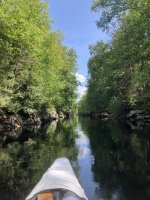
The Mégiscane River is generally considered to begin at a small lake near Monet called Lac Octavie. A string of other small connected lakes lie upstream of it, so I'm not sure why that point was chosen, possibly because there's no access to the lakes further upstream. From Lac Octavie the river runs through a string of lakes, heading generally north, up to Lac Poète. When the water is high enough — and the ice is out — you could probably run it in a few days at most. Recped said somewhere that he wanted to start "at the beginning of the river," and the new guidebook from the Rivieres et Lacs Canotables du Quebec starts the Mégiscane at the Barrage Mégiscane. There's now decent road access to that point. It's what the canoe club recommends, and after this trip, I'd agree.
The hydrology of the area has changed since I was there last. The major changes occurred in 1954, but they must have done more renovation since I was there thirty years ago. All the rivers in the area are diverted to lac de Poete and from there into a series of canals that lead to the Réservoir Gouin and from there into the Rivière Saint-Maurice, where Hydro-Québec has hydroelectric dams.
I saw only one mammal: a red squirrel, when I reached Réservoir Gouin. I also saw moose tracks around the edge of the lake I was camped at, and signs of beaver: cuts on trees. And that was it for the nonhuman mammals. A few birds flitted about in the bushes, some ducks, maybe an eagle or two. The edges of the river were plaited with dried white lake plants on the rocks, and gummy, unpleasant mud around all the edges. No clear water. I enjoy flowers and plants, and there were plenty. No good camping places.
Recped, if you still want to do the Mégiscane again, I'd start at the Barrage Mégiscane. That's where the river really commences, and there seem to be decent, well-used forestry roads going to it. Upstream, too much has changed.
Or you — editorially — could start with the Rivière Kekek, for which there's a description from the Canot Club of Québec. It was described as having more whitewater than the Mégiscane, and if it hasn't been modified, it would be another good way to enter the Mégiscane River. It joins the Mégiscane below the Barrage Mégiscane.
For someone truly adventurous, one could try paddling down the Suzie River. The upper river sounds like a pretty place, well forested. Jean told me that river doesn't go to the Mégiscane, but studying Google Earth, it looks to me like it could be done. The Suzie has been altered hydrologically too — it terminates in a straight canal running into Réservoir Gouin.
Having now examined these references at length, I am not at all sure the false start I got was on Suzie Riviere. I have not found a map on which it is labeled.
Meanwhile, I have been ejected from the pourvoirie Martin and am dejected. But once on the water, problems seem to fade. In the absence of a Plan B I decided to find a place to camp so I can consider my next move. The area was pretty quiet. I paddled around a large island, hoping to find a place there, with no luck.
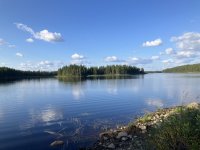
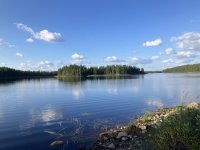
The island. It was much larger than it seemed, stretching out of sight behind.
I paddled around the bay for a bit. Summer houses, some quite lovely, were scattered here and there. I could not find a place away from the houses. So I stopped on a small slab of rock on a small peninsula and decided to set up camp there. No flat space. No place void of woody brush. After three weeks of sleeping on brush, stakes, rocks, etc. it looked good to me.
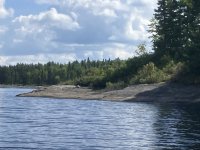
Peninsula for camping. Nothing flat, but at least bare rock. The ground just behind the rock dips and I just plonked the tent on top and bent over branches as needed. Many were needed.
By this time, I had been out around three weeks. Contents of the food bag were greatly diminished. Yet, hoisting a pack out of the canoe was now a Sisyphean chore. Under normal circumstances, on a long canoe trip, muscles become stronger, coordination is better. Instead gravity seemed to have increased, as if I had traveled to Jupiter.
Sitting on a rock, I took inventory. Hip: full range of motion, no complaint there. Shoulder: functional unless I moved it wrong -- then it was like being run through with a hot spike. Heart: I didn't want to think about the heart. Not after the chest pain on the first night. Constantly out of breath. Rest wasn't helping.
Got camp set up. Threw the tent on top of all the alder bushes. Threw the bedtime pack and sleeping back inside and called it good. I was just starting to enjoy this bit of paradise, when motor boats started coming in. And coming in. And coming in. Lucky for me, they were turning right into the canal instead of left in the direction of my camp. Until one did. A pontoon boat with four men and they pulled up and into the little house right across the way.
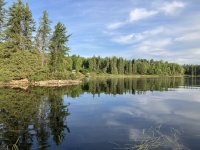
Camp across from me. Four men in a pontoon boat. You can only see the dock and a bit of the cabin here.
It took a long time for them to unload which was good because it took a long time for me to get up the gumption to paddle over and see if I could hitch a ride to Senneterre. I don't know where I get the courage to approach strangers and ask for a lift. I'd rather run a class III ledge. So I pulled up alongside their dock, right next to a man doing something with a bucket. I don't know if he was hard of hearing or concentrating on his job so much that he didn't hear me approach, but after long uncomfortable moments during which time I considered seriously that perhaps I had become invisible, I said, in French, "Excuse me. Hello. Do you speak English?" He looked up as if surprised to see me there. He told me he did not speak English. I explained my situation and request in broken French. He could not understand this either. I couldn't understand him -- he spoke Quebecois.
Finally some other guys came down and while nice enough, I got the feeling I was crashing their all men weekend. I repeated my request and explained what I was doing and that I needed help many times, to each of them. Finally one fellow confessed to some English. I heard they were leaving for - Senneterre- the next morning, early. (Here’s where I hold my breath, cross my fingers and pray to those guardian angels.)
They recommended many times that I speak to the Martin Pourvoirie and I had to explain again and again that he refused to help me. I heard one man distinctly say that he did not want me to be helped by them either. They recommended I try at another pourvoirie that was through another canal and north and then in one of several cuts into the mainland. But none of my maps went that far. I told them I refused to travel somewhere in the Quebec wilderness without a map. They came up with a basic map provided by Martin Pourvoirie and I agreed I would try it..
Even though I was bone tired, I started out with the pourvoirie map. It turns out there is another canal much shorter, really just an extension of an inland cut. And then I headed north. I paddled for several hours and knew I was getting close to crashing. I felt morally obligated to do my best to find this pourvoire, but when I got to the place where there were inland cuts and long islands I was stumped. Some of the inland cuts were dead ends and some went around islands and there was no way to tell from the water where this pourvoirie might be, especially when all I had was a cartoon map and and estimated location.
Mulling over my obligation to continue searching through a maze of islands, I rested in the canoe. The map was a joke. Was the inked dot in the right place? I didn't know if the pourvoirie existed or if it was open.
Running on fumes now, I was alone in the Quebec wilderness with a cartoon map. My duty to the fishermen fulfilled, I turned around and paddled back. A breath of wind at my back eased my return.
I met with the four fishermen again and told them I could not find the other pourvoirie. We discussed it more in a mix of two languages, three if you count Quebecois. At some point, one man hit the top of his head and said with great pleasure, "She has a *car* in Senneterre. She just wants a *ride* to Senneterre and then she will drive back here to get her gear." They all repeated it to each other, delighted -- information I thought was obvious from the start. Clearly it hadn't been.
Yes, they could give me a ride to Senneterre. They were leaving really early, like 9 am and I had to be ready then. And I was.
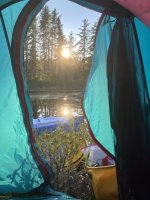
Sunset through the tent fly on my last night on the water.
I showed up bright and early while they were still loading up and I unloaded my gear and beached the canoe. I started walking my gear up the steep, long access and could barely make it. With nothing more to do themselves, many of them started hauling my packs and gear up. I was still exhausted. I didn't understand why resting and daily exercise was depleting me, rather than building me up. As I was pondering where to put the canoe - drag it off the access road and leave it in the bushes because I knew I could not get it up that steep slope. Without asking, the men hauled the canoe up and left it by the house. Bless them.
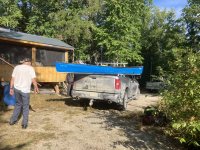
They didn’t want to carry my canoe up the ramp either. One truck backed down, they threw the canoe on the back end and brought it up to the cabin for me. Bless them.
At first it looked to me as if they had only one truck and I could understand their reluctance to try to fit me in. Later it became clear there were two trucks and I tried to help with some of their last packs and garbage bags, but I pretty much was just in the way. I stood back until I was directed into the back seat of one of the pickups. And off we went. The exciting part of my trip was over. I thought.
Suddenly, I realized in a panic, I would not know how to find this cottage again. I communicated my dismay to my rescuers and was giving directions in English and Quebecois, but I can't remember directions even when given in English in the US. I had no paper and no writing implements. How would I find my way back?